Wayground logo

Free Printable Worksheets

Font size

S
M
L
XL
Worksheets

Property of Waves

Total questions: 51

Worksheet time: 1hrs 12mins

Name
Class
Date
1.

What does a wave carry from place to place?

a)

energy

b)

matter

c)

people

2.

The highest point on a transverse wave is the

a)

compression

b)

crest

c)

rest position

d)

trough

3.

The lowest point on a transverse wave is the

a)

compression

b)

crest

c)

rest position

d)

trough

4.

Which property of the wave would change if you changed the amount of energy the wave had?

a)

amplitude

b)

frequency

c)

wavelength

d)

wave speed

5.

If the wavelength of a wave increased, what would happen to the frequency?

a)

decrease

b)

increase

c)

stay the same

6.

Mechanical waves usually travel fastest through:

a)

solids

b)

liquids

c)

gases

7.

Mechanical waves usually travels fastest as the temperature of the medium:

a)

increases

b)

decreases

c)

stays the same

8.

The number of waves that pass somewhere in a second is:

a)

amplitude

b)

frequency

c)

wavelength

9.

A wave that can travel through matter and empty space is a:

a)

electromagnetic wave

b)

longitudinal wavy

c)

transverse wave

10.

What kind of wave is this?

a)

electromagnetic

b)

longitudinal

c)

transverse

11.

Which are properties of a mechanical wave?

a)

can be longitudinal or transverse

b)

can move through space

c)

must have matter to move

d)

carries energy

12.

What are properties of electromagnetic waves?

a)

carry energy

b)

can move through space

c)

can move through matter

d)

include x-rays

13.

Water waves are unique because they:

a)

are transverse waves

b)

are longitudinal waves

c)

carry energy

d)

move matter from place to place

14.

As a longitudinal wave moves forward, the particles move:

a)

perpendicular to the wave's motion

b)

parallel to the wave's motion

c)

stand in one place

d)

move completely down the spring

15.
Waves that require a medium are called 
a)
mechanical waves
b)
transverse waves
c)
light waves
d)
gamma rays
16.
What happens when you increase the amplitude of a sound?
a)
it makes the sound louder
b)
it makes the sound travel faster
c)
it increases the wavelength of the sound
d)
it increases the frequency of the sound
17.

What kind of wave is pictured below?

a)

compressional wave

b)

transverse wave

c)

sound wave

d)

mechanical wave

18.
What can electromagnetic waves travel through?
a)
mediums
b)
empty space
c)
solely solids
d)
both mediums and empty space
19.
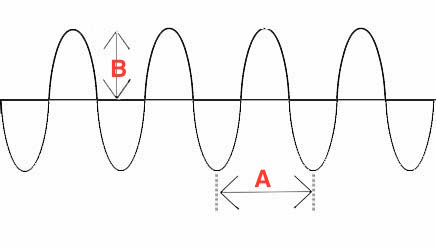
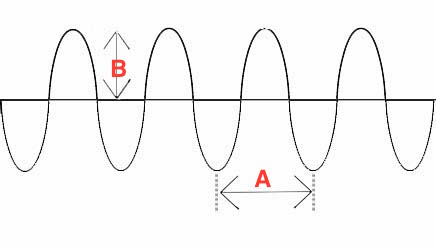
What property of this wave is represented by the letter "A"
a)
amplitude
b)
crest
c)
trough
d)
wavelength
20.
What property of the wave is represented by the letter "B"?
a)
amplitude
b)
crest
c)
trough
d)
wavelength
21.
What do waves carry from place to place?
a)
Energy, but not matter or particles
b)
Energy and matter or particles
c)
Matter or particles but not energy
d)
Neither energy nor matter or particles
22.
Which wave is pictured?
a)
Transverse
b)
Longitudinal
c)
Both
d)
Neither
23.
A wave carries...?
a)
energy only
b)
matter only
c)
energy and matter
d)
neither
24.
What type of wave move a slinky back and forth?
a)
longitudinal
b)
transverse
25.
Which vocabulary term is used to identify the distance between points C & G?
a)
Amplitude
b)
Crest
c)
Frequency
d)
Wavelength
26.
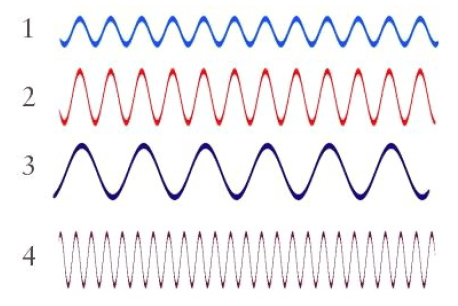
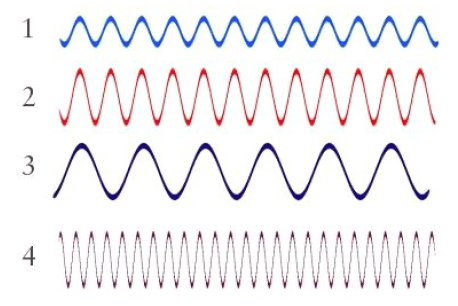
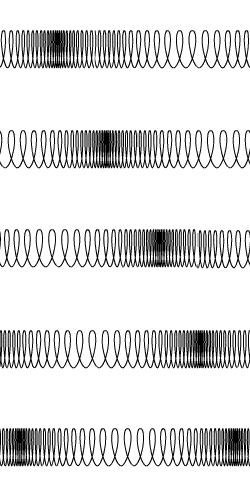
Which wave in the diagram has the greatest frequency?
a)
1
b)
2
c)
3
d)
4
27.
Which wave in the diagram has the greatest wavelength?
a)
1
b)
2
c)
3
d)
4
28.
Which of the following can sound travel through?
a)
solid
b)
liquid
c)
gas
d)
all of the above
29.
What type of wave is this?
a)
Longitudinal
b)
Transverse
30.

The highest point on a transverse wave is the

a)

compression

b)

crest

c)

rest position

d)

trough

31.
Which wave has a greater frequency?
a)
A
b)
B
32.

The number of times a wave passes a given point in a certain amount of time.

a)

Wavelength

b)

Speed

c)

Frequency

d)

Hertz

33.
In a longitudinal wave, the particles move...?
a)
back and forth
b)
up and down
c)
not at all
d)
at a 90 degree angle
34.
The type of waves that require medium to pass:
a)
Mechanical Waves
b)
Electromagnetic Waves
35.

The diagram shows a cartoon of a sound wave produced while a student is speaking.


What happens to the sound wave when the student speaks louder?

a)

The amplitude increases

b)

the wavelength will double

c)

the speed will increase

d)

the amplitude will decrease

36.
Sound is able to travel faster in solids than in air because the molecules in a solid are
a)
closer together than air molecules
b)
more easily moved than air molecules
c)
moving faster than air molecules moving faster than air molecules
d)
larger than air molecules
37.
Which vocabulary term is used to identify the distance between points C & G?
a)
Amplitude
b)
Crest
c)
Frequency
d)
Wavelength
38.
A mechanical wave cannot travel through...
a)
a vacuum(empty space).
b)
water.
c)
air. 
d)
glass.
39.
Which wave in the diagram has the greatest frequency?
a)
1
b)
2
c)
3
d)
4
40.
Which wave in the diagram has the greatest wavelength?
a)
1
b)
2
c)
3
d)
4
41.
Electromagnetic waves include the following except
a)
radio waves
b)
X-rays
c)
doing the wave at a football game
d)
microwaves
42.

Waves move in a pattern.

a)

True

b)

False

43.

Radio Waves are an example of _________ waves.

a)

mechanical

b)

electromagnetic

c)

light

44.

Frequency is always measured in _________

a)

kilometers

b)

Hertz

c)

centimeters

45.
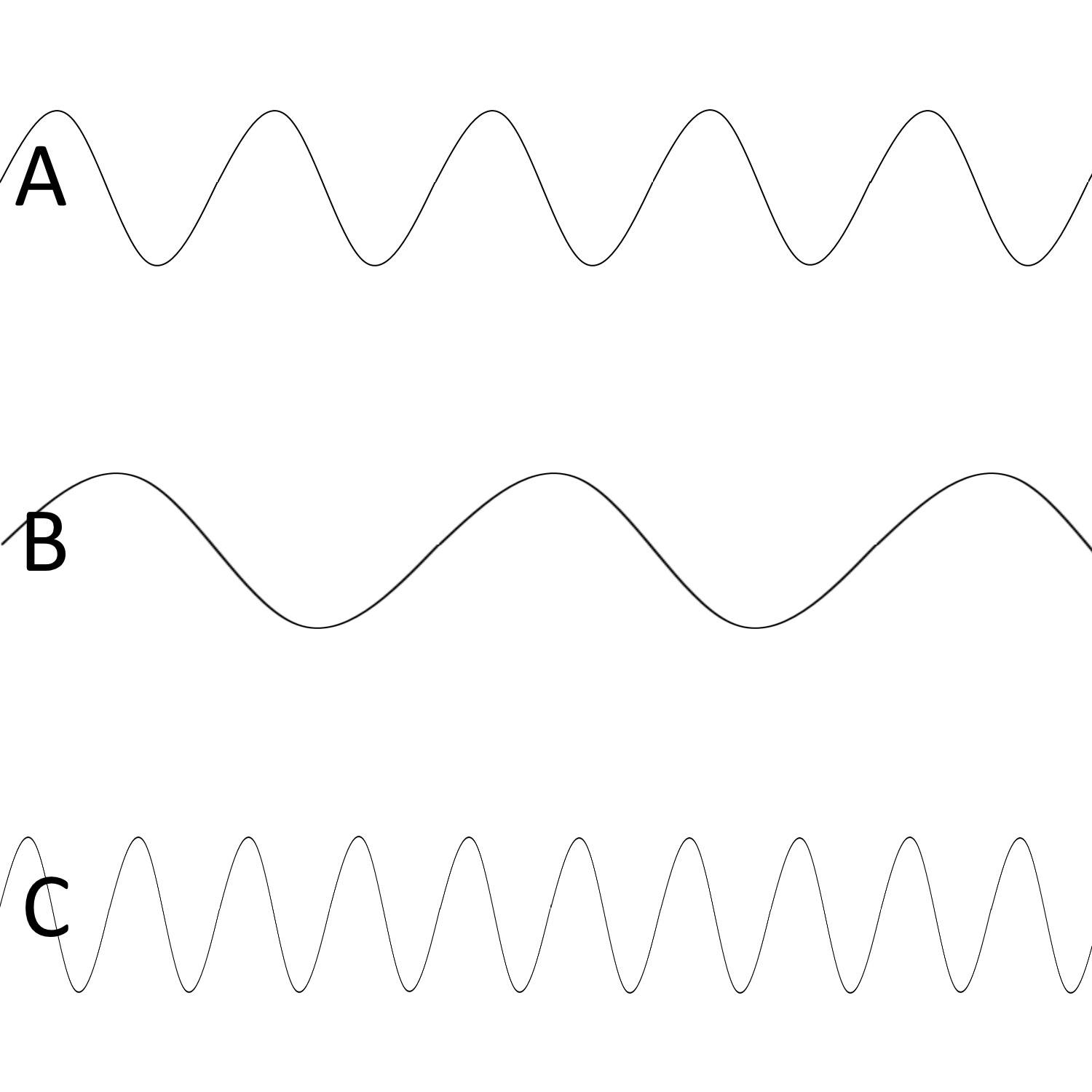
Which wave has the largest wavelength?
a)
A
b)
B
c)
C
d)
None (same wavelength)
46.

Sound is produced by something...

a)

echolocation

b)

vibrates

c)

vocal chords

47.

Some animals use this to navigate and hunt

a)

frequency

b)

ecolocation

c)

vibration

48.

How does an echo occur?

a)

sound travels faster than light

b)

sound bounces off solids

c)

sound is absorbed by solids

49.

A vibrating object causes this to move back and forth

a)

air molecules

b)

gases

c)

solids

50.

A(n)_________________________ is a reflected sound wave.

a)

echo

b)

Arc

c)

vibration

d)

rarefaction

51.

________________________ is the use of echos, or reflected sound, to find objects.

a)

ultrasound

b)

sonography

c)

echolocation

d)

reflexology