
 Worksheets
PHYS 2021-2022 Lesson 3.R1 Review
Total questions: 37
Worksheet time: 43mins
is the energy of particles moving around or vibrating within a substance.
Thermal energy
Chemical energy
Electrical energy
Light energy
is the energy stored in atomic bonds and bonds between atomic nuclei and electrons.
Thermal energy
Chemical energy
Electrical energy
Nuclear energy
A girl on a motorbike passes by at a speed of 15 m/s. Her mass is 40. kg. What is her kinetic energy?
300 joules
600 joules
950 joules
4500 joules
Calculate the potential energy of a roller coaster at the top of a 72 m hill that has a mass of 112 kg.
79,000 J
8,100 J
710 J
1,100 J

Calculate the kinetic energy of a truck that has a mass of 2900 kg and is moving at 55 m/s.
4.4 × 10⁶ J
1.6 × 10⁵ J
8.8 × 10⁶ J
8.0 × 10⁴ J
Calculate the gravitational potential energy of a rock with a mass of 55 kg which sits on a cliff 27 m high.
1.5 × 10⁴ J
1.5 × 10³ J
540 J
260 Joules
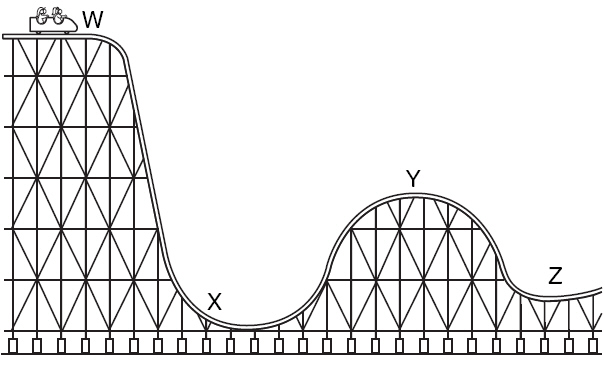
At which point in the roller coaster depicted is the potential energy of the car greatest?
[Neglect friction.]

A model airplane moves three times as fast as another identical model airplane. Compared with the kinetic energy of the slower airplane, the kinetic energy of the faster airplane is
three times as great.
nine times as great.
one third as great.
the same.
Whereas impulse involves force and time, work involves force and
energy
distance
power
acceleration
If a charging elephant has kinetic energy, it must also have
work.
potential energy.
momentum.
(none of the other answers)
Which is a unit of energy?
watts (W)
kilogram meters per second (kg m/s)
newtons (N)
joules (J)
What kind of energy does a marble rolling at the bottom of the hill have?
gravitational potential
chemical potential
kinetic
thermal
Rearrange the equation for kinetic energy, KE=21mv2, to solve for mass.
m=2v2KE
m=v22KE
m=2KEv2
m=KE2v2
A moving 10 kilogram object has 20 joules of kinetic energy. What is its speed?
What is the mass of a moving object that has 100 joules of kinetic energy and moves at 2 meters per second?

An explosion of gas from a Hawaiian volcano blows a rock into the sky at 20 m/s. If the rock has 2000 J of kinetic energy, what is its mass?
200 kg
20,000 kg
10 kg
100 kg
Which object involves an energy transformation from electrical to mechanical?


A kid applies a force of 70. newtons to a ball over 1.1 meters. How much work did they do on the ball?
You do 90. joules of work in 30. seconds. How much power have you generated?
30. watts
3.0 watts
2700 watts

A 2.0-kilogram ball has an initial velocity of 6.0 meters per second as it starts to roll up an incline. Ignoring any energy loss to friction, how high up the ramp will the ball roll?

A spring with spring constant 4.0 N/m is compressed by 0.25 m. How much energy is stored in the spring?
1.0 J
0.13 J

On the Giant Drop ride, people in a cart are dropped in free fall. The mass of one of the carts plus the passengers is 1200 kg. If the tower is 115 m tall, and no energy is lost to friction, how fast are the passengers going at the bottom of the ride, right before they stop?
47.5 m/s
1,130 m/s
2,260 m/s
33.6 m/s
is the energy stored in photons.
Elastic energy
Light energy
Electrical energy
Nuclear energy
comes from bonds between neutrons and protons in the centers of atoms.
Thermal energy
Light energy
Electrical energy
Nuclear energy
comes from electrons or other charged particles moving through and around in an object.
Thermal energy
Light energy
Electrical energy
Nuclear energy
is stored when work is done to stretch or deform an object.
Elastic energy
Light energy
Electrical energy
Nuclear energy
At which point in the roller coaster depicted is the kinetic energy of the car greatest?
[Neglect friction.]
A model airplane flies at half the altitude of another identical model airplane. Compared with the gravitational potential energy of the higher airplane, the gravitational potential energy of the lower airplane is
twice as great.
half as great.
one fourth as great.
the same.
Rearrange the equation for kinetic energy, KE=21mv2, to solve for speed.
v=2mKE
v=m2KE
v=m2KE
v=2mKE
Which object involves an energy transformation from chemical to thermal?
Which is a unit of power?
watts (W)
kilogram meters per second (kg m/s)
newtons (N)
joules (J)

Which of these graphs represents the relationship between kinetic energy and speed?
(a)
(b)
(c)
(d)

