
Font size
 Worksheets
AST.7-9 Solar System Review
Total questions: 69
Worksheet time: 47mins
Seventh planet from the sun:
Pluto
Uranus
Saturn
Jupiter
Known as the red planet:
Saturn
Mercury
Venus
Mars
What attracts a body toward any other object in space?
the sun
satellites
gravity
astroid belt
What causes the changes from night to day on Earth?
Earth's tilt
Earth's orbit of the sun
The moon orbiting Earth
Earth rotating on its axis
Which group of planets has more moons?
inner
outer
Which group of planets are mostly rock?
inner
outer
Which group of planets has rings?
inner
outer
Do the inner or outer planets revolve around the sun faster?
inner
outer
Which of the following is NOT a reason why Earth is the only planet with life as we know it?
Its atmosphere
It has liquid water
Its distance from the sun
Its moon
What is the second planet from the sun?
Mercury
Earth
Jupiter
Venus
Which is an object in the solar system that is a frozen mass of ice and dust?
an asteroid
a comet
a moon
a planet
What do Jupiter, Saturn, Uranus, and Neptune have in common?
They all have rocky surfaces.
They all appear to be similar to Earth.
They all are gaseous planets.
They all appear to be made of rock and ice.
The Solar Nebula Theory is:
A theory on how the Milky Way galaxy was formed
A theory on how the universe was formed
A theory on how the solar system will be destroyed by a red supergiant
A theory on how the solar system was formed from a cloud of dust and gas
As a nebula collapses it also begins to:
Expand
Rotate
Shake
Turn to ice
A nebula collapses down into a disk known as:
A compact disk
An irregular cloud
An accretion disk
An circular disk
A protostar
A planet
A protoplanet
A planetesimal
In order to form planets, planetesimals have to:
Colliding and breaking apart (fracturing)
Colliding and sticking together (accretion)
Colliding and bouncing around
Breaking down into smaller pieces
Why did the lighter elements stay in the Gas Giants?
Just because the solar wind does not affect these planets
Because they are much less dense
Because it is cold enough for gases to condense and their gravity is strong enough
Because of Jupiter's gravity in the early formation of the solar system
How long ago did these nebular processes start?
4.6 years ago
4.6 million years ago
5.6 billion years ago
4.6 billion years ago
What percentage of the nebula did the Sun accumulate?
99%
1%
50%
75%
The overall shape of the planets after accumulating all their material and differentiating is:
Irregular
A sphere
An oval
A disk
Where are most asteroids found?
between Earth and Venus
between Jupiter and Saturn
between Neptune and Pluto
between Mars and Jupiter

What do the outer planets have in common?
They are much larger than Earth and are made mainly of Hydrogen and Helium
The are about the same size as Earth and are mostly made of Hydrogen and Helium
They are must larger than Earth and are mainly made of iron
They are the same size as Earth and are mainly made of iron
has an elliptical orbit, has a rocky surface, and no atmospere
has an elliptical orbit, has rings, and a rocky surface
has an elliptical orbit, has a rocky surface, and is positioned between the Sun and the Asteroid Belt
has an elliptical orbit, a rocky surface, and is positioned between the Asteroid Belt and Pluto
Which two facts describe Earth?
largest inner planet
outer planet
terrestrial planet
gas giant
Which is the farthest planet from the sun?
Neptune
Saturn
Jupiter
Uranus
Saturn is known for its _______.
rings
atmopshere
moons
temperature
Uranus is different than other planets because it rotates on its side.
True
False

The Earth is the center of the solar system.

Mercury,Saturn
Jupiter, Uranus, Neptune
Jupiter, Neptune,
Mercury,Saturn,
Uranus
Mars,Jupiter,
Saturn,Uranus
Neptune
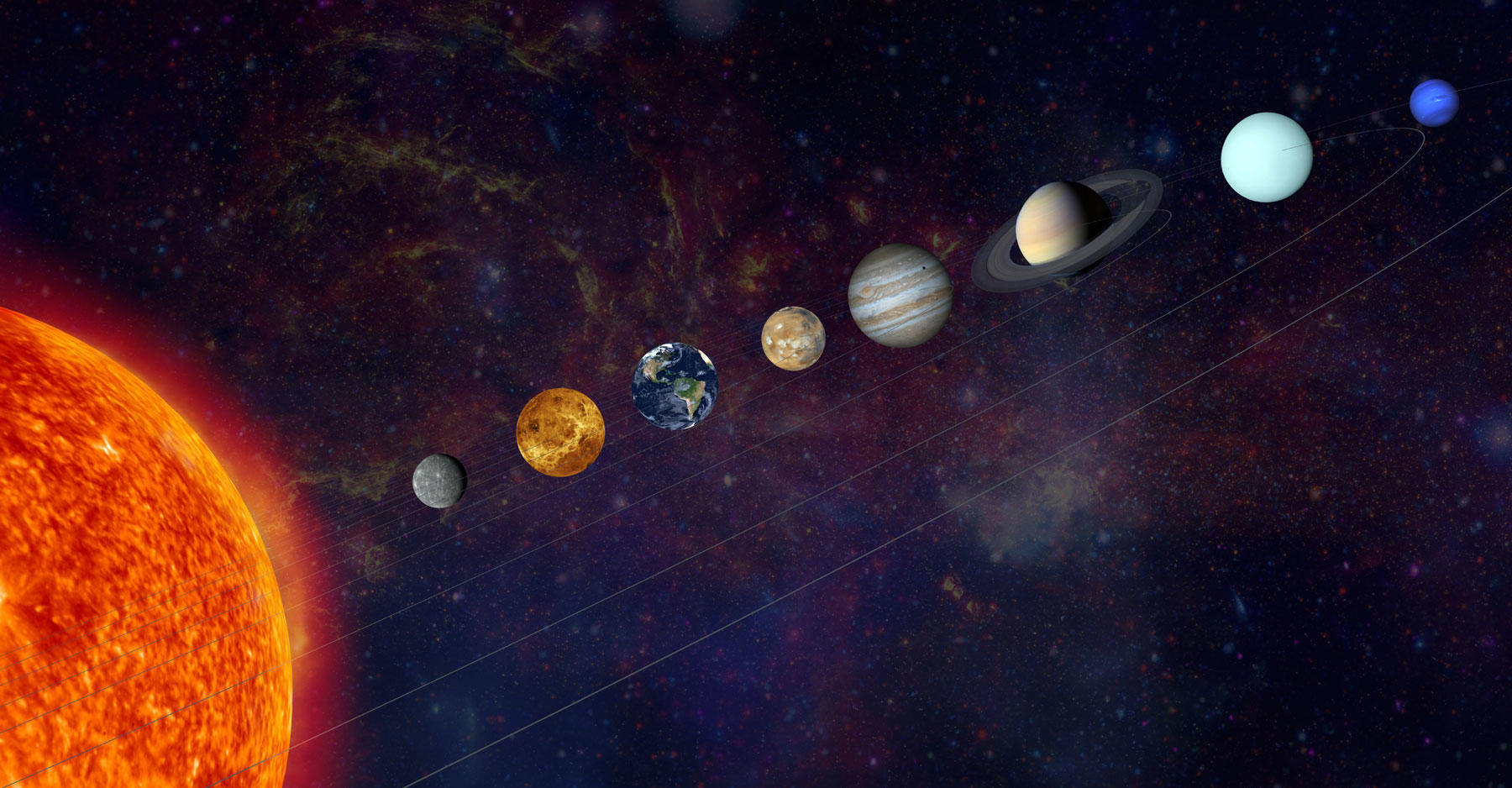
The planets are all equally distanced from each other.


Which planet has megahurricanes including the Great Red Spot?
Jupiter
Saturn
Uranus
Neptune
What are comets made of?
mud, rock, water
ice and rock
ice, dust, water
gas and dust
The _____ is the main body of the comet.
gas tail
coma
nucleus
dust tail
The ____ forms around the nucleus when the sun heats it up.
dust tail
coma
nucleus
gas tail
The comet's tail always flies __________________.
ahead of the comet
toward the sun
ahead of the sun
away from the sun
Comet tails are a result of __________.
their orbit
solar wind
north winds
momentum
One famous comet......
Galileo
Constellations
Halley's Comet
Charlie's Comet
Comets do not tend to travel on an orbit.
True
False
Ceres is an example of this:
asteroid
meteoroid
comet
meteor

Where do most comets come from?
In the Kuiper Belt & Oort Cloud beyond Neptune's orbit
In the Asteroid Belt between Mars and Jupiter
Near the Sun
Earth's atmosphere

Most meteors entering Earth's atmosphere are how big?
A grain of sand or small pebble
Size of a car
Size of a football field
State of Arizona


One similarity between asteroids & comets is that they all:
are made entirely of rock
come from the Asteroid Belt
come from the Oort Cloud
orbit the sun
T/F: It is thought that we (Earth) will NEVER be struck by another asteroid or comet due to the fact that Earth is a major planet which has "cleared its orbit".
True
False
T/F: Saturn is the only planet which has rings.
True
False, all Jovian planets have rings

What is the current explanation for Earth's large Moon?
It likely formed just like the planets did around the Sun by gravity pulling the dust and gas into a tight solid sphere.
It was likely a large asteroid which drifted too close to Earth & was captured by the Earth's gravity and remained in orbit.
It was likely formed by a Mars-sized object which collided with Earth, while the material blasted out to space accreted to form Moon.

