Wayground logo

Free Printable Worksheets

Font size

S
M
L
XL
Worksheets

Meteorology Test Review

Total questions: 70

Worksheet time: 1hrs 8mins

Name
Class
Date
1.
A front is
a)
where warm air is cooling at earth's surface
b)
a line where hot and cold air are separating
c)
a line where two different air masses meet
d)
where cold air is rising and forming rain clouds
2.
_____________ air is more dense and tends to sink
a)
cold
b)
warm
c)
moist
d)
dry
3.
What symbol is this?
a)
warm front
b)
cold front
c)
stationary front
d)
occluded front
4.

What is the name this front?

a)

warm front

b)

cold front

c)

stationary front

d)

occluded front

5.

Which front does this show?

a)

cold front

b)

warm front

c)

stationary front

d)

occluded front

6.

Which front is there little movement?

a)

warm front

b)

cold front

c)

occluded front

d)

stationary front

7.

What kind of front results in thunderstorms?

a)

warm front

b)

cold front

c)

occluded front

d)

stationary front

8.
What does this symbol on a weather map indicate? 
a)
High pressure system
b)
Low pressure system
c)
Cold front
d)
Warm front
9.
What does this symbol on a weather map indicate? 
a)
High pressure system
b)
Low pressure system
c)
Cold Front
d)
Warm Front
10.
Winds are caused by differences in 
a)
precipitation
b)
humidity
c)
air pressure
d)
turbulance
11.

What causes differences in air pressure?

a)

even heating of the Earth

b)

Even cooling of the earth

c)

uneven heating of the earth

d)

global warming

12.
Use the diagram to determine which statement is correct.
a)
The air at location 3 is more dense than the air at location 6.
b)
The air at location 2 is rushing in to take the place of the colder air at location 3.
c)
Location 1 heats up and cools down slower than location 7.
d)
High pressure air at location 2 is taking the place of the low pressure air at location 3.
13.
Wind belts are always named according to...
a)
how strong they are
b)
what temperature they are
c)
where they blow to
d)
where they come from
14.
Which storm forms over water?
a)
tornado
b)
hurricane
c)
thunderstorm
15.
Which storm would most likely form over Florida because it is a coastal state?
a)
hurricane
b)
tornado
c)
thunderstorm
16.

Why does a hurricane slow down when it hits land?

a)

The wind stops it

b)

It stops raining

c)

It loses its energy source

d)

The air is different

17.
The pressure inside a hurricane is _______.
a)
High
b)
Low
18.
In order for a hurricane to form, the water must be ________.
a)
Cool
b)
Warm
c)
Cold
d)
Hot
19.
2. Which are bigger, hurricanes or tornadoes?
a)
Tornadoes
b)
Hurricanes
20.

In what layer of the atmosphere do all weather events occur?

a)

Stratosphere

b)

Exosphere

c)

Mesosphere

d)

Troposphere

21.

As altitude increases, air pressure....

a)

Increases

b)

Decreases

c)

Stays the same

d)

Goes up and down

22.

The ozone layer is a sublayer of the ________ layer.

a)

Troposphere

b)

Stratosphere

c)

Exosphere

d)

Mesosphere

23.

Why is the ozone layer vital to life on Earth?

a)

Planes fly in the ozone layer

b)

It is made up of oxygen (O2)

c)

It shields the Earth from ultraviolet (UV) rays from the sun

d)

It causes clouds to be created

24.

This layer is the outermost layer of the atmosphere. Satellites orbit the atmosphere in this layer.

a)

Exosphere

b)

Mesosphere

c)

Thermosphere

d)

Ozone Layer

25.

What is the order of the layers of the atmosphere, starting with the layer closest to Earth's surface?

a)

Stratosphere, Troposphere, Exosphere, Mesosphere, Thermosphere

b)

Troposphere, Stratosphere, Mesosphere, Thermosphere, Exosphere

c)

Troposphere, Stratosphere, Mesosphere, Exosphere, Thermosphere

d)

Troposphere, Stratosphere, Thermosphere, Exosphere, Mesosphere

26.

What layer of the atmosphere has the highest air pressure?

a)

Troposphere

b)

Stratosphere

c)

Exosphere

d)

Mesosphere

27.

Which explanation correctly describes the greenhouse effect?

a)

The process of the atmosphere keeping the Earth's surface dense

b)

The process of the atmosphere trapping the sun's radiation, and making the Earth warm and livable for humans

c)

The process of the atmosphere keep us from floating into space

d)

The process of the atmosphere reflecting all of the Sun's heat back into space
28.
What is the transfer of heat by movement of liquids or gases?
a)
Radiation
b)
Convection
c)
Conduction
d)
Heat
29.
What is a transfer of heat energy by electromagnetic waves?
a)
Radiation
b)
Convection
c)
Conduction
d)
Heat
30.
What is the transfer of heat by direct contact?
a)
Convection
b)
Electromagnetic waves
c)
Radiation
d)
Conduction
31.
Do sea breezes typically happen during the day or night?
a)
Day
b)
Night
32.
Do land breezes typically happen during the day or night?
a)
Day
b)
Night
33.
During a land breeze which way does the wind blow?
a)
from the sea to the land
b)
from the land to the sea
34.
During a sea breeze which way does the wind blow?
a)
from the land to the sea
b)
from the sea to the land
35.
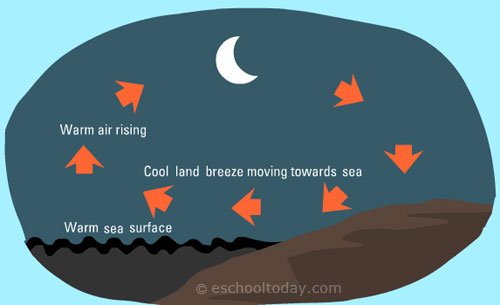
Is this a land or a sea breeze?
a)
land breeze
b)
sea breeze
36.
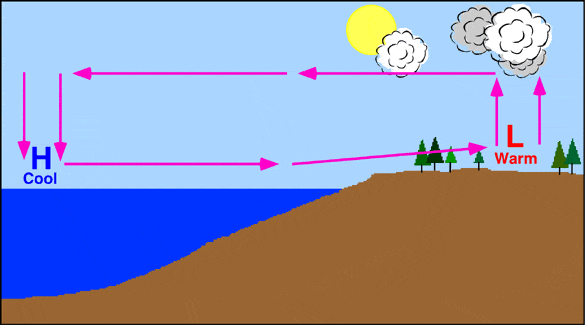
Is this a land or a sea breeze?
a)
land breeze
b)
sea breeze
37.
When warm air rises, ______ pressure forms at the surface of the land or sea.
a)
high
b)
some
c)
low
d)
none
38.
How does the air move in a land breeze?
a)
From east to west
b)
From west to east
c)
From the land to the ocean
d)
From the ocean to the land
39.
The strength of a sea breeze depends on
a)
the heat of the day
b)
the difference between the temperature of the sea and the land
c)
the wind speed
d)
the amount of precipitation that day
40.
In a sea breeze, the air is warmer above the _____.
a)
land
b)
ocean
c)
sky
d)
beach
41.
Where does the initial source of energy come from that creates winds?
a)
the moon
b)
the sun
c)
the Earth's surface
d)
the rotation of the Earth
42.
Land and water absorb and release the sun’s heat in different ways. One result of this is a sea breeze. Which statement is true of sea breezes?
a)
They originate in the day and blow toward the land.
b)
They originate in the day and blow toward the water.
c)
They originate in the evening and blow toward the land.
d)
They originate in the evening and blow toward the water.
43.
Why do land breezes occur at night?
a)
Land cools off slower than water, so the air above water is cooler.
b)
Water cools off faster than land, so the air above land is warmer.
c)
Land heats up slower than water, so the air stays cooler during the day.
d)
Water cools off slower than land, so the air above water is warmer.
44.
Which best describes why winds at the beach change direction between day and night? **
a)
because the temperatures over land and over water change 
b)
because warm air over land sinks and stays in place over land
c)
because cool air rises and is replaced by warm air from the ocean 
d)
because cool air sinks and stays in place over land 
45.

Why does the Earth experience unequal heating?

a)

The oceans are not equally distributed around the Earth.

b)

The Earth's revolution brings it closer to the Sun at certain points during the year.

c)

The Earth's axis is tilted.

d)

The atmosphere is not equally distributed around the Earth.

46.
Why is the Equator warmest?
a)
Because it is closest to the sun.
b)
Because it receives the most direct sunlight
c)
Because no clouds form here.
d)
Because it is far from the sun
47.

Why does Earth receive unequal heating?

a)

Different location receive different amounts of direct sunlight

b)

Earth moves closer and farther away from the sun.

c)

The core of the earth heats different parts of the Earth.

48.

Where on Earth receives the most indirect sunlight?

a)

the poles

b)

the equator

c)

all areas get the same light

49.
A cold front moving into an area can bring this type of weather...
a)
Warmer Temperatures, Clear Skies
b)
Colder Temperatures, Clear Skies
c)
Warmer Temperatures, Clouds
d)
Colder Temperatures, Clouds, and Precipitation
50.
A warm front moving into an area can bring this type of weather...
a)
Warmer Temperatures, Clear Skies
b)
Colder Temperatures, Clear Skies
c)
Warmer Temperatures, Clouds, and steady precipitation
d)
Colder Temperatures, Clouds, and Precipitation
51.
Warm air mass that does not carry water:
a)
continental tropical
b)
continental polar
c)
maritime tropical
d)
maritime polar
52.
Warm air moving upwards from the Gulf of Mexico is:
a)
continental tropical
b)
continental polar
c)
maritime tropical
d)
maritime polar
53.
Which city has partly cloudy skies?
a)
Boise
b)
New York
c)
Atlanta 
d)
Dallas
54.
Which city has the highest the highest temperature?
a)
Dallas
b)
Chicago
c)
Los Angeles
d)
Miami
55.
Which city is currently experiencing a snow storm?
a)
Seattle
b)
Los Angeles
c)
Chicago
d)
New York
56.

What is a definition for a hurricane?

a)

Just a natural disaster

b)

A violent tropical storm in the Caribbean

c)

A normal storm

d)

Weak blowing wind

57.

What are causes of hurricanes?

a)

Just warm water.

b)

Cold water with hot water.

c)

Water vapor and warm air.

d)

Just humid air.

58.

How are hurricanes form?

a)

Warm water and cold water combined.

b)

Warm air and cold air combined.

c)

Twisted water.

d)

Begins in warm water , then evaporate into the air that is heated and twist in the sky.
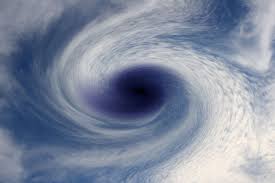
59.
What is the calm area in the center of a hurricane called?
a)
Wall
b)
Eye
c)
Arm
d)
Hole
60.
The pressure inside a hurricane is _______.
a)
High
b)
Low
61.
In order for a hurricane to form, the water must be ________.
a)
Cool
b)
Warm
c)
Cold
d)
Hot
62.

Hurricanes will begin to die out once they

a)

are over land or warm water

b)

are over land or cold water

c)

once it gets tired

d)

only if they are over warm water

63.
Low Pressure is associated with this type of weather...
a)
Cloudy/Overcast Weather
b)
Cold Weather
c)
Warm Weather
d)
Fair Weather
64.
High Pressure is associated with this type of weather...
a)
Cloudy/Overcast Weather
b)
Cold Weather
c)
Warm Weather
d)
Fair Weather
65.
What fuels a hurricane's strength?
a)
Wind
b)
Sunlight
c)
Warm Water
d)
Cold Water
66.
What is the calm area in the center of a hurricane called?
a)
Wall
b)
Eye
c)
Arm
d)
Hole
67.
What happens as a hurricane moves further in-land?
a)
It speeds up and gets stronger
b)
It turns around and goes back to sea
c)
It slows down and gets weaker
d)
It stalls
68.
What is the source for warming up ocean water?
a)
the sun
b)
water movement
c)
wind
d)
fish peeing in the ocean water
69.
The pressure inside a hurricane is _______.
a)
High
b)
Low
70.
Where do most hurricanes develop?
a)
Middle of the United States
b)
Near the Equator
c)
Near Canada and Alaska
d)
Antarctica