wayground logo

Free Printable Worksheets

Font size

S
M
L
XL
Worksheets

The Middle Ages

Total questions: 53

Worksheet time: 43mins

Name
Class
Date
1.

What was the main function of the Magna Carta?

a)

free serfs and peasants

b)

limit the king's power

c)

limit the pope's power

d)

provide money to the king

2.

Which of the following is the Roman Catholic Church known for? (Check all that apply)

a)

creating universities and schools

b)

promoting education (Greek/Roman philosophy)

c)

hand-copying the Bible

d)

providing a place of worship for all monotheistic faiths

3.
Which is the correct order, according to how the monotheistic religions settled in and claimed Jerusalem, or the Holy Land?
a)
Christians, Jews, Muslims
b)
Muslims, Christians, Jews
c)
Jews, Muslims, Christians
d)
Jews, Christians, Muslims
4.
What is the name for the system of promises between lords and vassals that governed Europe in the Middle Ages?
a)
Christianity
b)
Feudalism
c)
Shinto
d)
Chivalry
5.
Who was the great king of the France, united Europe, and was declared emperor of the Holy Roman Empire by Pope Leo III?
a)
Charlemagne
b)
William the Conqueror
c)
King Henry IV
d)
Pope Gregory VII
6.

In 1215, King John was forced to sign a document. What was the name of the document he had to sign?

a)

Great Constitution

b)

Bill of Rights

c)

Magna Carta

d)

Declaration of Independence

7.
Who brought the idea of feudalism to England and was the a former Viking leader?
a)
William the Conqueror
b)
King Henry IV
c)
Pope Gregory VII
d)
Charlemagne 
8.

How did the plague impact Europe? (Choose all that apply)

a)

Trade declined due to bankrupt businesses

b)

30 - 60% of Europe's population died (1/3 to 2/3 of the population)

c)

It contributed to the decline of feudalism

d)

More cathedrals were built

9.
Where did the plague start?
a)
Asia
b)
Africa
c)
Europe
d)
Australia 
10.
How did the Bubonic Plague spread?
a)
Bad water
b)
Fleas on rats
c)
Looking at people
d)
Alignment of the stars
11.
This city was on a crossroads between Europe and the Middle East.
a)
Cairo
b)
Constantinople
c)
Paris
d)
Moscow
12.
What were the Crusades fought over?
a)
excommunication
b)
to control Europe
c)
the United States
d)
the Holy Land
13.
What was the name of the series of wars fought between Christians and Muslims?
a)
Holy Wars
b)
Crusades
c)
Civil War
d)
Jerusalem
14.

A poor person who works on a farm and is not free is a ...

a)

lord

b)

vassal

c)

serf

d)

monarch

15.

Knights believed in the code of ____________, which meant they promised to defend the weak, be courteous to all women, be loyal to their king, and serve God at all times.

a)

nobles

b)

armor

c)

squire

d)

chivalry

16.

The middle ages took place between...

a)

500-1500 BC

b)

500-1500 AD

c)

7500-5000 BC

d)

775 BC-750 AD

17.

Charlemagne’s conquest and rule over Western Europe was important because:

a)

It led to a great empire that lasted 1000 years

b)

His empire spread Judaism across Europe

c)

His empire split after his son's death causing the fall of empires

d)

His empire merged with the Ottoman Empire

18.

Which of the following were NOT invaders of Western Europe during this time period?

a)

Japanese

b)

Magyars

c)

Vikings

d)

Muslims

19.

Which Church official was the highest authority in the Church?

a)

Bishop

b)

Archbishop

c)

Pope

d)

Abbott

20.

Land ruled by the Pope was called...

a)

The Church

b)

The Papal State

c)

The State of the Pope

d)

Jerusalem

21.

Persons with authority to preform religious services. (Priest, Monk, Bishop, Cardinal, Pope, ect..)

a)

Clergy

b)

Apprentrice

c)

Vassal

d)

Lord

22.

Expelling someone from the church.

a)

Excommunication

b)

Feudalism

c)

Crusade

d)

Medieval

23.

A medieval organization of craft workers and tradespeople in the Middle Ages.

a)

Convent

b)

Monastery

c)

Guild

d)

Manor

24.

A worker who has learned a trade and works for wages for other masters

a)

Squire

b)

Journeymen

c)

Craftsman

d)

Clergy

25.

A large estate, often including farms and a village, ruled by a lord or noble

a)

Self-Sufficient

b)

Castle

c)

Manor

d)

Excommunication

26.

"Devine Right" is the idea that a King and/or Queen have the authority to rule because they have......

a)

Taxes

b)

Their army

c)

Their money

d)

Been chosen by God

27.

Why is a serf willing to work on a manor, doing hard work for most of their lives, for free?

a)

They get high pay

b)

They are given land whenthey retire

c)

They believe that god has commanded them to do so

d)

They get the protection and stability

28.

Period in history between the collapse of Rome an the modern world.

a)

Bronze Age

b)

Classical Era

c)

Middle Ages

d)

Prehistory

29.

A grant of land given to a vassal from a lord.

a)

Serf

b)

Fief

c)

Chivalry

d)

Interdict

30.

Invaders from Scandinavia who often raided Europe during the 800's and 900's and eventually settled in Russia.

a)

Magyars

b)

Angles

c)

Saxon

d)

Vikings

31.

Group that emerges as a force in Western Europe after the fall of Rome in 476 C.E.?

a)

Chinese

b)

Franks

c)

Greeks

d)

Mauryan Empire

32.

Which two groups of invaders migrated form mainland Europe and influenced England?

a)

Magyars and Angles

b)

Vikings and Magyars

c)

Angles and Saxons

d)

Saxons and Magyars

33.

Political system of local government based on the granting of land in return for loyalty and military protection.

a)

Feudalism

b)

Anarchy

c)

Oligarchy

d)

Manorialism

34.

Church laws code based on religious teachings that governed all aspects of life during the Middle Ages.

a)

Common Law

b)

Canon Law

c)

Code of Hammurabi

d)

Feudalism

35.

The economic system during the Middle Ages that provided self-sufficient estates.

a)

Manorialism

b)

Feudalism

c)

Oligarchy

d)

Capitalism

36.

Nomadic group from Central Asia that invaded Europe, captured slaves, and eventually settled in what is now Hungary.

a)

Angles

b)

Saxons

c)

Magyars

d)

Vikings

37.

Individual who halted the spread of Islam at the Battle of Tours.

a)

Clovis

b)

Charles Martel

c)

Charlemagne

d)

William the Conqueror

38.
The ________________________ led to wage increases for peasants due to causing mass shortages of available workforce in feudal society.
a)
Black Plague
b)
Magna Carta
c)
Domesday
d)
Crusades
39.
This person believed that an unjust law was no law at all. They encouraged civil disobedience when dealing with unjust rulers and laws.
a)
Thomas Aquinas
b)
St. Augustine
c)
Joan of Arc
d)
Constantine
40.
The Hundred Years' War was a long lasting war between which two archrivals?
a)
England and France
b)
Texas and Oklahoma
c)
Spain and Portugal
d)
Roman Catholicism and Eastern Orthodoxy
41.
One effect of the Hundred Years' War that weakened feudal society was -
a)
military advancements which reduced the dependence of knights
b)
the increased dependence of knights to fight wars
c)
the peasants distrust of monarchs
d)
the peasants distrust of the church
42.
The area in yellow is called Scandinavia. Who came from there?
a)
Vikings
b)
Chinese
c)
Franks
d)
Eskimos
43.
Which group on the map (in green) settled in Eastern Europe/Hungary?
a)
Vikings
b)
Angles
c)
Saxons
d)
Magyars
44.
When Rome fell in AD 476, life in Europe changed.  How did life in the early Middle Ages differ from Roman times?
a)
trade increases
b)
people moved from rural areas to citiies
c)
education and literacy declined
d)
the population increases
45.
Places where monks lived to preserve Greco-Roman cultural achievements
a)
Monostaries
b)
Churches
c)
Convents
d)
Cathedrals
46.
The study of religion and God is 
a)
theology
b)
monastery
c)
convent
d)
philosophy
47.

After invading England in 1066, ______________________ took the throne after defeating Harold at the Battle of Hastings.

a)

William the Conqueror

b)

Edward I

c)

King Bob

d)

Charlemagne

48.
The medieval Church was a unifying force in Europe after the fall of Rome because it offered:
a)
indulgences for sinners
b)
stability and security
c)
redistribution of wealth
d)
multiple sets of beliefs 
49.
Constantinople led to Byzantine success because...
a)
Had invulnerable defenses and was militarily importnat
b)
Was at a crossroads between Asia and Europe
c)
Economically important through trade
d)
All of the above
50.
When Rome split near the end of its existence, why did the West fall when the East survived a thousand years longer?
a)
The Eastern Empire had a powerful army which the West did not.
b)
The Western Empire had no slaves to use for fighting the barbarians.
c)
The Eastern Empire had a more sustainable and advanced economy.
d)
The Western Empire had the political system that the East did not.
51.
Which empire came to an end as a result of the capture of Constantinople by the Ottoman Turks?
a)
the Seljuk Empire
b)
the Safavid Empire
c)
the Byzantine Empire
d)
the Mongolian Empire
52.
How did the Frankish king Clovis contribute to the spread of Christianity in the early Middle Ages?
a)
His conversion spread Christianity to the Germanic states.
b)
His crowning marked the beginning of the Holy Roman Empire.
c)
His missionary journeys brought Christianity to the British Isles
d)
His support of the Crusades gave the Roman Catholic Church more power.
53.
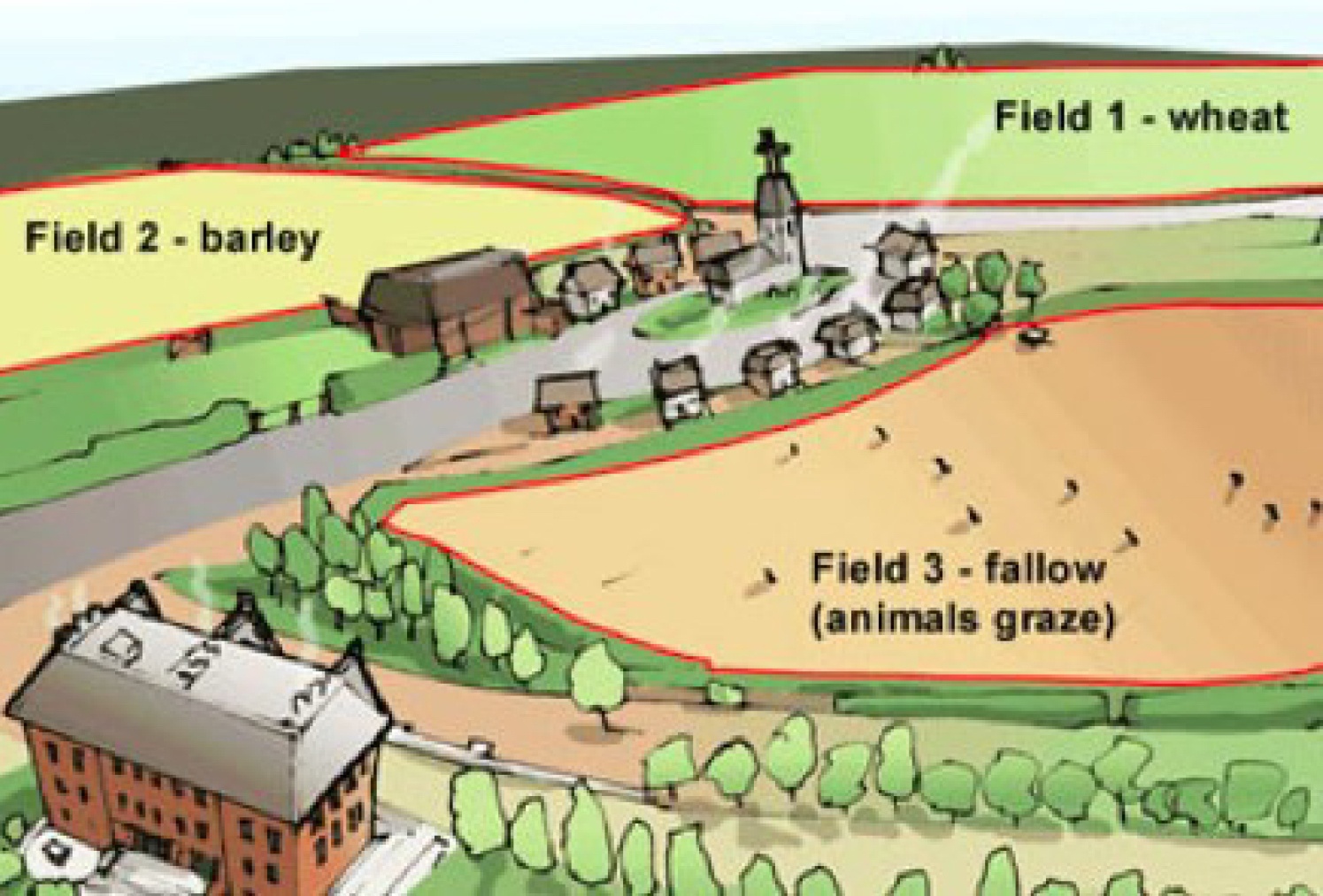
The picture above best describes which medieval farming technique?
a)
Three-field system
b)
Crop rotation
c)
Irrigation
d)
pig farming