wayground logo

Free Printable Worksheets

Font size

S
M
L
XL
Worksheets

TN Ready Vocabulary Word Review

Total questions: 100

Worksheet time: 1hrs 28mins

Name
Class
Date
1.
The distance from one point to the next corresponding point on a wave is called the ________________.
a)
waveform
b)
peak
c)
amplitude
d)
wavelength
2.

The number of waves that pass a fixed point in a given amount of time is...

a)

frequency

b)

wave speed

c)

amplitude

d)

wavelength

3.

Prisms are

a)

the highest part of a wave

b)

repetition of a sound

c)

piece of glass or other transparent material

d)

rate an object changes its position

4.

Why is the spectrum of light separated into its components of color when white light is directed to a prism?

a)

Because light reflects off the prism's surface

b)

The incident white light refracts and separates into its constituent colors

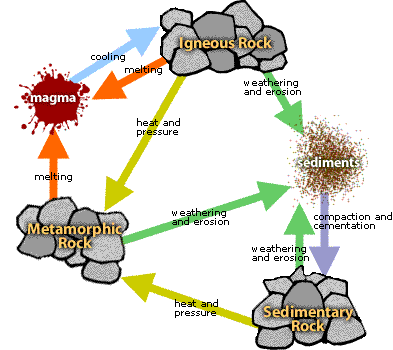
c)

The white light is absorbed by the prism, separating its colors

d)

The light speeds up as it moves from air into the denser plastic material

5.
What is the difference between reflection and refraction? 
a)
Both involve light bending through a medium
b)
Reflection is light bouncing off a medium's surface and refraction is light bending through a medium
c)
Reflection is light bending through a medium's surface and refraction is light bouncing off a medium
d)
Refraction is light being absorbed in a medium and reflection is light being bent through a different medium
6.

What is an echo?

a)

It is a sound

b)

It is a reflection of a sound

c)

It is an oscillation

d)

Frequency maybe?

7.
Sound waves are _______________
a)
Transverse waves
b)
Longitudinal waves
c)
Circular waves
d)
Seismic waves
8.
The wave crest is represented by which letter?
a)
A
b)
B
c)
C
d)
E
9.
The wave trough is represented by
a)
A
b)
B
c)
C
d)
D
10.
The amplitude of a wave is given by
a)
A
b)
B
c)
C
d)
D
11.
a)
Amplitude
b)
Crest
c)
Trough
d)
Wavelength
12.
a)
Frequency
b)
Amplitude
c)
Wavelength
d)
Trough
13.
A wave transfers:
a)
matter
b)
water
c)
energy
d)
particles
14.
When the particles of a medium are vibrating perpendicular to the direction of the wave,  this is a __________wave.
a)
sound
b)
water
c)
transverse
d)
longitudinal
15.
What are the parts of a longitudinal wave?
a)
Compressions and rarefactions
b)
Crests and troughs
c)
Compressions and crests
d)
Rarefactions and troughs
16.

What are the TWO main types of waves?

a)

Ocean

b)

Electromagnetic

c)

Sound

d)

Mechanical

17.

Hertz is the unit for ...

a)

loudness

b)

amplitude

c)

speed of a wave

d)

frequency

18.
How High or Low a sound is
a)
Volume
b)
Amplitude
c)
Pitch
d)
Vibrate
19.

the tendency of an object to resist a change in its motion

a)

acceleration

b)

inertia

c)

mass

d)

frame of reference

20.

Inertia is the tendency of an object to resist a change in its ___________.

a)

temperature

b)

shape

c)

size

d)

motion

21.

Inertia is Newton's _______ Law of Motion.

a)

First

b)

Second

c)

Third

22.

The SI unit for acceleration is

a)

mph

b)

ft/sec

c)

m/s2

d)

m/s

23.

The equation for acceleration is...

a)
b)
c)
d)
24.
What is the SI unit used to measure force? 
a)
pounds 
b)
grams 
c)
newtons 
d)
friction
25.
Gravity attracts all objects towards one another.
a)
False
b)
True
c)
It depends
26.
What is velocity?
a)
the quickness of an object
b)
the location of an object
c)
acceleration
d)
speed in a specific direction
27.

What type of force is this man using to push his grocery cart?

a)

Normal Force

b)

Gravity

c)

Air Resistance

d)

Applied Force

28.

What is the net force?

a)

3 N

b)

3 N, right

c)

17 N, right

d)

3 N, left

29.

A ____________ is a push or a pull on an object.

a)

friction

b)

force

c)

magnet

d)

gravity

30.
What force holds the planets in motion around the sun?
a)
Magnetic
b)
Electrical
c)
Gravitational
d)
Air Resistance
31.
What is a series circuit?
a)
The transfer of electrons from one object to another
b)
A circuit with a single path the current follows
c)
A circuit that goes in multiple directions
d)
A circuit that takes place in a series of events
32.
this circuit is .....?
a)
open
b)
parallel
c)
closed
d)
The cutest little circuit evah!
33.
When all parts of the circuit are connected it is a ______ circuit. 
a)
open
b)
closed
34.
A material in which electrons are not able to move easily 
a)
Circuit 
b)
Insulator 
c)
Resistance 
d)
Conductor
35.
A material in which electrons are able to move easily
a)
Circuit
b)
Insulator 
c)
Resistance 
d)
Conductor 
36.

Electricity if the flow of _____________

a)

electrons

b)

protons

c)

atoms

d)

neutrons

37.

A flow of electrons through a conductor is called:

a)

conductivity

b)

spark

c)

circuit

d)

current

38.

A device that converts chemical energy to electrical energy

a)

switch

b)

light

c)

battery

d)

bulb

39.

Which is measured using volts?

a)

voltage

b)

current

c)

resistance

40.

Battery is a...

a)

container in which chemical energy is converted into electricity and used as a power source

b)

material that halts the flow of electricity

c)

material that allows the flow of electricity

d)

device used to measure how much electrical output an outlet can have

41.

What is resistance

a)

the rate at which a charge is flowing

b)

the material's tendency to resist flow of electrons

c)

the difference of charge between 2 points

d)

it is futile

42.
AC stands for ___.
a)
Alternating Current
b)
Attraction Connections
43.

Direct current means that the current can...

a)

flow in any direction that it chooses

b)

only flow in one direction

c)

flow backwards or forwards depending on which way the switch is selected

44.

Like poles of a magnet

a)

repel

b)

attract

45.

Unlike poles of a magnet

a)

repel

b)

attract

46.

What is the force of attraction or repulsion of magnetic materials?

a)

electricity

b)

magnetism

c)

energy

d)

electromagnetism

47.
What do you make if you wrap a current-carrying wire around an iron bolt?
a)
electromagnet
b)
electric motor
c)
generator
48.
What is the region of force around a magnet known as?
a)
magnetic field
b)
magnetic pole
c)
magnetic domain 
d)
lodestone
49.

A rock deep within the Earth experiences extreme temperature and pressure. After a long period of time it becomes which rock?

a)

Magma

b)

Igneous

c)

Metamorphic

d)

Sedimentary

50.

Formed by cooling & solidification of lava (Select 2)
a)
Sedimentary
b)
Metamorphic
c)
Extrusive Igneous
d)
Intrusive Igneous
51.
Formed by compacting & cementing of sediments
a)
Sedimentary
b)
Metamorphic
c)
Extrusive Igneous
d)
Intrusive Igneous
52.
Contains fossils. 
a)
sedimentary rocks
b)
metamorphic rocks
c)
extrusive igneous rocks
d)
intrusive igneous rocks
53.
What was the name given to all the continents when they were joined as one super continent?
a)
Supreme Continent
b)
Eurasia
c)
Plate tectonics
d)
Pangea
54.

Tectonic plates float on top of the ________

a)

Crust

b)

Mantle

c)

Inner Core

d)

Outer Core

55.
This is the theory that states that all the continents started as a single massive continent and have been MOVING apart for over 200 million years and the man that proposed it.
a)
The Big Bang Theory, Einstein
b)
The Pangea Theory, Hutton
c)
The Tectonic Plate Theory, Darwin
d)
The Continental Drift Theory, Wegner
56.

Which layer of the Earth is solid iron and nickel?

a)

Mantle

b)

Crust

c)

Inner Core

d)

Outer core

57.

Divergent plates move _______ each other.

a)

away from

b)

towards

c)

underneath of

d)

over-top of

58.

Divergent boundaries cause the Mid-Ocean Ridge to form and ________.

a)

Mountains

b)

Rifts

c)

Volcanoes

d)

Earthquakes

59.

What natural hazard occurs when plates scrape and slide past each other?

a)

Tornadoes

b)

Tsunamis

c)

Hurricanes

d)

Earthquakes

60.

Convergent plates move ________ each other.

a)

toward

b)

away from

61.

During ___________, one plate moves below another

a)

Transform

b)

Subduction

c)

Convergence

d)

Divergence

62.
The belt of volcanoes around the rim of the Pacific Ocean is called:
a)
Island arc
b)
Ring of Fire
c)
Lava plateau
d)
Hawaii
63.
Shield volcanoes have:
a)
gently sloping sides
b)
a steep cone shape
c)
moderately sized sides
d)
long cracks along plate boundaries
64.
When a volcano erupts, empties the magma chamber, and collapses the top leaving a huge hole.
a)
Dike
b)
Caldera
c)
Silica
d)
Geyser
65.
This type of volcano has explosive eruptions that result in massive amounts of tephra (ash).
a)
Shield volcano
b)
Composite / Stratovolcano
c)
Cinder cone
d)
Fissure volcano
66.
What is letter A in the picture?
a)
Vent
b)
Crater
c)
Conduit
d)
Tephra
67.
What is letter B in the picture?
a)
Magma Chamber
b)
Crater
c)
Vent
d)
Conduit
68.
Change over time...
a)
Evolution
b)
Nucleotide 
69.
Charles Darwin came up with this theory 
a)
Natural Selection
b)
Mutation
70.
To adjust to a changing environment
a)
Mutation
b)
Adapt
71.
Which term refers to the process by which individuals that are better suited to the environment survive and reproduce therefore passing down their genes to their offspring? 
a)
Evolution 
b)
Variation 
c)
Adaptation
d)
Natural Selection 
72.
What is the process in which humans breed organisms for certain traits?
a)
natural selection
b)
inheritance
c)
artificial selection
d)
descent withOUT modification
73.
Who is the father of evolution?
a)
Darwin
b)
Mendel
c)
Newton
d)
Einstein
74.

The difference between Homologous Structures and Analogous Structures is...

a)

Homologous structures do not have a common ancestor whereas Analogous structures have a common ancestor

b)

Homologous have the same genetic make-up whereas Analogous structures have a different genetic make-up

c)

Homologous structures have the same function whereas Analogous structures do not

d)

Homologous structures have a common ancestor whereas Analogous structures do not

75.

Vestigial structures are structures that...

a)

have more than one purpose

b)

no longer have a purpose

c)

only have a structure in humans

d)

only have a structures in plants

76.
In what way can scientists determine the ages of fossils?
a)
relative dating
b)
radioactive dating
c)
law of superposition
d)
All of the above
77.

An area of land that drains to a particular river, lake, bay, or other body of water.

a)

Tributary

b)

Wetland

c)

Divide

d)

Watershed

78.
An area of permeable layer of rock or soil that holds a large amount of water in the saturated zone is called what?
a)
Aquifer
b)
Spring
c)
Well
d)
Reservoir
79.
Water stored  in cracks and pores below the Earth's surface is called:
a)
Groundwater
b)
Bogs
c)
Water in the ground
d)
surface water
80.

The top of the water surface in a saturated part of an aquifer

a)

water table

b)

Water cycle

c)

aquifer

d)

Percolation

81.

The process by which water moves through the soil

a)

Precipitation

b)

Percolation

c)

Condensation

d)

Evaporation

82.
Factories where crude oil is separated into fuels and other products are called
a)
incinerators.
b)
deposits.
c)
reserves.
d)
refineries.
83.
A liquid fossil fuel formed from the remains of animals, algae, and other organisms is
a)
petroleum.
b)
coal.
c)
natural gas.
d)
hydrocarbon.
84.

This Fossil Fuel is highly flammable (catches on fire easily) and a leak could cause a violent explosion or fire.

a)

petroleum

b)

wood

c)

coal

d)

natural gas

85.

This fossil fuel is formed from the remains of small organisms that lived in the ocean AND is a thick, black liquid

a)

natural gas

b)

coal

c)

oil

d)

steam

86.

Coal is formed from

a)

rocks

b)

a factory

c)

remains of small organisms that lived many millions of years ago in our oceans

d)

plant remains along with heat and pressure

87.
What is the greenhouse effect?
a)
The warming of a planet due to trapped radiation.
b)
The cooling of Earth due to air pollution.
c)
The heating of a solid, such as a rock.
88.

The three species pictured do not share a common ancestor, yet have evolved to have a similar anatomy and life style. This is an example of ?

a)

Homologous Structures

b)

Divergent Evolution

c)

Vestigial Organs

d)

Convergent Evolution

89.

The three species pictured share a common ancestor and have adapted so that each lives in a different environment. This is an example of

a)

Law of Superposition

b)

Evolutionary Arms Race

c)

Divergent Evolution

d)

Convergent Evolution

90.

Carbon-14 can be use to determine the _______ _______ of a fossil.

a)

Absolute age

b)

Relative age

c)

Vestigial organs

d)

Analogous structures

91.

The yucca moth depends on the small soap weed for food, and the small soap weed is only pollinated by the yucca moth. This is an example of

a)

Evolutionary Arms Race

b)

Convergent Evolution

c)

Coevolution

d)

Adaptive Radiation

92.

When ore is removed in layers by removing the soil that is on top.

a)

Open Pit Mining

b)

Oil Derricks

c)

Strip Mining

d)

Fracking

93.

Water that flows along Earth's surface to eventually return to the ocean is called ___.

a)

runoff

b)

storm drain

c)

tributary

d)

groundwater

94.

Areas of higher elevation that separate watersheds are called ---

a)

divides

b)

canyons

c)

plates

d)

tributaries

95.

Q. What type of fossil is an imprint in a rock?

a)

Cast

b)

Mold

c)

Trace

d)

Petrified

96.

This type of fossil forms when a mold is filled with sand or mud that hardens into the shape of the organism.

a)

Mold

b)

Cast

c)

Trace

d)

Petrified

97.

These fossils are distinguishable from other fossils because they were scattered over a large region, very common, and lived during a short span of geologic time

a)

Mold

b)

Cast

c)

Trace

d)

Index

98.

What type of fossil is pictured?

a)

Cast

b)

Mold

c)

Trace

d)

Petrified

99.

Reserve is the...

a)

irregular land lay-out due to underwater activity

b)

amount of fossil fuels that can be extracted from Earth

c)

area of land that separates waters flowing to different locations

d)

boundary between natural gas and coal

100.

This is an image of...

a)

Karst Topography

b)

Underwater Caves

c)

Groundwater

d)

Percolation