Wayground logo

Free Printable Worksheets

Font size

S
M
L
XL
Worksheets

Weather and Climate

Total questions: 60

Worksheet time: 56mins

Name
Class
Date
1.

Which layer of the atmosphere has meteors?

a)

troposphere

b)

stratosphere

c)

mesosphere

d)

thermosphere

2.

Which layer of the atmosphere contains the ionosphere?

a)

troposphere

b)

stratosphere

c)

mesosphere

d)

thermosphere

3.

Which layer of the atmosphere has weather?

a)

troposphere

b)

stratosphere

c)

mesosphere

d)

thermosphere

4.

Which layer of the atmosphere contains the ozone?

a)

troposphere

b)

stratosphere

c)

mesosphere

d)

thermosphere

5.

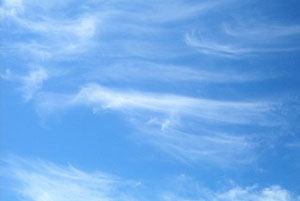
Which type of cloud is this?

a)

cirrus

b)

stratus

c)

cumulus

6.

Which type of cloud is this?

a)

cirrus

b)

stratus

c)

cumulus

7.

"atmo-" means

a)

gas or vapor

b)

water

c)

Earth or rocks

d)

life

8.

As you get farther away from the Earth, the layers of the atmosphere get

a)

colder

b)

warmer

9.

Earth's atmosphere is mostly made up of which 2 gases? CHOOSE 2!!!!!!

a)

nitrogen

b)

oxygen

c)

ozone

d)

water vapor

10.
Heat from the sun travels to Earth by _____.
a)
conduction
b)
convection
c)
insulation
d)
radiation
11.
What is greenhouse effect?
a)
the process by which gasses hold heat in the air .
b)
water vapor and dioxide.
c)
particles in the atmosphere.
d)
heat
12.
Sunburn is caused by _____________________.  It can't be felt as heat.
a)
infrared radiation
b)
visible light
c)
spectrum radiation
d)
ultraviolet radiation
13.
A natural process that holds heat in is called_________________.
a)
greenhouse effect
b)
infrared radiation
c)
ultraviolet radiation
d)
visible light
14.
The layers of the atmosphere in order from bottom to top are
a)
troposphere, stratosphere, mesosphere, thermosphere, exosphere
b)
troposphere, mesosphere, atmosphere, thermosphere
c)
mesosphere, thermosphere, troposphere, stratosphere, exosphere
d)
thermosphere, stratosphere, mesosphere, troposphere, exosphere
15.
A lava lamp with putty which heats, flows to the top, cools, then flows to the bottom is an example of:
a)
conduction
b)
convection
c)
radiation
16.
Where we live.
a)
stratosphere
b)
thermosphere
c)
troposphere
d)
mesosphere
17.
A measure of the amount of water vapor in the air is called what?
a)
Rigidity
b)
Moisture
c)
Humidity
d)
Fog
18.
This type of heat transfer is due to direct contact.
a)
Radiation
b)
Transpiration
c)
Conduction
d)
Convection
19.

Coriolis Effect

a)

bands of high and low pressure found about every 30 degrees of latitude

b)

the curving of a path of a moving object from an otherwise straight path due to Earths rotation

c)

winds that blow from east to west between 60 and 90 degrees latitude in both hemispheres

d)

narrow belts of strong winds that blow in the upper troposphere

20.

Polar Easterlies

a)

bands of high and low pressure found about every 30 degrees of latitude

b)

the curving of a path of a moving object from an otherwise straight path due to Earth's rotation

c)

winds that blow from east to west between 60 and 90 degrees latitude

d)

narrow belts of strong winds that blow in the upper troposphere

21.

How many primary wind belts are there in each hemisphere?

a)

1

b)

2

c)

3

d)

4

22.

What causes differences in air pressure?

a)

even heating of the Earth

b)

Even cooling of the earth

c)

uneven heating of the earth

d)

global warming

23.
Which statement correctly defines wind?
a)
Wind is the movement of air from areas of low pressure to areas of high pressure
b)
Wind is the movement of air to a colder area in the atmosphere.
c)
Wind is the movement of air from areas of high pressure to areas of low pressure.
d)
Wind is the movement of air pushed around and bouncing off Earth's surface.
24.
Why does warm air rise?
a)
Warm air is more dense than cooler air.
b)
Warm air has more pressure than cooler air.
c)
Warm air is less dense than cooler air.
d)
Warm air has a higher dew point than cooler air.
25.

The amount of water vapor in the air is known as ___.

a)

dew point

b)

humidty

c)

relative humidity

d)

rain

26.

Which one of the following is an accurate relative humidity reading?

a)

32 degrees

b)

24 mL

c)

45%

d)

15 NW

27.

The condition of the atmosphere at a certain time and place is referred to as ___.

a)

weather

b)

climate

c)

relative humidity

d)

dew point

28.

Which will hold more water, warm air or cold air?

a)

Warm Air

b)

Cold AIr

29.

Dew is what?

a)

Water that is pushed out by plants

b)

Water that was a gas in the atmosphere, but when it cooled turned into liquid water touching a solid object

c)

Water from the ground

30.
What does high humidity mean?
a)
It is cold. 
b)
It is hot. 
c)
There is a little evaporated water in the air. 
d)
There is a lot of evaporated water in the air. 
31.

This type of cloud is thick and puffy on top, and generally flat on the bottom. It has well-defined edges and can change shape rapidly.

a)

cumulus cloud

b)

stratus cloud

c)

cirrus cloud

d)

cloud 9

32.

How does the temperature change as you go up in elevation?

a)

The temperature gets colder as you go up

b)

The temperature gets warmer as you go up

c)

The temperature stays the same as you go up

33.

One way to get water vapor to condense from the air include

a)

Cooling the air down

b)

Warming the air up

34.

Warm air tends to ______

a)

Rise

b)

Sink

35.

What is a cloud made of? (mostly)

a)

Salt

b)

Dust

c)

Water droplets

d)

Water vapor

36.

When someone refers to 'dry air', what they really mean is _______ .

a)

high humidity air

b)

hot air

c)

cold air

d)

low humidity air

37.
This type of cloud is thin, wispy, and made of ice crystals
a)
cumulus cloud
b)
stratus cloud
c)
cirrus cloud
d)
cumulonimbus cloud
38.

Which type of cloud is lowest in the sky?

a)

Cirrus

b)

Cumulus

c)

Stratus

39.

The dew point is

a)

the point at which water vapor evaporates.

b)

the point at which water vapor condenses.

c)

the point at which hail starts.

d)

the point that water vapor becomes saturated.

40.
Nimbostratus and cumulonimbus clouds can signal what type of upcoming weather?
a)
fair skies
b)
hot, sunny weather
c)
windy weather
d)
rainy weather
41.
How do we characterize an air mass that forms over the ocean?
a)
Dry
b)
Wet
c)
Cold
d)
Warm
42.
How do we characterize an air mass that forms near the poles?
a)
Dry
b)
Wet
c)
Warm
d)
Cold
43.
How do we characterize an air mass that forms over near the equator?
a)
Dry
b)
Wet
c)
Cold
d)
Warm
44.
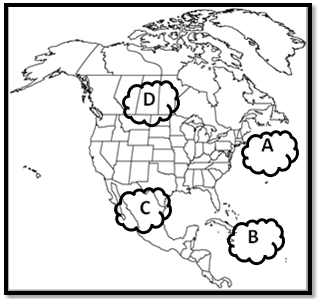
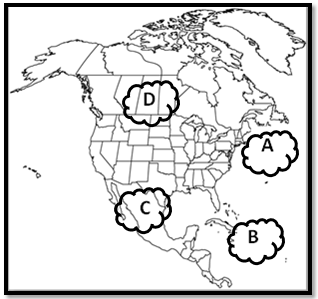
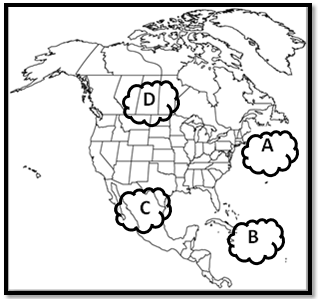
Which type of air would you find at air mass A?
a)
cold, dry
b)
warm, humid
c)
warm, dry
d)
cold, humid
45.
Which type of air would you find at air mass B?
a)
cold, dry
b)
warm, humid
c)
warm, dry
d)
cold, humid
46.
Which type of air would you find at air mass D?
a)
cold, dry
b)
warm, humid
c)
warm, dry
d)
cold, humid
47.
How do we name air masses?
a)
Water and temperature
b)
Air pressure
c)
Humidity and temperature
d)
Cold and warm
48.

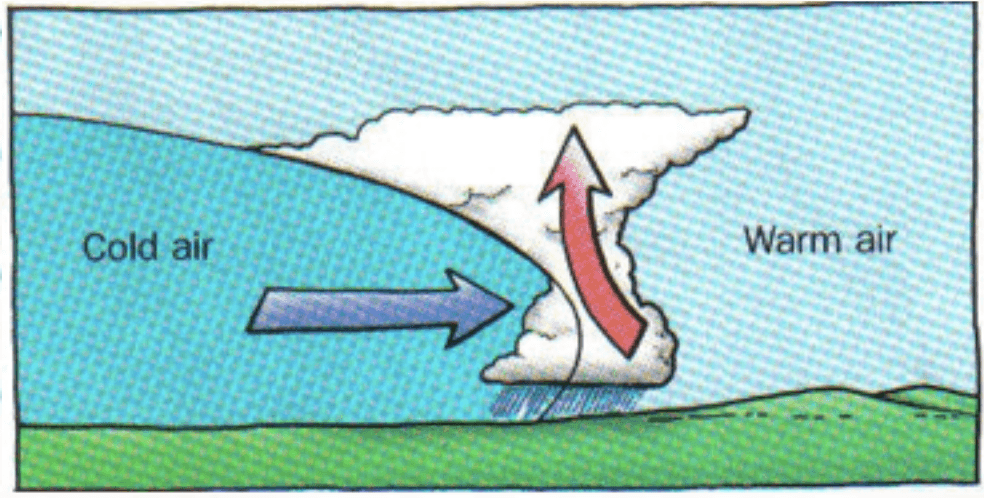
Name that front.

a)

Cold Front

b)

Warm Front

c)

Stationary Front

d)

Occluded Front

49.

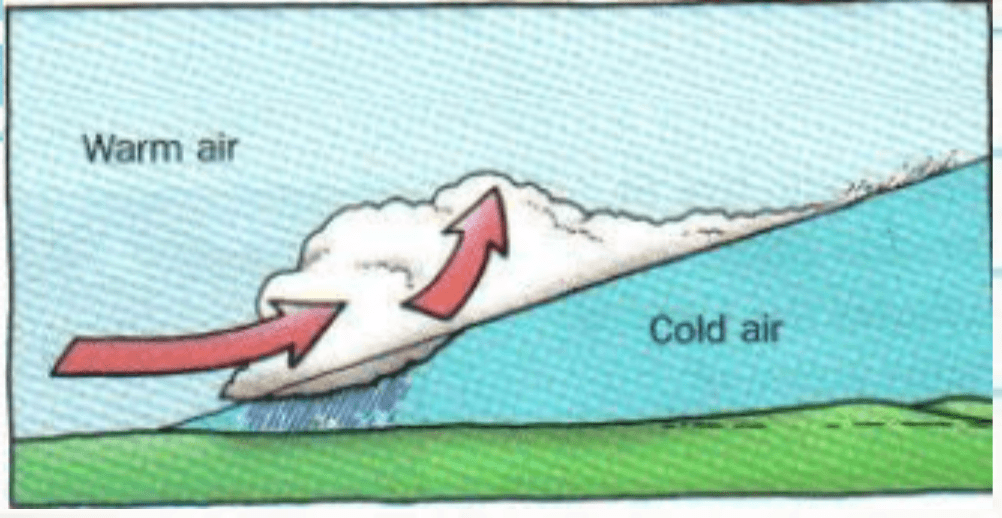
Name that front.

a)

Cold Front

b)

Warm Front

c)

Stationary Front

d)

Occluded Front

50.

Brings some clouds and gentle rains.

a)

Cold Front

b)

Warm Front

c)

Stationary Front

d)

Occluded Front

51.

Cold dense air slides underneath warm air. The warm air is forced up, cools, and condenses.

a)

Cold Front

b)

Warm Front

c)

Stationary Front

d)

Occluded Front

52.
In a high pressure systems
a)
there are few clouds because the air in moving downward
b)
there are many clouds because the air is very humid
c)
there are few clouds because the air is moving outward
d)
there are many clouds because the air is moving upward
53.
A front is
a)
where warm air is cooling at earth's surface
b)
a line where hot and cold air are separating
c)
a line where two different air masses meet
d)
where cold air is rising and forming rain clouds
54.
This is the symbol for which type of front?
a)
cold front
b)
warm front
c)
stationary front
d)
occluded front
55.
This is the symbol for which type of front?
a)
cold front
b)
warm front
c)
occluded front
d)
stationary front
56.
Which system results in drier, fairer weather?
a)
high pressure
b)
low pressure
c)
hurricane
d)
weather system
57.

What type of weather will you see along a cold front?

a)

Thunderstorms

b)

Sunny skies

c)

Gentle rain

d)

No weather

58.

What is a tornado?

a)

a violently rotating column of air

b)

a rotating tropical storm

c)

a winter storm characterized by high winds and snow

d)

a storm that occurs in cumulonimbus clouds

59.

What is climate?

a)

the condition of the atmosphere at any given time and place

b)

cloud cover and temperature

c)

precipitation and humidity at a given time and place

d)

weather conditions in an area over a long period of time

60.

Climate is affected by many factors including:

a)

latitude, elevation, and proximity to bodies of water

b)

tides and currents

c)

wind

d)

snow and sleet