
 Worksheets
Wave Behavior & Properties
Total questions: 55
Worksheet time: 2hrs 47mins
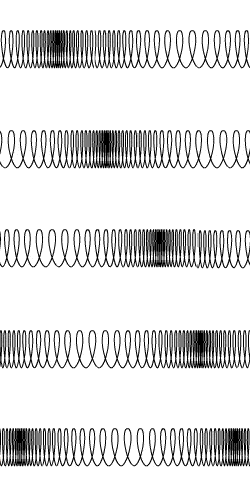
What type of wave is this?
compressional, aka: longitudinal
transverse
Which wave type has vibrations that run perpendicular (up & down) to the direction the wave energy travels?
transverse
compressional, aka; longitudinal
Which wave-type has vibrations that run parallel (back & forth) to the direction the wave's energy travels?
transverse
compressional, aka; longitudinal
An example of this type of wave is a sound wave.
transverse
compression; aka: longitudinal
If 100 waves pass a given point in 4 seconds, what is the wave's frequency?
25 Hz
100 Hz
4 Hz
400 Hz

The two waves have different...
amplitudes
speeds
wavelengths
frequencies
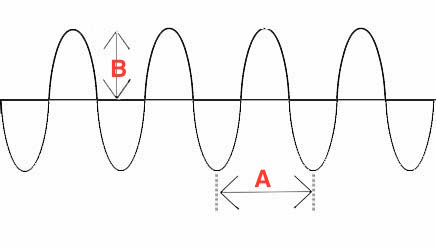
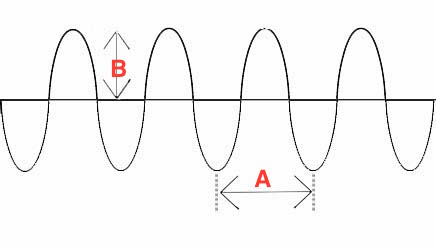
The highest point on a transverse wave is:
the crest
the trough
the top
the coast
The lowest point on a transverse wave is the:
Amplitude
Crest
Trough
Wavelength
The number of wavelengths that pass a point each per second is its_________.
frequency
period
longitudinal
transverse wave
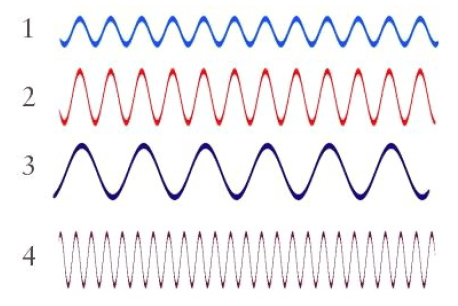
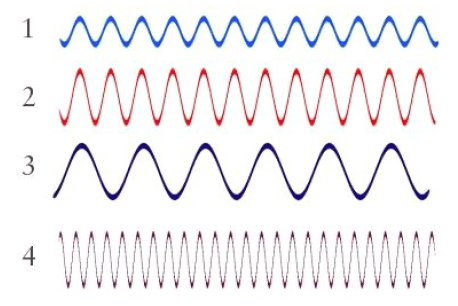
Which wave in the diagram has the greatest (longest) wavelength?
1
2
3
4
1. A wave has frequency of 5 Hz and a speed of 25 m/s. What is the wavelength of the wave?
25 m
125 m
5 m
25 m/s

Which part of a longitudinal wave is where particles are packed closely together?
compression- Part H
rarefaction-Part I
wavelength-Part G
amplitude - Part H to I
Sound is a form of energy produced by ______________.
Vibrations
Distances
Prisms
electricity
True or False: Sound can travel through a vacuum (space).
True
False
As a sound source approaches and then moves past a stationary observer, the observer will hear _________.
a steady rise in pitch
a sudden drop in pitch
a drop in pitch, then a rise in pitch
a rise in pitch, then a drop in pitch
Frequency of waves is measured in _____.
Hertz
Decibels
Watts

Any smooth surface that reflects light to form an image is a(n) ____.
telescope
microscope
mirror
lens


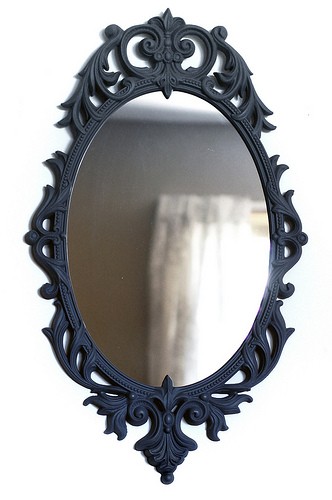
The following is a picture of what type of mirror?
Convex mirror
Concave mirror
Plane Mirror
Flat Mirror
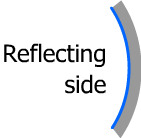
The following is a picture of what type of mirror?
Convex Mirror
Concave Mirror
Plane Mirror
Flat Mirror



Which window is opaque?
Window 1
Window 2
Window 3
None
What is the ray of light that strikes the surface?
Incident ray
reflected ray
normal ray
normal
Which describes the image formed by a convex mirror?
Real
Inverted
Enlarged
Virtual
Which ray diagram shows a real image?


None of the above

Type of mirror used by a dentist to get magnified view of a patient's teeth...
Plane
Convex
Concave

What does it mean to refract?
to bounce off
to curve outward
to bend
to reflect

Holography, such as the mirrored piggy, produces...
real images
virtual images
Both real images and virtual images
none of the above
The highest point on a wave is:
the crest
the trough
the top
the coast

Which represents a concave lens?
A
B
A and B
neither A or B
What type of lens do you have in your eye?
Concave
Prismatic
Objective
Convex
What is a real image?
An right-side-up image produced by virtual rays and can be projected on a screen
An upside-down image produced by real rays and cannot be projected on a screen
A right-side-up image produced by virtual rays and cannot be projected on a screen
An upside-down image produced by real rays and can be projected on a screen

Which of the following will correct nearsightedness?
concave lens
convex lens
concave mirror
convex mirror
Which part of a longitudinal wave is where particles are packed closely together?
compression- Part H
rarefaction-Part I
wavelength-Part G
amplitude - Part H to I

How would this material be described based on how the light reacts?
opaque
transparent
translucent

How would this material be described based on how light reacts to it?
transparent
translucent
opaque

The following visual demonstrates which process of light behavior?
scattering
diffusion
polarization
reflection
A virtual image can be produced by which of the following?
concave and convex mirrors
plane mirror
concave and convex lenses
all mirrors and lenses

