wayground logo

Free Printable Worksheets

Font size

S
M
L
XL
Worksheets

Unit 10 Classifying Elements and Compounds

Total questions: 50

Worksheet time: 2hrs 40mins
Name
Class
Date
1.
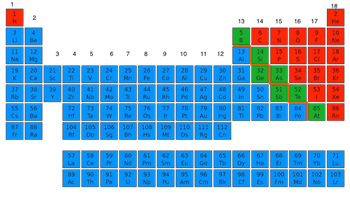
Where are the nonmetals located on the periodic table? 
a)
Blue
b)
Red
c)
Green
2.
Where are metals located on the periodic table?
a)
Blue
b)
Green
c)
Red
3.
Where are the metalloids located on the periodic table?
a)
Blue
b)
Red
c)
Green
4.
All of the following would classify an element as a metal except?
a)
Dull
b)
Luster
c)
Malleable
d)
Hard
5.
Iron is a good conductor, malleable and magnetic. What type of element is Iron? 
a)
Metal
b)
Nonmetal
c)
Metalloid
d)
Pretty
6.
Which of the following correctly lists the three main groups of elements from greatest conductivity to least conductivity?
a)
Nonmetals -metalloids-metals
b)
metals-nonmetals-metalloids
c)
metalloids-metals-nonmetals
d)
metals-metalloids-nonmetals
7.
Silicon is a semiconductor and has properties of both metals and nonmetals. What type of element is Silicon? 
a)
Metal
b)
Nonmetal
c)
Metalloid
d)
Pretty
8.

Metals are found

a)

on the left side of the Periodic Table

b)

on the right side of the Periodic Table

c)

along the staircase (zig-zag line) on the Periodic Table

9.

Which of the following is the only metal that exist as a liquid at room temperature?

a)

Gold (Au)

b)

Mercury (Hg)

c)

Titanium (Ti)

10.
What does ductile mean?
a)
electricity flows easily
b)
quacks like a duck
c)
can be drawn into a wire
d)
able to bend
11.

Is this a metal, metalloid, or nonmetal?

a)

Metal

b)

Metalloid

c)

Nonmetal

12.

Is this a metal, metalloid, or nonmetal?

a)

Metal

b)

Metalloid

c)

Nonmetal

13.

Is this a metal, metalloid, or nonmetal?

a)

Metal

b)

Metalloid

c)

Nonmetal

14.

Is this a metal, metalloid, or nonmetal?

a)

Metal

b)

Metalloid

c)

Nonmetal

15.

Hydrogen (H) is a _______.

a)

Metal

b)

Metalloid

c)

Nonmetal

16.

Sodium (Na) is a _______.

a)

Metal

b)

Metalloid

c)

Nonmetal

17.

Boron (B) is a _______.

a)

Metal

b)

Metalloid

c)

Nonmetal

18.

Fluorine (F) is a _______.

a)

Metal

b)

Metalloid

c)

Nonmetal

19.

Potassium (K) is a _______.

a)

Metal

b)

Metalloid

c)

Nonmetal

20.

Calcium (Ca) is a _______.

a)

Metal

b)

Metalloid

c)

Nonmetal

21.

Aluminum (Al) is a _______.

a)

Metal

b)

Metalloid

c)

Nonmetal

22.

Silicon (Si) is a _______.

a)

Metal

b)

Metalloid

c)

Nonmetal

23.

Sulfur (S) is a _______.

a)

Metal

b)

Metalloid

c)

Nonmetal

24.

Chlorine (Cl) is a _______.

a)

Metal

b)

Metalloid

c)

Nonmetal

25.

Beryllium (Be) is a _______.

a)

Metal

b)

Metalloid

c)

Nonmetal

26.

The horizontal rows on the periodic table are called

a)

groups

b)

families

c)

periods

d)

atomic numbers

27.
All solids at room temperature
a)
ionic compounds
b)
covalent compounds
28.
Some are solids, some are liquids, and some are gases at room temperature.
a)
ionic compounds
b)
covalent compounds
29.
When dissolved in water, the solution is a good conductor of electricity.
a)
ionic compounds
b)
covalent compounds
30.
usually hard but brittle
a)
ionic compounds
b)
covalent compounds
31.
usually soft
a)
ionic compounds
b)
covalent compounds
32.

Compounds composed of a ______________ and _____________ like the compound CaCl2 , are ionic compounds.

a)

metal ... metal

b)

nonmetal ... nonmetal

c)

metal ... nonmetal

33.
Ionic Bonding involves...
a)
The transfer of protons
b)
The transfer of nuetrons 
c)
The transfer of electrons
d)
None Of the above
34.

Which of the following describes covalent bonds?

a)

Bonds form because of opposite charges

b)

electrons are shared to fill outer electron shells

c)

Electrons are transferred between atoms

d)

Covalent bonds are magical

35.

What two types of atoms make a covalent bond?

a)

2 Nonmetals

b)

1 Nonmetal and 1 Metal

c)

2 Metals

d)

2 Noble Gases

36.

Which two elements would NOT form an ionic bond?

a)

calcium and lithium

b)

calcium and oxygen

c)

lithium and oxygen

d)

calcium and carbon

37.
Covalent bonds are between...
a)
Metal and Non-metal
b)
Non-metal and Non-metal
c)
Metal and Metal
38.
Why do elements bond?
a)
To be friends
b)
To create a new element
c)
To become stable
39.

Which of the following is an Covalent compound?

a)

NaCl

b)

CaCl2

c)

KI

d)

CO

40.

HCl

a)

Covalent

b)

Ionic

c)

Metallic

41.

BeS

a)

Covalent

b)

Ionic

c)

Metallic

42.

FeO

a)

Covalent

b)

Ionic

c)

Metallic

43.

N2

a)

Covalent

b)

Ionic

c)

Metallic

44.

NH3

a)

Covalent

b)

Ionic

c)

Metallic

45.

Which of these are considered properties of metals? (choose ALL that apply)

a)

brittleness

b)

low melting point

c)

luster (shininess)

d)

malleability

e)

ductility

46.

______________ is a compound that contains one or more metal elements bonded to another element.

a)

Covalent Compound

b)

Metallic Compound

c)

Ionic Compound

47.

Type of bond between atoms of Silver (Ag)

a)

Covalent

b)

Ionic

c)

Metallic

48.

Al2O3

a)

Ionic Bond

b)

Covalent Bond

49.
What type of bond forms between two or more atoms that are charged (+/-)?
a)
Covalent bond
b)
Incomplete bond
c)
Ionic bond
d)
Metallic bond
50.

Which of the following is an ionic compound?

a)

HCl

b)

H2O

c)

MgO

d)

CO2