Wayground logo

Free Printable Worksheets

Font size

S
M
L
XL
Worksheets

Waves

Total questions: 52

Worksheet time: 47mins
Name
Class
Date
1.
regular disturbances that carry energy through matter or space
a)
crest
b)
energy
c)
wave
d)
trough
2.
In a longitudinal wave, the particles move...?
a)
back and forth
b)
up and down
c)
vertically
d)
in the direction of the hertz
3.
When the frequency of a wave increases, what happens to the wavelength?
a)
The wavelength is not directly affected by the frequency of a wave.
b)
The wavelength increases.
c)
The wavelength decreases.
d)
More specific information is needed to form a conclusion about the wavelength.
4.
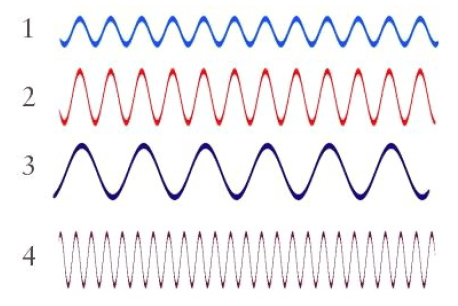
Which wave in the diagram has the greatest frequency?
a)
1
b)
2
c)
3
d)
4
5.
Which of the following can sound travel through?
a)
solid
b)
liquid
c)
gas
d)
all of the above
6.

Which wave is from a combination of parallel and perpendicular motions?

a)

transverse wave

b)

longitudinal wave

c)

surface wave

d)

electromagnetic wave

7.
The number of wavelengths that pass a point each per second is:
a)
frequency
b)
period
c)
longitudinal 
d)
transverse wave 
8.
All waves carry
a)
energy
b)
light 
c)
matter
d)
particles
9.
What kind of wave is pictured below?
a)
compressional wave
b)
transverse wave
c)
sound wave
d)
mechanical wave
10.
Which type of wave is pictured here?
a)
Longitudinal
b)
Transverse
c)
Light 
d)
Electromagnetic
11.

Which type of wave moves parallel to the direction of the wave?

a)

transverse

b)

longitudinal

c)

surface

d)

electromagnetic

12.
The distance from one point to the next corresponding point on a wave is called the ________________.
a)
waveform
b)
peak
c)
amplitude
d)
wavelength
13.
When the sound source moves, the frequency changes
ex. police car siren sounding lower pitch after the car passes
a)
pitch
b)
frequency
c)
Doppler Effect
d)
medium
14.
When the frequency of a wave increases, what happens to the wavelength?
a)
The wavelength is not directly affected by the frequency of a wave.
b)
The wavelength increases.
c)
The wavelength decreases.
d)
More specific information is needed to form a conclusion about the wavelength.
15.
which material does sound travel the fastest?
a)
solid 
b)
liquid 
c)
gases
16.
When a wave strikes and object and bounces off. (example echo)
a)
medium
b)
refraction
c)
reflection
d)
interference
17.
When a wave bends as it passes through at an angle from one medium to another.(example: pencil in a glass of water-)
a)
medium
b)
refraction
c)
reflection
d)
interference
18.
What types of waves carry energy at a right angle or perpendicular to the direction of the energy flow?
a)
Longitudinal waves
b)
Transverse waves
c)
Sound waves
d)
P-waves
19.
What do waves carry from place to place?
a)
Energy, but not matter or particles
b)
Energy and matter or particles
c)
Matter or particles but not energy
d)
Neither energy nor matter or particles
20.
Sound is an example of which type of wave?
a)
Transverse
b)
Longitudinal
c)
Both
d)
Neither
21.
Light is an example of which type of wave?
a)
Transverse
b)
Longitudinal
c)
Both
d)
Neither
22.
Sound needs a medium to travel through.  What is a medium?
a)
solid, liquid, gas
b)
open space
c)
waves
d)
nothing
23.
a)
Reflection
b)
Refraction
24.
a)
Diffraction
b)
Interference
25.
a)
Refraction
b)
Reflection
26.
a)
Constructive Interference
b)
Destructive Interference
27.
What force does not act on a pendulum?
a)
restoring force
b)
weight
c)
tension
d)
mass
28.
The general term for determining the position of an object by reflecting sound off of it is called...
a)
reverberation
b)
echolocation
c)
beats
d)
resonance
29.
All waves transmit...
a)
energy
b)
particles
c)
matter
d)
sound
30.
While in the front yard, you can hear your dog barking in the backyard. This situation illustrates that sound waves can...
a)
refract
b)
reflect
c)
form beats
d)
diffract
31.
The phenomenon of a wave bouncing off a surface is called...
a)
refraction
b)
reflection
c)
rarefaction
d)
interference
32.
Multiples of a fundamental in a sound are called...
a)
fundamental frequencies
b)
reverberations
c)
harmonics
d)
acoustics
33.

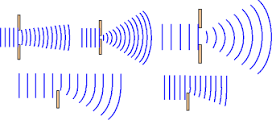
This illustration best depicts which of the following behaviors?

a)

Reflection

b)

Refraction

c)

Diffraction

d)

Resonance

34.

This image best depicts which of the following wave behaviors?

a)

Reflection

b)

Refraction

c)

Diffraction

d)

Resonance

35.

This image depicts which of the following wave behaviors?

a)

Reflection

b)

Refraction

c)

Diffraction

d)

Resonance

36.

Definition: When one object vibrating at the same natural frequency of a second object forces that second object into vibrational motion.

a)

Reflection

b)

Refraction

c)

Diffraction

d)

Resonance

37.

The image depicts which of the following wave behaviors?

a)

Resonance

b)

Doppler Effect

c)

Polarization

d)

Diffraction

38.

The image depicts which of the following wave behaviors?

a)

Resonance

b)

Doppler Effect

c)

Interference

d)

Polarization

39.

The two blue and purple waves will undergo _________________ when they meet.

a)

Constructive interference

b)

Destructive interference

40.

The image of the two waves depicts

a)

Constructive interference

b)

Destructive interference

41.

Definition: the change in direction of a wave passing from one medium to another

a)

Reflection

b)

Refraction

c)

Diffraction

d)

Polarization

42.

Definition: when a wave reaches the interface between two different media, typically some of the wave will bounce back into the original medium.

a)

Reflection

b)

Refraction

c)

Diffraction

d)

Polarization

43.

Definition: The spreading out of waves as they pass through an opening or around objects.

a)

Reflection

b)

Refraction

c)

Diffraction

d)

Resonance

44.

Two waves that undergo constructive interference must be...

a)

In phase

b)

Out of phase

45.

Two waves that undergo destructive interference must be...

a)

In phase

b)

Out of phase

46.

The two forms that waves can take are...

a)

Transverse

b)

Circular

c)

Diamond

d)

Longitudinal

47.

Light waves and sound waves are similar in that...

a)

They are both longitudinal waves

b)

They are both transverse waves

c)

They both transmit energy

d)

They both can travel through space.

48.

Which of the pictured is responsible for our sky being blue?

a)

Transmission

b)

Reflection

c)

Refraction

d)

Scattering

e)

Absorption

49.

Which of the pictured is responsible for black pavement being hot?

a)

Transmission

b)

Reflection

c)

Refraction

d)

Scattering

e)

Absorption

50.

Which of the pictured is responsible for us being able to see objects?

a)

Transmission

b)

Reflection

c)

Refraction

d)

Scattering

e)

Absorption

51.
Resonance occurs when
a)
an object is forced to vibrate at its natural frequency.
b)
sound changes speed in going from one medium to another.
c)
the amplitude of a wave is amplified.
d)
sound makes multiple reflections
52.
The medium (or tension) through which a wave travels affects its...
a)
Wavelength
b)
Speed
c)
Amplitude