
NEW
Font size
S
M
L
XL
 Worksheets
Physics Spring Break Refresh (Newton's Laws & Motion & Forces)
Total questions: 24
Worksheet time: 22mins
Name
Class
Date
1.
According to Newton’s first law of motion, a moving object that is not acted on by an unbalanced force will
a)
remain in motion.
b)
eventually come to a stop.
c)
change its momentum.
d)
accelerate.
2.
A sled sliding on a flat, icy surface with a constant velocity is best described by
a)
Newton’s first law of motion for objects at rest.
b)
Newton’s first law of motion for objects in motion.
c)
Newton’s second law of motion.
d)
Newton’s third law of motion.
3.

A person steps out of the boat and onto the dock. As the person moves forward onto the dock, the boat moves backward. Which statement best describes the backward motion of the boat as the person steps forward?
a)
For every action there is an equal and opposite reaction.
b)
Every mass exerts a force on every other mass.
c)
An object at rest tends to stay at rest.
d)
Friction opposes the motion of an object.
4.

A person in car slides to the right when going through a very sharp left turn on the highway.
a)
1st Law
b)
2nd Law
c)
3rd Law
5.
What is the definition of "weight"?
a)
the force in which gravity pulls on an object
b)
the time it takes to get on a ride
c)
the amount of matter in an object
d)
the size of an object
6.
An object will not have any inertia if it is __________?
a)
Accelerating
b)
Moving in a circle
c)
In space
d)
… Nonsense! All objects have inertia
7.
267.5 N unbalanced force applied to push a stuffed chair across the room, causing an acceleration of 4.2 m/s2. What is the mass of the chair?
a)
26.75 kg
b)
63.69 kg
c)
263.3 kg
d)
1123.5 kg
8.
Which of these best describes why your weight (on Earth) would change on another planet?
a)
weight doesn’t change, no matter where you are
b)
different planets have different gravitational pulls
c)
In general, the smaller the planet, the greater weight
d)
dehydration effects on different planets change weight
9.

"For every action, there is an equal and opposite reaction."
a)
Newton's 1st Law
b)
Newton's 2nd Law
c)
Newton's 3rd Law
d)
Newton's 4th Law
10.

Force = Mass x Acceleration
a)
Newton's 1st Law
b)
Newton's 2nd Law
c)
Newton's 3rd Law
d)
Newton's 4th Law
11.

The tendency of an object to resist changes in its motion is...
a)
inertia
b)
force
c)
acceleration
d)
velocity
12.

Any push or pull on an object.
a)
force
b)
velocity
c)
inertia
d)
momentum
13.

The force that opposes motion between two surfaces in contact with each other.
a)
inertia
b)
friction
c)
momentum
d)
gravity
14.
You push against a wall and the wall is pushing back on you.
a)
Newton's
1st
Law of Motion
1st
Law of Motion
b)
Newton's
2nd
Law of Motion
2nd
Law of Motion
c)
Newton's
3rd
Law of Motion
3rd
Law of Motion
15.
An automobile you are riding in suddenly stops, but you continue to go forward.
a)
Newton's
1st
Law of Motion
1st
Law of Motion
b)
Newton's
2nd
Law of Motion
2nd
Law of Motion
c)
Newton's
3rd
Law of Motion
3rd
Law of Motion
16.
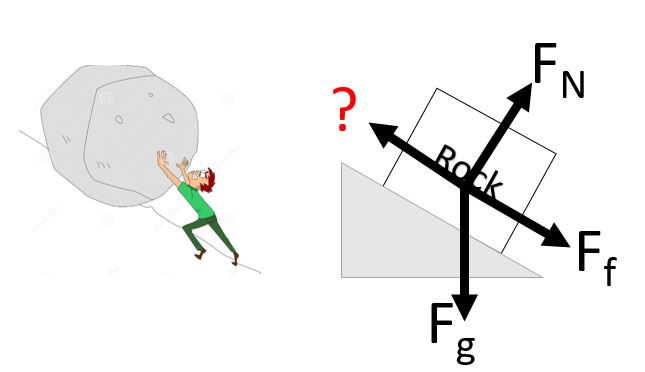
Name the missing force...
a)
applied force
b)
weight force
c)
lift
d)
normal force
17.
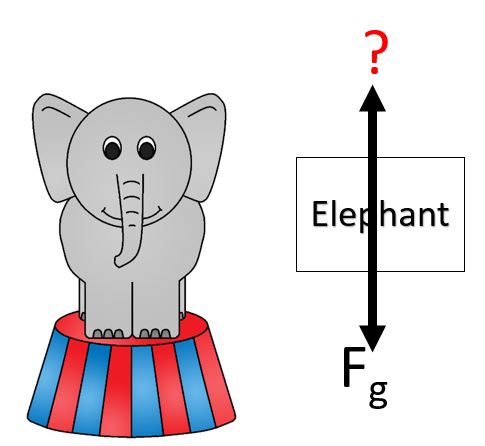
Name the missing force...
a)
weight force
b)
normal force
c)
applied force
d)
frictional force
18.
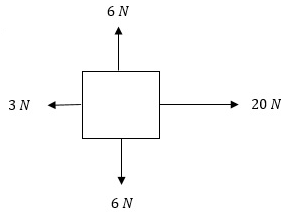
What is the NET FORCE of this diagram?
a)
17 N, right
b)
17 N, left
c)
23 N, right
d)
12 N, up
19.

How can friction be reduced?
a)
reduce the force acting between the 2 surfaces
b)
reduce the roughness of the 2 surfaces coming in contact
c)
use wax, grease or oil
d)
all of the above are ways of reducing friction
20.
Which of the following is an example of friction that is helpful?
a)
Brakes used on a bike
b)
Tires from a car on the road
c)
Tread on the bottom of your shoes
d)
All are examples that are helpful
21.
Which of the following is an example of friction that is harmful?
a)
Pencil marking on paper
b)
Engine parts wearing out
c)
sand placed on ice in the winter
d)
Using an eraser to erase marks
22.
FN=100N, Ff=20N
a)
μ=5.0
b)
μ=0.2
c)
μ=1.2
d)
μ=0.1
23.
A box takes 40 N to start moving when the coefficient of static friction is .54. What is the weight of the box?
a)
81 N
b)
18 N
c)
98 N
d)
74 N
24.
Normal force is
a)
Always opposite the weight
b)
Always parallel and down the incline
c)
Always perpendicular to the surface
d)
It depends on the direction of motion
Reset

