
 Worksheets
Solar System and Space Test Review
Total questions: 45
Worksheet time: 28mins
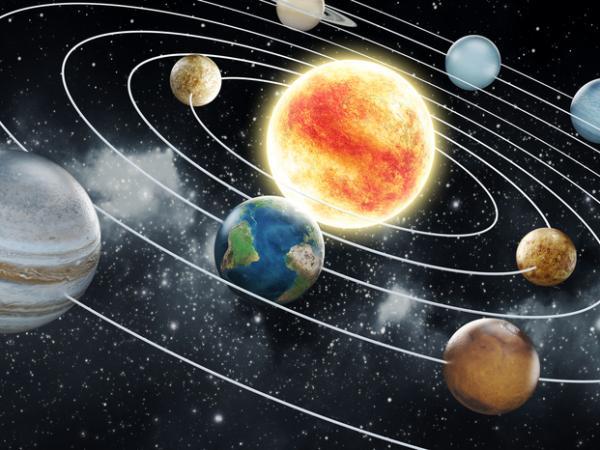
One of the main differences between the outer and inner planets is __________.
the inner planets all have water
the inner planets are much bigger than the outer planets
the outer planets are gas planets
the outer planets have do not have rings and the inner planets do
Where is the asteroid belt found?
Between Earth and Mars
Between Uranus and Neptune
Between Mercury and Venus
Between Mars and Jupiter
What planet has a very hot surface and is most like Earth in size?
Venus
Mercury
Mars
Uranus
Which property makes Earth unique compared to other planets in the solar system?
It orbits the Sun.
It is a rocky planet
It has liquid water
It rotates on its axis.
Which contributes to Earth’s ability to sustain life?
The atmosphere allows all of the sun’s radiation to enter due to Earth’s distance from the sun.
The atmosphere prevents all space debris from reaching the surface due to the ozone layer.
The atmosphere is extremely thin due to the temperatures of the sun.
The atmosphere is breathable due to the unique mixture of gases.
What is the correct order of the planets in the Solar System, starting closest to the Sun?
Mars, Mercury, Earth, Venus, Jupiter, Saturn, Uranus, Neptune,
Mercury, Venus, Earth, Mars, Jupiter, Saturn, Uranus, Neptune
Mercury, Mars, Venus, Earth, Jupiter, Saturn, Uranus, Neptune,
Mercury, Venus, Earth, Mars, Jupiter, Neptune, Uranus, Saturn
Which planet has the most extensive ring structure, the second largest in solar system, has at least 31 moons (the largest being Titan), and has thick outer rings of hydrogen, helium, ammonia, methane, and water vapor?
Jupiter
Neptune
Saturn
Pluto
What do Mercury, Venus, Earth, and Mars all have in common?
They are all very cold planets.
They are considered terrestrial planets, that is rocky or have metals with hard surface.
They are about the same size.
They are considered gas giants
The four inner planets are rocky and small. Which description best fits the next four outer planets?
They are also rocky and small.
They are very large and has no moons
They are small and made of ice.
They are very large, made of gases with no solid surface
Which planet is the largest planet in the solar system and is the fifth planet?
the sun
Uranus
Jupiter
Earth
Which is the eighth planet from the Sun and orbits the Sun once every 164.8 years and is blue in color?
Neptune
Jupiter
Saturn
Mars
Which of the following is ordered from largest to smallest?
Universe -> Galaxy -> Solar System -> Planet
Planet -> Galaxy -> Solar System -> Universe
Planet -> Solar System -> Galaxy -> Universe D.) Universe
Universe -> Solar System -> Galaxy -> Planet
The inner planets are also called a
Gas giants
Terrestrial planets
Large planets
Asteroid
Name for region containing all 8 planets, the sun, asteroids, and other celestial objects?
The Solar System
The Degoba System
Asteroid Belt
Kuiper Belt system
What is the object that all planets in our solar system orbit?
The moon
The sun
The Milky Way
Mercury
Which of the these planets would have the greatest gravitational pull on a nearby object?
Mars
Mercury
Jupiter
Neptune


what was the first creature in space
a dog
a human
a hamster
monkey

On July 16, 1969, three U.S. astronauts set off on the Apollo 11 space mission to attempt the...
first lunar (moon) landing
first orbit of the Earth
first journey into outer space

The ________ was designed to land humans on the Moon and bring them safely back to Earth.
Project Apollo
Project Mercury


A _____________ bursts through Earth's atmosphere at amazingly fast speeds and appears as a "shooting star"
Asteroid
Meteor
Comet
Why is it difficult to get good images from a telescope on Earth?
Because of the gases in the atmosphere
Because of the clouds
The planet with the fastest orbital speed is
Venus
Mercury
Neptune
Earth
The planet with the slowest orbital speed is
Neptune
Uranus
Saturn
Pluto

