
 Worksheets
Test Practice electrical mechanical
Total questions: 56
Worksheet time: 38mins
Suppose that an astronaut throws a baseball in outer space at a location far from significant influences of gravity and air resistance. One would expect that the baseball would ____.
eventually stop since all objects ultimately "lose their steam"
eventually stop as its inertia slowly becomes used up
continue in motion with the same speed and direction
either a, b, or c -- depending on whether the astronaut continues to push it
The law of inertia (Newton's first law) applies _____.
to moving objects only
only to objects that are not moving
to both moving and nonmoving objects
Inertia refers to _____
the tendency of moving objects to remain in motion
the force which keeps moving objects in motion with a constant velocity
the force that keeps stationary objects at rest
the tendency of stationary objects to remain at rest
A skateboard rolls down a hill, reaches the level surface and eventually comes to a stop. The fact that the skateboard ultimately stops is best explained by ____.
an unbalanced force would be required to keep the sled moving forward at constant speed
the presence of an unbalanced force (e.g., friction) can cause a moving object to stop
the presence of inertia causes it to stop
the natural tendency of any object is to ultimately stop
Inertia depends on ______
Velocity
Speed
Distance
Mass

List the objects in order from least to greatest inertia.
CDBA
ABCD
BCDA
CBAD
An astronaut kicks a soccer ball in outer space at a location far from significant influences of gravity and air resistance. The soccer ball will _________.
continue in motion with the same speed and direction
eventually stop as its inertia slowly becomes used up
eventually stop since all objects ultimately "lose their steam"
either a, b, or c -- depending on whether the astronaut continues to kick it
More mass = More inertia
True
False
Inertia is the tendency of an object to resist a change in its ___________.
temperature
shape
size
motion
Inertia is Newton's _______ Law of Motion.
First
Second
Third
What is the relationship between heavy objects and inertia?
Only heavy objects have inertia.
Heavy objects have more inertia.
Heavy objects have less inertia.
Heavy objects have no inertia.

Diagram 3 shows a cat chasing a rat. The inertia of the cat is bigger than the rat because.
The size of the cat is bigger than the rat
The length of the cat is more than the rat
The mass of the cat is bigger than the rat

While you’re ice-skating with your friends, you push off from one end of the rink and slide forward. Based on Newton’s first law of motion, what is true?
You will lose your balance and fall over before you reach the middle of the ice rink.
You will continue to slide across the ice until a force makes you stop or change direction.
The force of gravity will make you keep your velocity until your friend makes you stop.
The size of your ice skates will determine how quickly or slowly you travel across the ice.
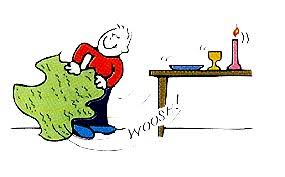
Which explains why the tablecloth trick works?
The dishes are stuck in place due to air resistance.
The tablecloth is an ilusion.
The dishes have inertia, and therefore stay on the table.
magic
F= mass * acceleration
A 20 kg bike accelerates at 10 m/s2. what is the force acting upon it?
25 Newtons
20 Newtons
200 Newtons
10 Newtons
An object of mass 10 kg is accelerated upward at 2 m/s2. What force is required?
20 N
2 N
5 N
0 N
F = ma
Which of Newton's laws best fits with the following statement: Objects at rest tend to stay at rest
First
Second
Third
Which of Newton's laws best fits with the following statement: More mass means more force needed to accelerate
first
second
third
Which of the following is an example of acceleration?
Skiing faster when you go down a hill
Riding your bike straight down the street at a constant speed
Driving your car at 30 mph and not changing the speed
If an objects mass increases with a constant force, the acceleration
increases
decreases
If an object's acceleration decreases while a constant force is applied to the object, the mass will
increase
decrease
stay the same
If an objects force is increased while the acceleration on an object is constant, the mass
increases
decreases
stays the same
Which shows the relationship between acceleration, mass, and net force?
acceleration = force x mass
acceleration = force/mass
acceleration = mass/force
For every action there is an equal and opposite reaction.
Newton's First Law of Motion
Newton's Second Law of Motion
Newton's Third Law of Motion
When you push on a wall, the wall pushes on you.
True
False
If you push on a wall with a force of 30 N, the force acting on you from the wall is which of the following?
0 N
10 N
20 N
30 N

As the resistance of a circuit increases, the current will
increase
decrease
stay the same
increase and then decrease
What equation links voltage, current and resistance
V = IR
V = CR
V = I/R
V = R/I
V = C/R
What unit is used to measure resistance?
Ohms
Omega
Volts
Amps
What unit is used to measure current?
Ohms
Omega
Volts
Amps
What is the resistance of a lightbulb that experiences 9 Volts and 3 amps of current?
1/3 ohms
3 ohms
27 ohms
9 ohms
What is the voltage of a circuit with 4 ohms of resistance and 3 amps of current?
12 V
21 V
4/3 V
3/4 V

Speakers need a household voltage of 110 V to push a current of 5.5 A through them. What is the
resistance of the speakers?
10Ω
20Ω
30Ω
40Ω

An alarm clock draws 0.5 A of current when connected to a 120 volt circuit. Calculate its resistance.
60Ω
120Ω
180Ω
240Ω

An IPod uses a standard 1.5 V battery. How much resistance is in the circuit if it uses a current of 0.01A?
50Ω
100Ω
150Ω
200Ω

A circuit contains a 1.5 volt battery and a bulb with a resistance of 3 ohms. Calculate the current.
0.5A
1A
1.5A
2A

What current flows through a hair dryer plugged into a 120 Volt circuit if it has a resistance of 25 ohms?
2.4A
3.6A
4.8A
6A
Which component converts chemical energy into electrical energy
battery
lightbulb
resistor
LED
Which component converts electrical energy to thermal energy?
Buzzer
Resistor
Lightbulb
LED
Which component controls the direction that electricity flows in a circuit?
Diode
Motor
Buzzer
LED
What is the job of a diode in reverse diode?
Allow electricity to flow through
Stop electricity to flow through
Produce light
Produce sound

