wayground logo

Free Printable Worksheets

NEW

Font size

S
M
L
XL
Worksheets

EOC 5 - Classification and Phylogeny

Total questions: 42

Worksheet time: 46mins

Name
Class
Date
1.
The scientific name for an organism is made from the:
a)
class and family name
b)
genus and species name
c)
domain and kingdom name
d)
kingdom and phylum name
2.
Who first proposed binomial nomenclature as a way of classifying organisms?
a)

Carolus Linnaeus

b)

Gregor Mendel

c)
Charles Darwin
d)
Henry Groseclose
3.
Which organisms are closely related? 
a)
American badger and leopard
b)
coyote and gray wolf
c)
european otter and leopard
d)
coyote and american badger
4.
Organisms in this smallest taxonomic group share many characteristics.
a)
domain
b)
kingdom
c)
species
d)
class
5.
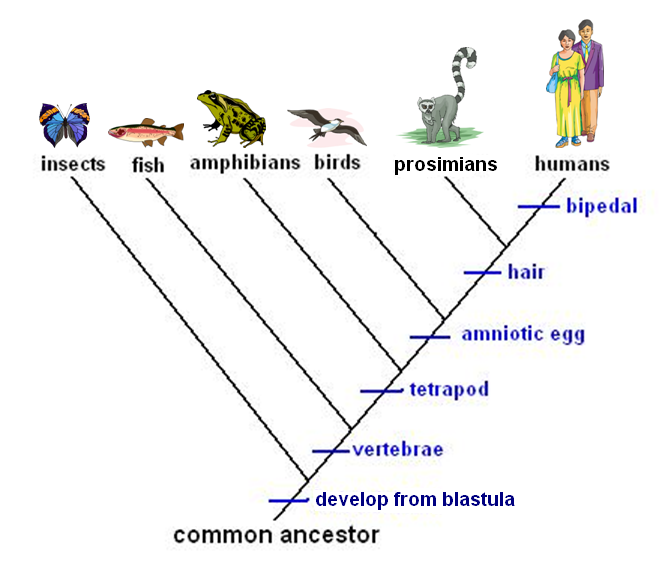
Which organisms pictured on the cladogram have hair?
a)
prosimians only
b)
prosimians and humans
c)
humans only
d)
prosimians and birds
6.

Members of this kingdom are always multicellular and heterotrophic.

a)

Plantae

b)

Protista

c)

Animalia

d)

Achaebacteria

7.
What kingdom do unicellular, prokaryotic organisms that live in extreme environments?
a)
Animal
b)
Archaebacteria
c)
Eubacteria
d)
Plant
8.

I am prokaryotic and am found everywhere that's not extreme. What kingdom do I belong to?

a)

Eubacteria

b)

Archaebacteria

c)

Fungi

d)

Protista

9.

I'm motile (I can move) and have no cell walls. What kingdom do I belong to?

a)

Animalia

b)

Archaebacteria

c)

Eubacteria

d)

Plantae

10.
This organism is multicellular, heterotroph, that has a cell wall made of chitin.  What kingdom does it belong in?
a)
fungi
b)
plantae
c)
animalia
d)
eubacteria
11.
This organism is found in pond water.  It has a nucleus, is microscopic, unicellular and can perform photosynthesis.  What kingdom does it belong in?
a)
protista
b)
eubacteria
c)
archaebacteria
d)
plantae
12.
This organism is multicellular, autotroph, that has a cell wall made of cellulose.
a)
animalia
b)
plantae
c)
fungi
d)
eubacteria
13.
What do viruses need to reproduce?
a)
they need genetic material
b)
They need a host cell
c)
They need  bacteria
d)
They need insulin
14.
Reasons that viruses are considered to be nonliving is because
a)
They are not cellular
b)
They cannot reproduce on their own
c)
They cannot make proteins
d)
all of the above
15.
Viruses are...
a)
prokaryotic
b)
eukaryotic
c)
non-living
d)
endospores
16.
Viruses 
a)
have many cells
b)
are misfolded proteins
c)
are a protein coat around genetic material
d)
endospores
17.

Modern Classification (Phylogeny) adds what to Linnaeus's taxonomic criteria?

a)

evolutionary relationships & DNA (biochemical characters)

b)

habitat type

c)

fewer categories than Linnaeus

d)

a naming system called binomial nomenclature

18.

Members of these 2 kingdoms can never make their own food:

a)

animal & fungi

b)

animal & plant

c)

fungi & protist

d)

archaebacteria & eubacteria

19.

Which of the following is NOT a domain of life?

a)

Prokarya

b)

Eukarya

c)

Eubacteria

d)

Archaebacteria

20.
What is the purpose of a dichotomous key?
a)
to find a common ancestor
b)
to show the evolution of organisms
c)
to show relationships between organisms
d)
to identify organisms
21.
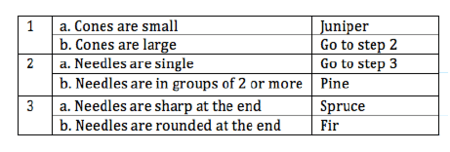
A dichotomous key for trees is provided. Hikers found a tree that has large brown cones and single sharp needles. What species of tree have the hikers found?
a)
Juniper
b)
Pine
c)
Spruce
d)
Fir
22.
A dichotomous key for insects is given. To what order does an insect with two pairs of scaly wings belong?
a)
Coleoptera
b)
Heteroptera
c)
Diptera
d)
Lepidoptera
23.
All bacteria have DNA. 
a)
true
b)
false
24.
Plants and animal cells both have a nucleus.
a)
True
b)
False
25.

Halophiles are organisms that are able to grow and live in extreme salty environments. Which DOMAIN are halophiles in?

a)

archaebacteria

b)

archaea

c)

bacteria

d)

eubacteria

26.

This organism is in DOMAIN EUKARYA. It is UNICELLULAR. Although they do NOT have cell walls, they do HAVE CHLOROPLASTS. Which kingdom is this organism found in?

a)

Bacteria

b)

fungi

c)

archaebacteria

d)

Protista

27.
Which applies to members of the kingdom FUNGI?
a)
They have cell walls of chitin
b)
They have no cell walls or chloroplasts
c)
They include slime molds and giant kelp
d)
They include mosses and ferns
28.
Which applies to members of the kingdom ANIMALIA?
a)
They have cell walls of chitin
b)
They have no cell walls or chloroplasts
c)
They include slime molds and giant kelp
d)
They include mosses and ferns
29.
Which applies to members of the kingdom PROTISTA?
a)
They have cell walls of chitin
b)
They have no cell walls or chloroplasts
c)
They include slime molds and giant kelp
d)
They include mosses and ferns
30.
Which is TRUE about members of the domain Archaea?
a)
They are unicellular.
b)
They are eukaryotes.
c)
They lack cell walls.
d)
They lack cell membranes.
31.

According to this image, which two domains of life are most related?

a)

Bacteria & Archaea

b)

Archaea & Eukarya

c)

Eukarya & Bacteria

32.

Which group of animals on this tree are most closely related to birds?

a)

Saurischian dinosaurs

b)

Ornithischian dinosaurs

c)

Crocodiles

d)

None of these are related to birds

33.

According to this tree, which of these animal phyla are most closely related?

a)

Arthropoda & Mollusca

b)

Arthropoda & Chordata

c)

Chordata & Mollusca

34.

Where is the alligator and T. rex's common ancestor?

a)

Point A

b)

Point B

c)

Point C

d)

Point D

35.

The diagram below represents possible genetic relationships between groups of organisms.

Which statement is a valid conclusion that can be drawn from the diagram?

a)

Insects are more complex than mammals.

b)

Earthworms and sea stars have a common ancestor.

c)

Snails appeared on Earth before corals.

d)

Sponges were the last new species to appear on Earth.

36.

What is the purpose of a cladogram?

a)

To map the ancestral relationships and shared traits of different organisms.

b)

To trace the inherited traits of a single species over time.

c)

To check the likelihood of an offspring having a particular trait.

d)

To monitor mutations that arise among different populations.

37.

Which letter represents the most recent common ancestor of sponges and mushrooms?

a)

A

b)

B

c)

C

d)

D

e)

E

38.

According to the diagram, what is the common ancestor of ALL organisms on the phylogenetic tree?

a)

B

b)

C

c)

D

d)

E

39.

Using the diagram, is organism 4 MORE closely related to organism 3 or 5?

a)

3

b)

5

40.

According to the diagram, what was the last common ancestor of organisms 2 and 3?

a)

A

b)

B

c)

C

d)

D

41.

What is the common ancestor of Letters A, B, C, D, E?

a)

1

b)

2

c)

3

d)

4

42.

Of the choices listed, which species is the oldest?

a)

H

b)

D

c)

C

d)

A