wayground logo

Free Printable Worksheets

Font size

S
M
L
XL
Worksheets

Biology Spring Milestone Retest Tutorial 2022

Total questions: 62

Worksheet time: 1hrs 2mins

Name
Class
Date
1.
The function of the plasma membrane is....
a)
to regulate what enters and leaves the cell.
b)
fight bacteria and viruses that enter the cell.
c)
provide rigid support and protection to the cell.
d)
make sure each cell can move
2.

Active transport is the movement of large materials across a cell membrane from ______ to ______ concentration

a)

high to low

b)

low to high

c)

high to high

d)

low to low

3.

Active transport across a cell membrane from low to high concentration, requires

a)

energy (ATP)

b)

no energy

c)

water

d)

oxygen

4.
What is diffusion?
a)
when molecules move from a low concentration to a high concentration 
b)
when molecules move from a high concentration to a low concentration.
c)
no movement 
d)
molecules move everywhere
5.
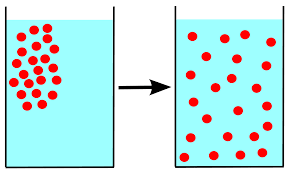
The picture below is an example of _________________.
a)
osmosis
b)
isotonic
c)
diffusion
d)
active transport
6.
Movement of molecules from an area of high concentration to an area of low concentration is
a)
diffusion 
b)
passive transport
c)
osmosis
d)
all of the above
7.

Which group of animals on this tree are most closely related to birds?

a)

Saurischian dinosaurs

b)

Ornithischian dinosaurs

c)

Crocodiles

d)

None of these are related to birds

8.

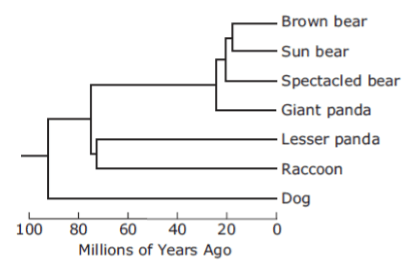
Who is the closest relative to the brown bear?

a)

Giant panda

b)

Dog

c)

Lesser panda

d)

Sun bear

9.
order of replication
a)
3, 4, 2, 1
b)
3, 1, 4, 2
c)
2, 1, 4, 3
d)
3, 4, 1, 2
10.
Which sequence of DNA bases would pair with this partial strand
CAT TCA CTG
a)
ATG TGA CAG
b)
TAC ACT GTC
c)
GTA AGT GAC
d)
CAT TCA CTG
11.
What is the purpose of photosynthesis?
a)
make glucose
b)
make ATP
c)
make light
d)
release carbon dioxide
12.
In which way are photosynthesis and cellular respiration different?
a)
Cellular respiration stores ATP, while photosynthesis releases ATP.
b)
Cellular respiration produces oxygen, while photosynthesis uses oxygen.
c)
Photosynthesis releases energy, while cellular respiration stores energy.
d)
Photosynthesis used carbon dioxide, while cellular respiration produces carbon dioxide.
13.
What are the reactants (what's needed) for photosynthesis?
a)
glucose and oxygen
b)
light, water, and carbon dioxide
14.
What are the products (what's made) during photosynthesis?
a)
glucose and oxygen
b)
water, light, and carbon dioxide
15.

Which viral cycle takes the longest to show symptoms?

a)

Lysogenic

b)

Lytic

16.

If Jason is feeling symptoms relatively quickly from a virus that he contracted, the virus must be in the

a)

lytic cycle

b)

lysogenic cycle

c)

the capsid bursts

d)

the virus becomes dormant

17.
Which statement best describes the importance of sexual reproduction?
a)
sexual reproduction produces variation in offspring
b)
sexual reprosuction provides regeneration of body parts
c)
sexual reproduction occurs between individuals of the same species
d)
sexual reproduction produces offspring that are identical
18.
Which of the following cell types is formed by meiosis?
a)

skin cells

b)

Gametes (sex cells such as sperm and egg)

c)
blood cells
d)
muscle cells
19.
Which of the following statements correctly describes meiosis?
a)

Meiosis does not occur in reproductive cells. (gametes)

b)

The cells produced at the end are identical to the parent cell and to each other

c)

the cells produced at the end contain half the # of chromosomes of the parent cell

d)
cells divide only once during meiosis
20.
Meiosis is the key process in the production of_________.
a)

somatic cells (body cells such as skin, muscle, blood)
b)
RNA
c)
white blood cells
d)
gametes
21.
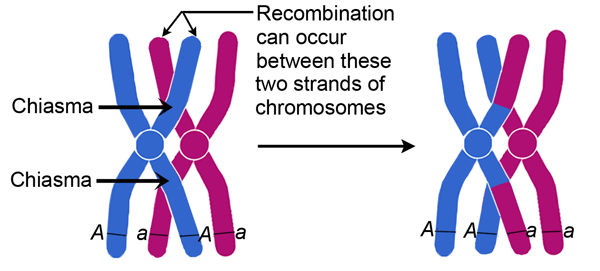
This image shows chromosomes during Prophase 1. Which of the following correctly describes the process shown?
a)
segregation of sister chromatids
b)
condensation and segregation of alleles
c)
mutationin which the DNA content of the gene is altered
d)

crossing - over in which alleles are exchanged, thus increasing genetic variety
22.
Which biomolecule is responsible for insulation and LONG term energy storage?
a)
Proteins
b)
Nucleic Acids
c)
Lipids
d)
Carbohydrates
23.
What is the function of a carbohydrate?
(Why do I need this before a workout?)
a)
Quick energy
b)
Movement
c)
Stores genetic information
d)
Speeds up reactions
24.
What is the function of RNA and DNA?
a)
Storing energy
b)
Storing sugars
c)
Storing genetic material
d)
Storing cells
25.
Which is NOT a function of Protiens?
a)
Chemical reactions of enzymes
b)
Short term energy
c)
Immune responce
d)
cell signaling 
26.
Which of these provides long term energy?
a)
nucleic acid
b)
carbohydrates
c)
proteins
d)
lipids
27.
Cells spend the majority of their lives in
a)

Interphase (G1, S, G2)

b)
Mitosis
c)
Synthesis 
d)
Gap 2
28.
What occurs during G1?
a)
Checkpoint after S phase
b)
Chromosomes line up at the equator.
c)
The cell grows and develops.
d)
Spindle fibers separate chromosomes to opposite poles of the cell. 
29.
Interphase has 3 stages; G1, S, and G2.  What happens during synthesis?
a)
Cells grow and carry out normal functions
b)
Cells copy organelles and prepare for a critical checkpoint
c)
The cell splits into two new daughter cells
d)
The cell makes a copy of its DNA
30.

The immune system fights diseases. The circulatory system pairs with the immune system because ___.

a)

blood is made in the bones.

b)

plasma carries nutrients.

c)

red blood cells carry oxygen.

d)

white blood cells fight infection.

31.

What 2 systems: Absorb and deliver the digested nutrients to the cells

a)

Digestive and muscular

b)

Muscular and lymphatic

c)

Digestive and circulatory

d)

Nervous and skeletal

32.

What 2 systems: Allow organs to contract and push food through

a)

Muscular and Skeletal

b)

Excretory and Muscular

c)

Endocrine and Muscular

d)

Muscular and Digestive

33.

Olympic sprinters undergo increased heart and breathing rates while competing. Which of the following best describes the interactions among systems of a sprinter?

a)

Respiratory system is working to obtain more oxygen, while the circulatory system works to transport the oxygen to the muscles.

b)

The digestive system takes in more glucose, while the excretory system removes waste.

c)

The endocrine system transports ATP to the nervous system

d)

Excretory system removes waste from the digestive system to reduce weight so the sprinter can run faster

34.
Organisms with differences/variations that are helpful will ______________________
a)

live longer and successfully mate more often

b)
become extinct
c)
show no change
d)

have trouble finding a mate

35.

What can happen to a population over time if some of the individuals have a trait that gives them an advantage?

a)

The appearance of the trait will become less frequent in the population

b)
The population will become extinct
c)

The appearance of the trait will become more frequent in the population

d)

Individual organisms will change their traits to have an advantage

36.
Reasons that viruses are considered to be nonliving is because
a)
They are not cellular
b)
They cannot reproduce on their own
c)
They cannot make proteins
d)
all of the above
37.
What do viruses need to reproduce?
a)
they need genetic material
b)
They need a host cell
c)
They need  bacteria
d)
They need insulin
38.
What mutation has occurred here? 
T-G-A-C-C-A
T-G-A-G-C-A
a)
Substitution
b)
Deletion
c)
Insertion
d)
Frameshift 
39.
DNA molecule segment is : TTACGCAAG
The mutated DNA segment is TTCGCAAG. This is an example of ___ mutation.
a)
Substitution
b)
Deletion
c)
Insertion
d)
Inversion
40.

When cells go through mitosis repeatedly without entering interphase, this results

a)

arthritis

b)

cancer

c)

mutation

d)

diabetes

41.
What determines the code, or information, of a DNA molecule?
a)
the shape (structure) of the nitrogen bases
b)
the order (sequence) of the nitrogen bases
c)
the color of the nitrogen bases
d)
the frequency (number) of nitrogen bases
42.
How can a person's muscle cells have the same exact DNA sequences as their nerve cells even though the look and perform completely different?
a)
The two different cells become mutated
b)
The proteins expressed in each cell are different
c)
They actually have different DNA in the two types of cells.
d)
The genome of the different cells changes
43.
The purpose of cellular respiration is to produce ?
a)

energy (ATP)

b)
oxygen
c)
sugar
d)
protein
44.

What is the organelle where cellular respiration occurs to produce ATP?

a)
nucleus
b)
mitochondria
c)
ribosomes
d)
lysosomes
45.
What goes in box 1
a)
AABb
b)
AABB
c)
aabb
d)
AaBb
46.
What goes in box 3
a)
Aabb
b)
AABB
c)
AAbb
d)
aaBb
47.

What happens when enzymes are heated to a high temperature or extreme pHs?

a)
The enzymes die.
b)
The shapes of the enzyme are altered or denatured
c)
The enzymes' amino acid sequence changes.
d)
The enzymes remain the same
48.

What is the difference between mRNA and DNA?

a)

DNA is a double helix, mRNA is a single strand

b)

DNA has deoxyribose sugar, and mRNA has ribose sugar

c)

DNA uses Thymine, and mRNA uses Uracil

d)

All of the above

49.
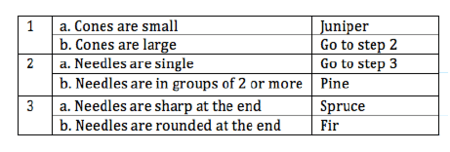
A dichotomous key for trees is provided. Hikers found a tree that has large brown cones and single sharp needles. What species of tree have the hikers found?
a)
Juniper
b)
Pine
c)
Spruce
d)
Fir
50.
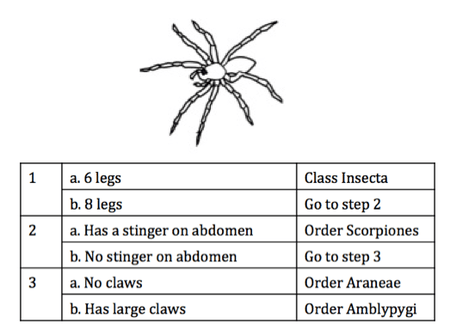
An illustration and a dichotomous key are given. What is the correct classification for this organism?
a)
Class Insecta
b)
Order Amblygygi
c)
Order Araneae
d)
Order Scorpiones
51.
A dichotomous key for insects is given. To what order does an insect with two pairs of scaly wings belong?
a)
Coleoptera
b)
Heteroptera
c)
Diptera
d)
Lepidoptera
52.

Which cell does NOT have a nucleus?

a)

Prokaryote

b)

Eukaryotes

53.
Which of the following is found inside a prokaryote?
a)
cytoplasm
b)
DNA
c)
ribosomes
d)
all of these
54.
What type of cell has a nucleus? 
a)
eukaryotic
b)
prokaryotic 
55.

Which cells contain Ribosomes?

a)

Prokaryotic

b)

Eukaryotic

c)

Both

56.

Which cells have cytoplasm?

a)

Prokaryotic

b)

Eukaryotic

c)

Both

57.

Which type of cell is surrounded by a cell membrane?

a)

Prokaryotic

b)

Eukaryotic

c)

Both

58.

This organelle turns radiant energy into sugar. This is where photosynthesis occurs.

a)

cell wall

b)

chloroplast

c)

cell membrane

d)

nucleus

59.

How could you describe the relationship between two populations of squirrels that cannot successfully produce offspring together?

a)

they are in the same family but different orders.

b)

They are in the same class, but different phyla.

c)

The are the same genus,but different species.

d)

They are in the same species but different kingdoms.

60.

Will mutations that occur in somatic (body) cells be passed down to the offspring of an organism that reproduces sexually?

a)

Yes, because all cells of the parent are used to create the offspring.

b)

Yes, because 100% of the offspring's genetics come from the parent with the mutation.

c)

No, because somatic cells are not used to create offspring.

d)

No, because the genetics of the parent without the mutation will dominate the mutated cells.

61.

How is the capsid of a virus similar to the cell membrane of cells?

a)

Both code for amino acids used to make proteins.

b)

Both transform energy.

c)

Both transport nutrients.

d)

Both protect nucleic acids (DNA or RNA) that is inside.

62.

What characteristics could be used to differentiate a fungus from a plant?

a)

Only plants can be multicellular. All fungi are unicellular.

b)

Only fungi cells have a cell wall.

c)

Only plants perfrom photosynthesis. Fungi are decomposers.

d)

Plants only reproduce asexually.