wayground logo

Free Printable Worksheets

NEW

Font size

S
M
L
XL
Worksheets

Evolution, Classification, Geologic Time

Total questions: 60

Worksheet time: 5hrs 0mins

Name
Class
Date
1.

Mammals are a dominant group in which era?

a)

Cenozoic

b)

Mesozoic

c)

Paleozoic

d)

Cambrianozoic

2.

How old do Paleontologists believe the Earth is?

a)

2019 years old

b)

3.6 billion years old

c)

4.6 billion years old

d)

4.6 million years old

3.

What type of event usually marks the end of an Era

a)

A Mass Extinction

b)

A Quinceanera

c)

An earthquake

d)

A Volcanic Eruption

4.

What are the four eras in order from OLDEST to NEWEST?

a)

Pre-Cambrian, Paleozoic, Mesozoic, Cenozoic

b)

Pre-Cambrian, Mesozoic, Paleozoic, Cenozoic

c)

Cenozoic, Mesozoic, Paleozoic, Pre-Cambrian

d)

Mesozoic, Pre-Cambrian, Cenozoic, Paleozoic

5.

Which era is the most recent, the one that we are currently in?

a)

Mesozoic

b)

Paleozoic

c)

Cenozoic

d)

Precambrian

6.

90% of Earth’s history occurred during which era?

a)

Precambrian

b)

Paleozoic

c)

Mesozoic

d)

Cenozoic

7.

The first word in a scientific name is the

a)

species

b)

phylum

c)

genus

d)

class

8.

The scientist who came up with the current classification system

a)

Darwin

b)

Newton

c)

Mendel

d)

Linnaeus

9.
The 8 levels of classification, broadest to most specific.
a)
Domain, Genus, Family, Order, Class, Phylum, Kingdom, Species
b)
Domain, Species, Kingdom, Genus, Phylum, Family, Class, Order
c)
Domain, Kingdom, Phylum, Class, Order, Family, Genus, Species
d)
Order, Kingdom, Species, Domain, Phylum, Family, Class, Genus
10.

Prokaryotes do not have a nucleus or membrane bound organelles.

a)

True

b)

False

11.
An example of an unicellular organism would be:
a)
monkey
b)
bacteria
c)
spider
d)
human
12.
What is the term for a feature that allows an organism to survive in its environment?
a)
adaptation
b)
variation
c)
homologous structure
d)
vestigial structure
13.
What is the process of which humans breed organisms for certain traits?
a)
artificial selection
b)
descent without modification
c)
inheritance of acquired characteristics
d)
natural selection
14.
When an organism completely dies out, it is called.....
a)
Adaption
b)
Extinction
c)
Fossilization
d)
Mutation
15.
Two organisms that are closely related would have
a)
very similar DNA sequence
b)
exactly the same DNA sequences
c)
no proteins in common
d)
completely different DNA sequence
16.

The two domains composed of only unicellular organisms are:

a)

protista and plantae

b)

eukarya and bacteria

c)

archaea and bacteria

d)

archaea and eukarya

17.

A Human hand and a whale flipper have similar bone structures, but have different functions. These are examples of:

a)

Coevolution

b)

Homologous structures

c)

Analogous Structures

d)

Freak Biology

18.

A Tyrannosaurus Rex and a Mountain Lion have similar features, but are not descended from a common ancestor.  This is an example of:

a)

Homologous structures

b)

Habitat sharing

c)

Analogous structures

d)

Shared derived characters

19.

HIV and AIDS are caused by:

a)

DNA virus

b)

Retrovirus

c)

Prion

d)

Bacteria

20.

We know that viruses are not alive because:

a)

They are not cellular

b)

They cannot reproduce independently

c)

They cannot obtain or use energy

d)

All of the Above

21.

 A virus is unique in that it:

a)

Contains DNA.

b)

Contains RNA

c)

Cannot reproduce outside a living host cell.

d)

Can cause disease

22.

A prophage is made of:

a)

Bacteriophages

b)

Carbohydrates

c)

Capsid proteins

d)

Bacteria and virus genetic material

23.

Which of the following structures or processes do viruses and prokaryotes have in common?

a)

Ribosomes

b)

Cytoplasm

c)

Mitosis

d)

Nucleic Acids

24.

The work of these scientists in the 1950s showed that organic substances such as amino acids could have been produced on primitive earth.

a)

Miller/Urey

b)

Watson

c)

Darwin

d)

All of the above

25.

The early earth atmosphere is thought to have been composed of all but which of the following:

a)

Carbon Dioxide

b)

Nitrogen

c)

Oxygen

d)

Methane

26.

Which of the following is considered by most biologists to be the most accurate in supporting the theory of evolution?

a)

fossils

b)

embryology

c)

DNA sequencing

d)

genetic equilibrium

27.

Birds have strong beaks for breaking apart seeds. Their beaks are an example of:

a)

the struggle for existence

b)

a tendency towards perfection

c)

the inheritance of acquired traits

d)

an adaptation.

28.

Why did oceans not exist on Earth nearly 4 billion years ago?

a)

No water molecules were present.

b)

Water remained a gas because Earth was very hot.

c)

Water existed as ice because Earth was very cold.

d)

There was no oxygen gas in the atmosphere

29.

Viruses are living organisms

a)

FALSE

b)

TRUE

30.
Which viral life cycle allows viral genetic material to lay dormant while the host cell reproduces?
a)
lytic
b)
mitosis
c)
lysogenic
d)
S phase
31.
Is a virus considered living or non-living?
a)
Living
b)
Non-Living
c)
Neither
32.
Which can be treated with antibiotics?
a)
Virus
b)
Bacteria
c)
Mutagen
d)
Parasite
33.

Who is most closely related to Taxidea taxus?

a)

Lutra lutra

b)

Panthera pardus

c)

Canis latrans

d)

Canis lupus

34.

Which group of animals on this tree are most closely related to birds?

a)

Saurischian dinosaurs

b)

Ornithischian dinosaurs

c)

Crocodiles

d)

None of these are related to birds

35.

If a plant has vascular tissue but no seeds, which of the four plant groups here would it fall into?

a)

Ferns

b)

Cone-bearing plants

c)

Mosses

d)

Flowering plants

36.

According to this tree, which of these animal phyla are most closely related?

a)

Arthropoda & Mollusca

b)

Arthropoda & Chordata

c)

Chordata & Mollusca

37.

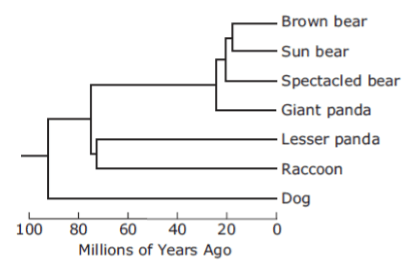
Who is the closest relative to the brown bear?

a)

Giant panda

b)

Dog

c)

Lesser panda

d)

Sun bear

38.
Structures with no function that are remnants of an organism’s evolutionary past are
a)
Not visible organisms.
b)
Vestigial
c)
Young in origin
d)
Useful to the organism
39.
These structures shown are ________.
a)
Homologous structures
b)
Analogous structures
c)
Structural adaptation
d)
Functional adaptation
40.
Which layer is the oldest and youngest?
a)
C and B
b)
C and E
c)
D and E
d)
A and B
41.
Which era is the longest?
a)
Cenozoic
b)
Cambrian
c)
Precambrian
d)
Phanerozoic
42.

Preserved remains of plants and animals from the remote past are called?

a)

Sedimentary rocks

b)

Radioactive dating

c)

Decayed organisms

d)

Fossils

43.
Scientists are studying the evolutionary history of a group of plants in the United States, and they developed an evolutionary tree, as shown below.Which statement can be inferred from the evolutionary tree?
a)
Species 1 is most closely related to Species 8.
b)
Species 2 is most closely related to Species 3.
c)
Species 3 is most closely related to Species 7.
d)
Species 5 is most closely related to Species 6.
44.
Which species’ DNA is most similar to the DNA of the toothed whale? 
a)
Hippopotamus 
b)
Baleen Whale
c)
Grazing Mammals
d)
Camels
45.

the smallest, most specific classification category

a)

Genus

b)

Phylum

c)

Order

d)

Species

46.

Which of the following is the correct order from broadest to smallest?

a)

Kingdom, Class, Order, Family, Genus, Species, Phylum

b)

Species, Genus, Family, Order, Class, Phylum, Kingdom

c)

Kingdom, Phylum, Order, Class, Family, Genus, Species

d)

Kingdom, Phylum, Class, Order, Family, Genus, Species

47.
The scientific name for water bear is Hypsibius dujardini.  What is its genus?
a)
Hypsibius 
b)
dujardini
c)
water 
d)
tardigrade
48.
The scientific name for water bear is Hypsibius dujardini.  What is its species?
a)
Hypsibius 
b)
dujardini
c)
water 
d)
tardigrade
49.
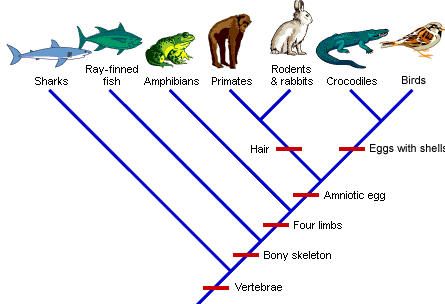
According to this cladogram, primates are most closely related to -
a)
Amphibians
b)
Rodents and rabbits
c)
Crocodiles
d)
Birds
50.
According to this cladogram, birds are LEAST related to -
a)
Amphibians
b)
Sharks
c)
Ray Finned Fish
d)
Crocodiles
51.
Which trait do only humans have, according to the cladogram?
a)
jaws
b)
mammary glands & hair
c)
terrestrial during all life stages
d)
opposable thumbs
52.
According to the cladogram, which organism is most distantly related to the human?
a)
crayfish
b)
rat
c)
perch
d)
frog
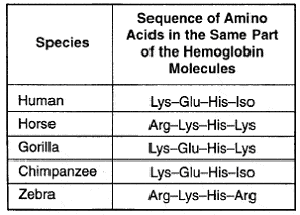
53.
You look at two species and see very similar amino acid sequences. What does this likely tell you?
a)
These are the same animal.
b)
These animals have a common ancestor.
c)
These animals are not likely related.
d)
These animals are likely becoming one species.
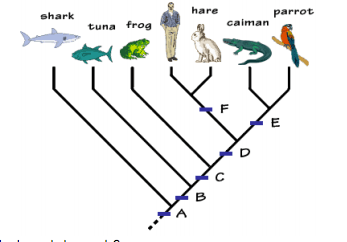
54.
On the cladogram, which organism is the closest relative of the human?
a)
Frog
b)
Hare
c)
Caiman
d)
Parrot
55.
The system of classification for organisms is called -
a)
taxonomy
b)
classification
c)
terraformy
d)
cladogram
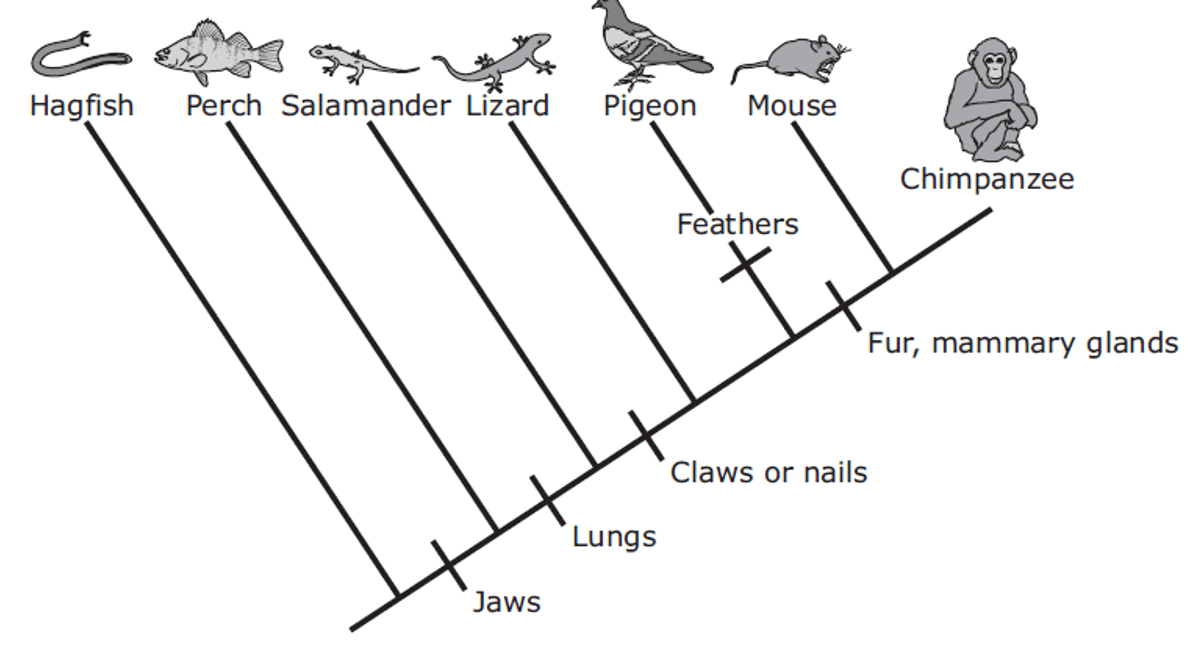
56.
All the animals to the right of the hagfish would have the common characteristic of -
a)
Fur
b)
Claws or nails
c)
Lungs
d)
Jaws
57.
What is the name of bird Z?
a)
Certhidea
b)
Geospiza
c)
Camarhynchus
d)
Platyspiza
58.
Which of these is a characteristic shared between Fungi and Plantae?
a)
Heterotrophic
b)
Mobile
c)
Prokaryotic
d)
Multicellular
59.

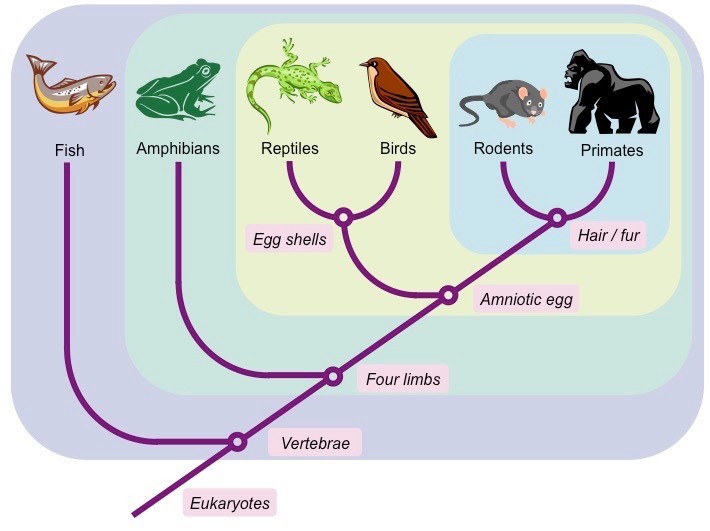
What characteristic distinguishes amphibians from birds and reptiles?

a)

Amniotic egg

b)

Egg shells

c)

Vertebrae

d)

Hair/fur

60.

What distinguishes zebras from from giraffes?

a)

un-branching horns (in males)

b)

even number of toes

c)

fur

d)

carnivorous teeth