
 Worksheets
Periodic Table
Total questions: 44
Worksheet time: 33mins
What are the vertical columns on the periodic called?
groups
periods
nonmetals
metals
metalloids
What do the vertical columns on the periodic table tell us?
The number of orbitals/energy levels/shells
The number of valence electrons (electrons on the outer most shell)
What are the horizontal rows on the periodic table called?
periods
groups
metals
nonmetals
metalloids
What do the horizontal rows on the periodic table tell us?
The number of orbitals/energy levels/shells
The number of valence electrons (the electrons on the outer most shell)

What group and period does this element belong in? *
period 1 and group 3
period 3 and group 1
period 2 and group 3
period 3 and group 2

How many valence electrons does the element have?
1
2
3
4
This element has two valence electrons and two energy levels?
Beryllium (Be)
Lithium (Li)
Zinc (Zn)
How many valence electrons and energy levels does (Pb) lead have?
4 valence electrons and 6 energy levels (orbitals)
6 valence electrons and 4 energy levels (orbitals)
5 valence electrons and 5 energy levels (orbitals)
5 valence electrons and 10 energy levels (orbitals)
what is the biggest group on the table
metals
nonmetals
metalloids
halogens
how many rows are on the table
4
5
6
7
how many groups/families are on the table
15
16
17
18
Group 1 elements are known as
halogens
noble gases
alkali metals
alkaline earth metals
what is the name of group number 2
transition metals
halogens
metalloids
alkaline earth metals
where are the metalloids found
far left, vertical
stair step/diagonal
far right horizontal
at the bottom
what group number are the halogens
18
1
2
17
what group number are the noble gases
17
18
14
15
what is the small group of elements called that include C,N,O
metals
nonmetals
metalloids
noble gases
an arrangement of the elements according to their atomic numbers so that elements with similar properties are in the same column and properties repeat from row to row
Periodic Table of Elements
Atomic Theory
Isotopes
Subatomic Particles
a row on the Periodic Table of Elements
family
period
row
isotope
Use your periodic table to find which element has 5 protons.
Lithium
Calcium
Boron
Neon
How many elements are in their liquid state at room temperature? (Use your periodic table on page 24)
1
2
12
28
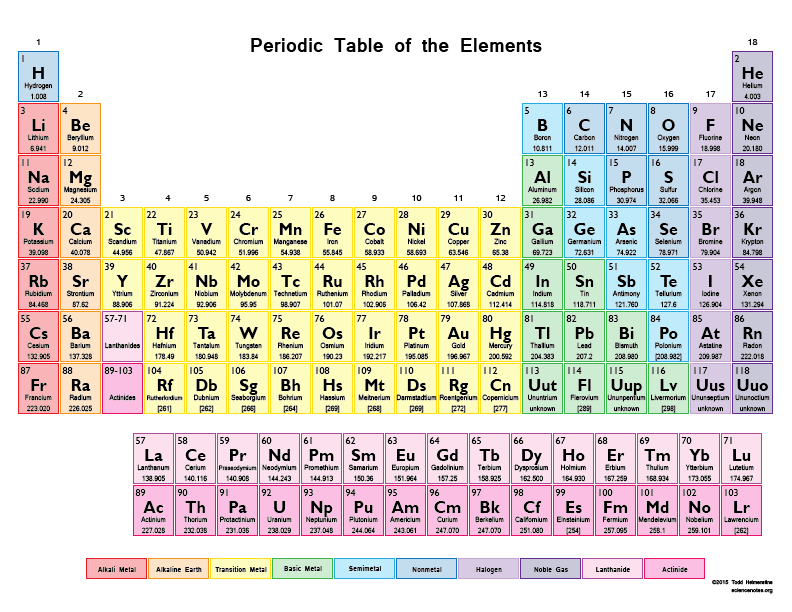
What is the atomic number of Barium, Ba? (enlarge the periodic table)
20
38
56
88
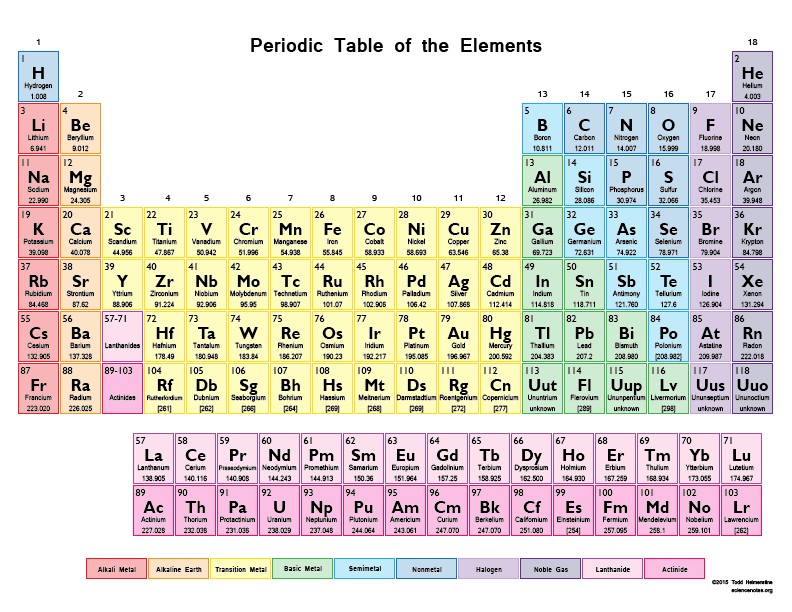
How many protons are in a sodium atom, Na? (tap to enlarge the periodic table)
Sodium has 1 proton.
Sodium has 3 protons.
Sodium has 11 protons
Moseley

atomic number


"The repeating physical and chemical properties of the elements are periodic functions of their atomic numbers." This is known as the:
law of properties
rule of characteristics
periodic law
Moseley's rule
Moseley changed the periodic table by
ordering by atomic mass
adding noble gases
naming the groups
ordering by atomic number
Elements in group 2 have _______ valence electrons.
1
2
3
6
Elements of the __________ react violently when exposed to water.
alkali metals
alkaline earth metals
halogens
noble gases
The elements in group 17 are known as the
alkali metals
alkaline earth metals
halogens
noble gases
Group 18 elements are called the
alkali metals
alkaline earth metals
halogens
noble gases
Elements in this group have filled valence shells and are unreactive.
alkali metals
alkaline earth metals
halogens
noble gases
Able to be drawn into a thin wire is known as being
ductile
malleable
luster
pullability
Characteristics of metals include (select all that apply)
shiny
dull
conductors of heat & electricity
ductile & malleable
Transition metals fall between groups
1-2
3-12
13-18

