Wayground logo

Free Printable Worksheets

Font size

S
M
L
XL
Worksheets

Heat, Light and Sound Marathon

Total questions: 52

Worksheet time: 26mins

Name
Class
Date
1.
A disturbance that travels through a medium as a longitudinal wave
a)
sound
b)
wavelength
c)
pitch
d)
frequency
2.
The number of wavelengths that pass a point each second
a)
frequency
b)
wavelength
c)
pitch
d)
amplitude
3.
Material (matter) through which a wave travels
a)
medium
b)
Doppler Effect
c)
sound
d)
pitch
4.

What is the term for how "high" or "low" a sound is; a deep voice versus a lifeguard whistle?

a)
pitch
b)
frequency
c)
sound
d)
medium
5.

A wave in which the vibration is in the same direction as that in which the wave is traveling is called a:

a)
longitudinal wave
b)
ocean wave
c)
transverse wave
d)
mechanical wave
6.
The part of a longitudinal wave where the particles of the medium are close together.
a)
rarefaction
b)
compression
c)
crest
d)
trough
7.
A part in a longitudinal wave where the particles are spread apart
a)
compression
b)
rarefaction
c)
crest
d)
trough
8.
The number of wavelengths that pass a point each second
a)
crest
b)
amplitude
c)
frequency
d)
pitch
9.

A disturbance that transfers energy from one place to another without transferring matter is called?

a)
wave
b)
trough
c)
pitch
d)
sound
10.
A reflected sound wave
a)
frequency
b)
pitch
c)
echo
d)
rarefaction
11.
A wave that requires a medium through which to travel
a)
mechanical wave
b)
chemical wave
c)
electromagnetic wave
d)
pitch
12.
Highest point of a wave
a)
crest
b)
trough
c)
wavelength
d)
frequency
13.

Some students observing a classroom device being used, noticed the below energy transformations. 

Electrical → Mechanical → Sound

Which device were the students most likely observing?

a)

A triple beam balance measuring an object’s mass.

b)

A pencil sharpener plugged into a wall outlet.

c)

A projector displaying a diagram on the screen.

d)

A working flashlight used to light up a dark corner.

14.

What is the distance in between two waves called?

Specifically between two peaks/crests/troughs?

a)

The Rarefaction

b)

Wavelength

c)

Amplitude

d)

Hydrophobic Tails

15.

This is a high frequency wave. Which part of the wave is "B"?

a)

Crest

b)

Peak

c)

Wavelength

d)

Trough

16.

What is transferred from place to place by waves?

a)

Particles

b)

Matter

c)

Energy

d)

Light

17.

If the amplitude of a wave increases, the energy of the wave:

a)

Increases

b)

Decreases

c)

Stays the same

d)

Hydrophobic tails

18.

If the amplitude of a sound wave decreases, we hear the sound get:

a)

Louder

b)

Quieter

c)

Higher Pitched

d)

Lower Pitched

19.

What can electromagnetic waves travel through (select all that apply)?

a)

Solids

b)

Liquids

c)

Gas

d)

Vacuums

20.

What can mechanical waves travel through (select all that apply)?

a)

Solids

b)

Liquids

c)

Gasses

d)

Vacuums

21.

If a wave has a greater frequency, what happens to the wavelength?

a)

Increases

b)

Decreases

c)

Stays the Same

d)

Superior Vena Cava

22.

The area of a longitudinal wave where particles are pushed close together are called:

a)

Compressions

b)

wavelength

c)

rarefaction

d)

semi-permeable membrane

23.

The areas of a longitudinal waves where particles are spread far apart from each other are called:

a)

Amplitude

b)

Frequency

c)

Rarefactions

d)

Compressions

24.

Sound waves can travel through a vacuum because they don't require particles.

a)

True

b)

False

25.

You can't hear sounds in outer space because there is no:

a)

Energy

b)

Light

c)

Medium

d)

Friends we made along the way

26.

Which are properties of a mechanical wave? [Select ALL that apply]

a)

can be longitudinal or transverse

b)

must have matter to move

c)

carries energy

d)

can move through space

27.
What is the transfer of heat by movement of liquids or gases?
a)
Radiation
b)
Convection
c)
Conduction
d)
Heat
28.

What are waves that can transfer heat and light through the vacuum of empty space?
a)
Electromagnetic waves
b)
Convection
c)
Conduction
d)
Heat
29.
What is a transfer of heat energy by electromagnetic waves?
a)
Radiation
b)
Convection
c)
Conduction
d)
Heat
30.
What is the transfer of heat by direct contact?
a)
Convection
b)
Electromagnetic waves
c)
Radiation
d)
Conduction
31.
What is a substance that does NOT conduct heat well?
a)
Conductor
b)
Insulator
c)
Convector
d)
Radiator
32.
What is a substance that DOES conduct heat well?
a)
Conductor
b)
Insulator
c)
Convector
d)
Radiator
33.

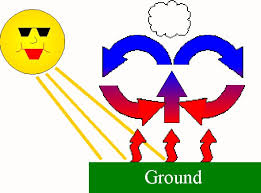
After heat from radiation warms the ground, warm air rises and the cool air sinks. This is...

a)
conduction
b)
convection
c)

Insulation

34.
Heat transfers from an area of ________temperature to an area of ______ temperature.
a)
high to low
b)
low to high
c)
high to high
35.
Warm water from the ocean moves to the north while cool waters moves to the south. This is an example of.. 
a)
Conduction
b)
Convection
c)
Radiation
36.
If an object has particles that are moving very quickly, the object 's temperature is probably _____.
a)
cold
b)
slow
c)
big
d)
hot
37.
You're holding hands with your best friend.  Your friend's hands are REALLY warm and yours are really cold.  After a few minutes, this has changed.  How might you explain what happened?
a)
The cold energy from your hand transferred to your friend's hand through conduction.
b)
The heat energy from your friend's hand transferred to your hand through conduction. 
c)
The cold energy from your hand transferred to your friend's hand through convection.
d)
The heat energy from your friend's hand transferred to your hand through convection.
38.

On a hot summer day, a student dropped an ice cream onto a park bench. Within minutes, the ice cream melted. Which method of heat transfer best describes the process the student observed?

a)
radiation
b)
melting
c)
conduction
d)
convection
39.

The wave of energy we can see is ___________

a)

visible light

b)

radio waves

c)

microwaves

d)

x-rays

40.

What is it called when light waves enter a substance?

a)

refraction

b)

reflection

c)

energy

d)

absorption

41.

When light bounces off something it is known as _____________

a)

reflection

b)

refraction

c)

light energy

d)

mechanical energy

42.

The definition of the word refract is __________

a)

to make warm

b)

to go through

c)

to bend

d)

to create energy

43.

What color of the rainbow has the longest wavelength?

a)

red

b)

blue

c)

green

d)

violet

44.

What type of wave is a sound wave?

a)

transverse

b)

mechanical

c)

longitudinal

d)

electrical

45.

When you change the pitch of the wave, the __________ of the wave is changing.

a)

wavelength

b)

amplitude

c)

crest

d)

trough

46.

The highest point of a wave is known as the ___________

a)

wavelength

b)

trough

c)

amplitude

d)

crest

47.

The louder the sound, the higher the ____________ of the wave.

a)

amplitude

b)

wavelength

c)

pitch

d)

compression

48.
Digital offers better clarity, but analog gives you richer quality.
a)
True
b)
False
49.
This is how analog signal looks like.
a)
True
b)
False
50.
An analog signal is sent in Discrete pulses in two states, on= 1 or off= 0.
a)
True
b)
False
51.
Is this digital or analog?
a)
Digital 
b)
Analog
52.
Is this digital or analog?
a)
Digital 
b)
Analog