
NEW
Font size
 Worksheets
Wave Unit Review
Total questions: 60
Worksheet time: 2hrs 0mins

A student placed a pencil in a cup of water. The pencil appears broken because light
always travels in a straight line.
bends when it passes through water.
makes the water in the glass evaporate.
reflects the pencil on the water's surface.


Based on the image, which medium has a larger index of refraction?
Medium 1 has a larger index of refraction.
Medium 2 has a larger index of refraction.
Both mediums have the same index of refraction.
Cannot be determined.
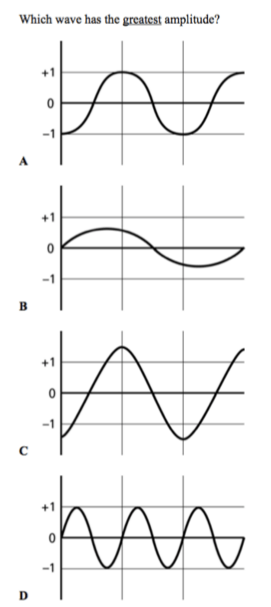
The amplitude measures from
Crest to Crest
Crest to Rest Position
Crest to wavelength
Crest to Trough
Wavelength measures from
Crest to Crest
Crest the Resting Point
Crest to Trough
Crest to Amplitude


Which property of the wave would change if you changed the amount of energy the wave had?
amplitude
frequency
wavelength
wave speed
If the wavelength of a wave increased, what would happen to the frequency?
decrease
increase
stay the same
The number of waves that pass somewhere in a second is:
amplitude
frequency
wavelength

Which wave has the greatest wavelength?
Red Wave
Orange Wave
Green Wave
Purple Wave

Which wave has the lowest wavelength?
Red
Violet
Orange
Green
A wave is a disturbance that transfers ________ from one place to another.
Matter
Mass
Energy
If a wave has a long wavelength, it will have __________ energy.
High
Medium
Low
If a wave has a high frequency, it will have __________ energy.
High
Medium
Low
If a wave has a high amplitude, it will have __________ energy.
High
Medium
Low

Which wave has a higher frequency?
A
B

True or False: Waves A and B have the same amplitude.
True
False

How is your eardrum like a real drum?
It produces sound.
It vibrates.
It is frequently struck by the bones in your middle ear.
It is hollow.
The auditory nerve sends signals to the ....
cochlea
ear drum
brain
Sound waves travel the fastest in
solid
liquid
gas
vacuum of empty space
Light waves travel the fastest in
solid
liquid
gas
vacuum of empty space
Which has the greatest energy among the colors in a rainbow?
green
orange
red
violet
Why does white light separate into different colors as it passes through a prism?
The colors are changed by addition.
This is an example of color by subtraction.
Different colored light has different wavelengths.
The side part of a prism only let certain colors of light pass through.
Which of the following is true about the relationship between frequency and energy?
The frequency of the color of light and energy are not related.
As the frequency of the color of light increases, its energy decreases.
As the frequency of the color of light decreases, the energy increases.
As the frequency of the color of light increases, the energy also increases.

Amplitude affects what aspect of light?
color
frequency
brighness
Why do some objects look white?
They reflect all wavelengths of visible light
Only white light hits the object
They relect white wavelengths of visible light
They absorb all wavelengths of visible light
Material that allows light to pass through allowing you to see "clearly" to the other side.
opaque
translucent
transparent
Why does an apple look red?
because it absorbs red light and reflects white light
because it absorbs red light waves and reflects the others
because it absorbs all colors of light
because it reflects red light waves and absorbs the others
Seen through a red filter, blue objects appear...
red
blue
green
black
white
Seen through a red filter, white objects appear...
red
blue
green
black
white

How does light behave when hitting this shirt?
Yellow is absorbed; all other colors are reflected.
Yellow is reflected; all other colors are absorbed.
All colors are absorbed, but yellow is refracted.
Yellow is scattered and all other colors are absorbed.

Which color(s) will be transmitted by this filter?
No colors are transmitted.
All colors but green
Only green

Which color will transmit through the filter?
Red only
Blue and Violet
Green
All colors
You and your father inspect an empty house with the hopes of buying it. You walk through the rooms talking to one another, and you notice that your voices and footsteps are echoing in the big, empty house. What causes the echo?
sound waves reflecting off smooth, hard surfaces throughout the house
sound waves moving around the large rooms
sound waves moving slowly through air
sound waves refracting around corners in the empty rooms

Sound waves travel as ________ waves.
Transverse
Longitudinal
Surface
Sound is made when a source of energy forces the matter around it to __________.
Vibrate
Amplitude
Stay still
Pitch
Sound waves CANNOT travel through which of these:
Paper
Milk
Outer space
The high pitch sound is


What best describes the doppler effect?
An apparent change in frequency of a wave due to the relative motion between a wave source and an observer
An apparent change in the amplitude of a wave due to the relative motion between a wave source and an observer.
Q1.If you press down on a piano key it makes a sound wave. Now you press the key harder, and it's louder. How did that change the sound wave?
The sound's amplitude and energy increased.
The sound's wavelength increased.
The sound's frequency increased.
The sound's energy would decrease
Light waves bouncing off a surface is known as?
Transmission
Refraction
Reflection
Absorption
This is the term that describes when light passes through matter.
Transmission
Transparent
Translucent
Opaque
This is when light changes direction slightly when it passes from one material to another.
Transmission
Reflection
Refraction
Absorption


the passage of light through a medium
transmission
reflection
diffraction
absorption

What is the relationship between frequency and wavelength?
high frequency --> short wavelength
high frequency --> long wavelength
low frequency --> short wavelength
there is no relationship
All electromagnetic waves travel through space at ?
the speed of sound
the speed of lightning bugs
the speed of light
the speed of light and sound

