
 Worksheets
BUSINESS ECONOMICS II
Total questions: 92
Worksheet time: 2hrs 51mins
What is the goal of a firm?
to make profits
to maximize profits
to maximize revenue
none of the above
MR =
MC
NC
WC
KFC
What is the profit maximizing condition?
MR = D
MR = MC
MC = D
D = Profits

The image above shows a firm making
Economic Profit
Economic loss
Breaking even
Shutting down
Which of the following could attract new firm to join an industry?
Normal profits
Economic losses
Economic profits
Accounting profits
A perfect competitive firm charges a price that is ____________.
different to other firms
higher than other firms
lower than other firms
similar to other firms
What is the goal of a firm?
to make profits
to maximize profits
to maximize revenue
none of the above
Under perfect competition , price is determined at ______
Equilibrium price of the industry
Equilibrium price of the firm
when MC = MR
All of these
Under perfect competition , each firm is a
Price maker
Price taker
Neither a and b
Both a and b
Which market has no competition?
perfect competition
oligopoly
imperfect competition
monopolistic competition
Which of the following describes a monopoly firm?
Single seller
Many sellers
Many substitutes
No barrier to entry
If a monopoly firm practices price discrimination the firm will _____________.
earn smaller profit
produce lower quantity than before price discrimination
charge a higher price when demand is inelastic and a lower price when demand is elastic
charge a higher price when demand is elastic and a lower price when demand is inelastic
What is the profit maximizing condition?
MR = D
MR = MC
MC = D
D = Profits
If a firm sells its output on a market that is characterized by many sellers and buyers, a homogeneous product, unlimited long-run resource mobility, and perfect knowledge, then the firm is a
monopolist
oligopolist
perfect competition
monopolistic competition
The demand curve for an individual firm within a perfectly competitive industry is
perfectly elastic
perfectly inelastic
downwards sloping
upwards sloping
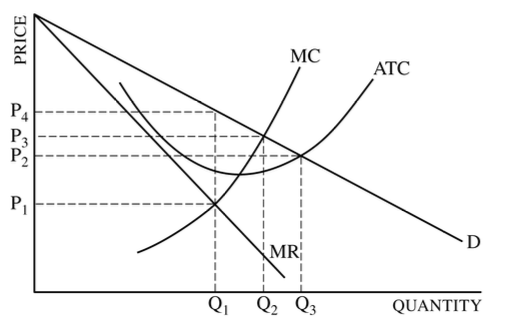
which one of these is NOT an assumption of the monopolistic competition?
there are many firms
the firms are relatively small
the products the firms supply are indistinguishable
In monopolistic competition...
Allocative efficiency is reached
Productive efficiency is reached
Profit is maximized
All of the answers are correct

Monopoly
Oligopoly
Oligopsony
Monopsony

Profit-Maximizing Price (Pf)
Profit-Maximizing Quantity (Qf)
Equilibrium Price (Pe)
Ultra Price (Up)

Profit-Maximizing Price (Pf)
Profit-Maximizing Quantity (Qf)
Equilibrium Quantity (Qe)
Equilibrium Cost (Ce)

Marginal Revenue = Demand = Average Revenue = Price
Marginal Revenue = Cost = Another Cost = Marginal Cost
Average Revenue = Price = Factor Cost = Profit-Maximizing Quantity
Demand = Supply = Quantity = Price
Revenue maximization level of output is at
MC = MR
MC = AR
MC = 0
MC = AC
What is not an advantage of a monopoly?
achieving economies of scale
high level of research and development
Producing a greater quantity at profit-maximizing level of output
higher prices and lower output
Which of the following is NOT a major barrier to entry for a monopolist?
control over a key input
patent protection
economies of scale
product differentiation
A single-price monopoly is characterized by a marginal revenue curve that is
upward sloping.
downward sloping.
horizontal.
vertical.
Monopoly power is high when
There are no close substitutes
There are no rivals
There is only a single seller of the product
All of the above
Patent right for invention leads to
Natural monopoly
Fiscal monopoly
Legal monopoly
Technical monopoly
In short run, the monopolists
Incurs a loss
Makes a profit
Break even
Any of the above

A
B
C
D
Which of the following describes a monopoly firm?
Single seller
Many sellers
Many substitutes
No barrier to entry
In the monopoly, the firm's marginal revenue curve is ________, while in a perfectly competitive market, each firm's marginal revenue curve is ________.
downward sloping; horizontal
horizontal; downward sloping
upward sloping; horizontal
downward sloping; upward sloping
The demand curve for a monopolistically competitive firm is downward sloping because:
the products produced by different firms are not identical
there are a small number of firms in the market
the product is produced by using scarce resources
it is easy for firms to enter or exit the market
One of the assumptions of monopolistic competition is that it is made of a ...... number of firms
large
small
moderate
In the short run, in monopolistic competition, the producers produce at a level of output that is...
productively efficient
allocatively efficient
profit maximizing
The product differentiation is also known as....
price competition
non-price competition
economics of scale
price discrimination
In the long run, in monopolistic competition, the producers will produce at a level of output .....
that is socially optimum
where AC is at a minimum
where MC=MR
In the long run all firms are making
abnormal profit
normal profit
losses
Short-run losses encourage firms to...
enter the industry
leave the industry
stay in the industry
What differs monopolistic competition from perfect competition?
product differentiation
long-run inefficiency
barriers to entry
the short-run profits and losses possibility
In monopolistic competition, the demand curve for a firm is....
relatively elastic
relatively inelastic
unit elastic
Which one of the following statements is not a characteristic of monopolistic competition?
Ease of entry into the industry
Product differentiation
A relatively large number of sellers
A homogenous product
In long-run equilibrium in a monopolistically competitive market, firms typically:
earn a normal profit
charge a price equal to marginal cost
earn an above-normal profit
charge a price equal to marginal revenue
What type of products will firms produce in monopolistic competition?
Firms produce significantly differentiated products
Firms produce slightly differentiated products
Firms produce homogenous products with one modification
Firms produce a variety of different products

A
B
C
D

The monopolistically competitive firm's profit-maximising output in the short run will be
0e
0f
0g
0h

In the short run, monopolistically competitive firm will make
a per unit loss of cd
a per unit loss of bd
a per unit profit of bc
a per unit profit of ad
Which of the following best describes an oligopistic market?
Many sellers with identical barriers to entry
Many sellers, each with a clearly differentiated product, and no barriers to entry
A few competing sellers with similar products and high barriers to entry
A few competing sellers of identical products and no barriers to entry
No competition among sellers and high barriers to entry
The demand curve for a monopolistically competitive firm is downward sloping because
there are a large number of firms
the product is produced by using scarce resources
the products produced by different firms are not identical
it is easy for firms to enter or exit the market
the marginal cost rises as output produced increases
What are the three parts of product cost?
direct materials
direct labor
manufacturing overhead
all of the above
It includes all other costs incurred in production but do
not become part of the product.
Manufacturing overhead
Direct labor
Direct materials
all of the above
Which of the following best describes an oligopoly?
many monopolistically competitive firms
a few firms sharing monopoly power
a former monopoly that has been broken up by the government
a government-granted franchise or monopoly
Collusion most frequently occurs in industries that are
oligopolistic
monopolistically competitive
monopolistic
perfectly competitive
If oligopolists engagein collusion and successfully form a cartel, the market outcome is
the same as if it were served by a monopoly
The same as if it were served by competitive firms
The same as if it were served by competitive firms
Known as Nash equilibrium
When an oligopolit individually chooses its level of production to maximize its profits, it produces an output that is
More than the level produced by a monopoly and less than the level produced by a competitive market
Less than the level produced by a monopoly and more than the level produced by a competitive market
Less than the level produced by a monopoly and more than the level produced by a competitive market
Less than the price charged by either a monopoly of a competitive market
An oligopoly is defined as a type of
market structure where ____ firms have
market control
one
many
three or more
two or more
How many firms are there in an oligopoly?
Many
Few
One
Eight
Although it ignores the time value of money, what is the most common method used in practice for capital budgeting?
internal rate of return
net present value
payback
accounting rate of return
Which of the following is always true with regard to the net present value (NPV) approach?
The NPV and the IRR approaches will always rank projects in the same order
The NPV and Payback approaches will always rank projects in the same approaches
If a project is found to be acceptable under the NPV approach, it would also be acceptable under the internal rate of return (IRR) approach
If a project is found to be acceptable under the NPV approach, it would also be acceptable under the payback approach
This is a form of analysis defined by calculating how long it will take for the asset to "earn back" the money you invested in purchasing it.
internal rate of return
net present value
payback method analysis
tax accounting
This answers the question, "How much is my asset worth right now?"
net present value
internal rate of return
discount rate
capital budgeting
When selecting the best project from a group of mutually exclusive projects, you should choose the project with the highest ________.
net present value
internal rate of return
accounting rate of return
payback period
A significant advantage of the net present value is that it _______.
fully considers time value of money
takes into consideration the yield to maturity
usus profit in the analysis
none of the above

You are analyzing two mutually exclusive projects of similar size and have determined the following data. Both projects have 5-year lives.
Based on the above details, which of the two projects would you accept?
Project A because it has the shortest payback period.
Both as they both have positive NPV.
Project B and reject Project A based on their NPV.
The advantage of the payback period is :
Adjustment for uncertainty of early CF
It is simple to calculate and use
Does not discount CF
None of the above
___________ is the planning process used to determine whether an organization long term investments
Capital Rationing
Capital Budgeting
Cost of Capital
Leverage

Which of the following projects has the shortest payback period?
B
A

Which of the following projects has the highest IRR?
B
A
Marginal cost is _____ cost.
Fixed
Variable
Semi-Variable
Stepped
Contribution is fixed cost + _____.
sales
variable
profit
margin of safety
BEP is a point where there,s no _____ no _____.
fixed cost, variable cost
profit, loss
sales, contribution
none of the above
A movie theater sells its tickets at lower prices to students and seniors. This is an example of:
Prompt payment
Price discrimination
Price skimming
Stability pricing
Which pricing strategy involves setting prices based on the costs for producing, distributing and selling the product plus a fair rate of return for its effort and risk?
Customer Value-Based Pricing
Competition-Based Pricing
Cost-Based Pricing
Dynamic Pricing
Which of the following Pricing Strategies describes when you take the cost of producing a good and add on a percentage of profit to arrive at the selling price?
Cost-plus pricing
Low pricing
Promotional Pricing
High pricing
What are 3 things pricing may be based on?
Product, promotion, and service
Cost, Demand, and Competition
Cost, Demand, and Customers
Price, Promotion, Professionalism

