wayground logo

Free Printable Worksheets

Font size

S
M
L
XL
Worksheets

1960 Review

Total questions: 85

Worksheet time: 7hrs 5mins

Name
Class
Date
1.

What is Kennedy's legislative agenda called?

a)

Great Society

b)

Fair Deal

c)

New Frontier

d)

Square Deal

2.

What did Kennedy's "flexible response" plan call for?

a)

a buildup of nuclear weapons

b)

a buildup of conventional weapons

c)

a reduction of military bases

d)

a reduction of the Special Forces

3.

Why did Kennedy cancel air support for the Bay of Pigs invasion?

a)

to keep US involvement a secret

b)

to avoid going to war with Cuba

c)

to withdraw his support for the overthrow of Castro's gov't

d)

to give the operation a better chance to succeed

4.

What was Johnson's legislative agenda called?

a)

Great Society

b)

New Frontier

c)

Fair Deal

d)

Square Deal

5.

When it came to the space race. What did Kennedy want the US to be the first to do?

a)

Put a man in space

b)

Put a woman into space

c)

Put a man on the moon

d)

Put a satellite into space

6.

What agency was a major part of Johnson's "War on Poverty"?

a)

Upward Bound

b)

Job Corps

c)

VISTA

d)

Office of Economic Opportunity

7.

Which Supreme Court case says suspects are entitled to an attorney, even if they cannot pay?

a)

Escobedo v Illinois

b)

Gideon v Wainwright

c)

Engel v Vitale

d)

Griswold v Connecticut

8.

Which program is government funded health insurance for the elderly?

a)

Medicaid

b)

Head Start

c)

Medicare

d)

VISTA

9.
President Johnson signed the Civil Rights Act in ...
a)
1919
b)
1929
c)
1964
d)
2015
10.
Johnson's domestic program was called
a)
New Deal
b)
Square Deal
c)
Welfare
d)
Great Society
11.
Which of the following was a major part of Johnson’s Great Society?
a)
a tax increase
b)
aid to foreign countries
c)
health care legislation
d)
reductions in antipoverty programs
12.
Which of the following best describes the major guiding principle behind the foreign policies of Kennedy and Johnson?
a)
to keep European nations out of Latin America
b)
to stifle Asian trade to benefit European trade
c)
to make peace with the Soviet Union
d)
to increase the number of immigrants from northern and western Europe
13.
Which of the following statements best connects Johnson’s Great Society to President Franklin Roosevelt’s New Deal?
a)
The Great Society had no connection to the New Deal
b)
The Great Society sought, like the New Deal, to improve the lives of Americans facing economic hardships.
c)
The Great Society was created to solve problems created by the New Deal
d)
The Great Society and the New Deal were both ideas of the Republican Party
14.
All of the following were goals of the Great Society EXCEPT
a)
the elimination of poverty
b)
political reform
c)
aid to public education
d)
medical care for older Americans
15.
Some critics complained that the Great Society programs
a)
gave the rich too many tax breaks
b)
gave the federal government too much power
c)
paid too little attention to health care
d)
favored rural over urban citizens
16.
This is a pre-school program  for low-income children
a)
Medicaid
b)
Kindergarten
c)
Head Start
d)
Medicare
17.
This provided low-cost medical insurance to people over 65
a)
Medicaid
b)
Medicare
c)
Head Start
d)
VISTA
18.
What did the Voting Rights Act of 1965 enable federal officers to do?
a)
register voters
b)
oversee the collection of poll taxes
c)
oversee programs to test voter literacy
d)
recount votes
19.
Before serving as vice-president, Johnson was 
a)
a senator
b)
a representative 
c)
a governor
d)
both A and B
20.
Johnson's domestic program was called
a)
New Deal
b)
Square Deal
c)
Welfare
d)
Great Society
21.
Unlike Kennedy, President Lyndon B. Johnson ( in his second term)
a)
had a strong mandate from the people
b)
was more concerned with foreign than domestic policy
c)
opposed civil rights legislation
d)
believed military commanders should use nuclear weapons
22.
Which of the following was a major part of Johnson’s Great Society?
a)
a tax increase
b)
aid to foreign countries
c)
health care legislation
d)
reductions in antipoverty programs
23.
Several of the important decisions of the Supreme Court under Chief Justice Earl Warren focused on
a)
medical care for the poor and elderly
b)
continuing segregation policies in American public schools
c)
declaring Great Society legislation unconstitutional
d)
protecting the constitutional rights of citizen accused of crimes
24.
Which of the following best describes the major guiding principle behind the foreign policies of Kennedy and Johnson?
a)
to keep European nations out of Latin America
b)
to stifle Asian trade to benefit European trade
c)
to make peace with the Soviet Union
d)
to increase the number of immigrants from northern and western Europe
25.
As a senator, Lyndon Johnson was famed for his ability to.....
a)
speak for hours at a time
b)
accomplish his political goals
c)
respond to the demands of big business
d)
write legislation
26.
Which of the following positions on today’s society would the President likely agree?
a)
If we are to achieve a Great Society we have to make progress in making sure that all Americans share in the wealth our society produces
b)
People living in poverty should not expect any help in trying to improve their economic situation
c)
A persons educational level is not related to their economic success
d)
We have achieved a Great Society
27.
Which of the following statements best connects Johnson’s Great Society to President Franklin Roosevelt’s New Deal?
a)
The Great Society had no connection to the New Deal
b)
The Great Society sought, like the New Deal, to improve the lives of Americans facing economic hardships.
c)
The Great Society was created to solve problems created by the New Deal
d)
The Great Society and the New Deal were both ideas of the Republican Party
28.
Johnson sent marines into the Dominican Republican in 1965 in order
a)
seize control of the government
b)
protect American citizens
c)
support the rebel army
d)
oversee democratic elections
29.
All of the following were goals of the Great Society EXCEPT
a)
the elimination of poverty
b)
political reform
c)
aid to public education
d)
medical care for older Americans
30.
Some critics complained that the Great Society programs
a)
gave the rich too many tax breaks
b)
gave the federal government too much power
c)
paid too little attention to health care
d)
favored rural over urban citizens
31.
This is a pre-school program  for low-income children
a)
Medicaid
b)
Kindergarten
c)
Head Start
d)
Medicare
32.
This provided low-cost medical insurance to people over 65
a)
Medicaid
b)
Medicare
c)
Head Start
d)
VISTA
33.
What did the Voting Rights Act of 1965 enable federal officers to do?
a)
register voters
b)
oversee the collection of poll taxes
c)
oversee programs to test voter literacy
d)
recount votes
34.
Which of the following was not one the programs LBJ started under the "Great Society"?
a)
National Youth Administration
b)
Head Start
c)
Extended Medicare
d)
Jobs Corp
35.
Which of the following groups was intended to benefit the most from the Great Society programs?
a)
Minorities and the poor
b)
White, middle-class families
c)
Farmers and laborers
d)
Businessmen
36.
What kind of society did President Lyndon B. Johnson envision when he created the Great Society programs?
a)
one that ensured access to justice, education, decent housing, and health care for all Americans
b)
on that emphasized that all people are equal only in the eyes of God
c)
one in which extremism in the defense of liberty is encouraged 
d)
one that made separate schools for black and white children truly equal
37.
This created the Job Corps, VISTA, and Project Head Start in an effort to fight the “war on poverty”
a)
Civil Rights Act
b)
Economic Opportunity Act 
c)
Pendleton Service Act
d)
Warren Court 
38.
Which of the following was not one the programs LBJ started under the "Great Society"?
a)
National Youth Administration
b)
Head Start
c)
Extended Medicare
d)
Jobs Corps
39.
Johnson sent marines into the Dominican Republican in 1965 in order
a)
seize control of the government
b)
protect American citizens
c)
support the rebel army
d)
oversee democratic elections
40.

What European country controlled Vietnam until World War II?

a)

France

b)

Germany

c)

Great Britain

d)

Spain

41.

The Ho Chi Minh Trail was

a)

a secret path which was used by the Viet Cong in Saigon.

b)

a supply line for the Vietcong which ran through neutral countries.

c)

the route that the Americans took when they left South Vietnam.

d)

a supply line used by South Vietnam.

42.

After the Vietnam War

a)

South Vietnam stayed independent but communist.

b)

both countries were reunited.

c)

the Americans had to pay for most of the damage.

d)

all of the above.

43.

Which of the following was NOT used by the American military in Vietnam?

a)

Aerial attacks (regular bombs)

b)

Agent Orange

c)

Napalm

d)

Nuclear bombs

44.

Where was the United States Navy allegedly attacked in 1964?

a)

Gulf of Thailand

b)

Gulf of Tonkin

c)

Pearl Harbor

d)

South China Sea

45.

Which of the following was not a reason for the Vietnam War?

a)

The Domino Theory

b)

Containment

c)

Gulf of Tonkin Incident

d)

Vietnamization

46.

Which American president escalated the Vietnam War and did not run for re-election as a result of anti-war activities in the United States?

a)

Kennedy

b)

Nixon

c)

Truman

d)

Johnson

47.

In the ____________________, United States soldiers killed at least 450 women, children, and elderly men, shocking the American public.

a)

My Lai Massacre

b)

Attack on Sai Pan

c)

Tet Offensive

d)

Attack on Khe Sanh

48.

US troop reduction in Vietnam; transfer of combat operations from American to South Vietnamese troops

a)

Domino Theory

b)

Kent State University

c)

Tet Offensive

d)

Vietnamization

49.

The sustained bombing of North Vietnamese and Viet Cong troops, ordered by Johnson in 1965

a)

Domino Theory

b)

Operation Rolling Thunder

c)

Gulf of Tonkin Resolution

d)

Tet Offensive

50.

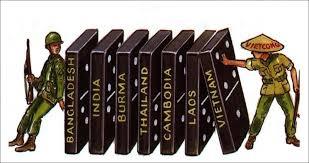
If one country falls to communism, the countries around would also fall to communism

a)

Vietnamization

b)

Domino Theory

c)

Tet Offensive

d)

Democratic Republic of Vietnam

51.

The Vietnamese who fought against the U.S. and South Vietnamese troops

a)

Democratic Republic of Vietnam

b)

Ngo Dinh Diem

c)

Viet Cong

d)

Ho Chi Minh

52.

Gave the President expansive war powers

a)

Operation Rolling Thunder

b)

Domino Theory

c)

Tet Offensive

d)

Gulf of Tonkin Resolution

53.

1968, massive attack by the Viet Cong on major cities in South Vietnam; caused American public support of war to plummet

a)

Operation Rolling Thunder

b)

Gulf of Tonkin Resolution

c)

Tet Offensive

d)

Kent State University

54.
The idea that if South Vietnam fell to communism, other nations would soon follow...
a)
Vietnamization 
b)
Communism
c)
Domino Theory
d)
Imperialism
55.
Allowed the public to be negatively influenced concerning the  Vietnam war?
a)
Television and media bias
b)
Radio 
c)
Telegraph
d)
Internet
56.
What were the problems of fighting in Vietnam?
a)
Identifying the enemy 
b)
Jungle/Location provided cover and a place to transport enemy supplies
c)
Weather and climate
d)
all of these
57.
Which side ended up winning the war, if not militarily, politically due to the lack of support of the civilian population?
a)
United states
b)
South Vietnam
c)
North Vietnam
d)
North korea
58.
What rule was Vietnam unified under 
a)
Democratic
b)
Communist
c)
Socialist 
d)
Monarchy
59.
In Vietnam the fighters used an irregular warfare tactic that made it difficult for our soldiers to be successful...it was called?
a)
Vietnamese Warfare tactics
b)
Cheetah Warfare
c)
Hidden Warfare
d)
Guerrilla warfare
60.
Shifting the burden of actual combat from American troops to S. Vietnamese forces.
a)
Vietminization
b)
Vietcong
c)
Internationalism
d)
Linkage
61.
What event sparked significant protests in the United States during the 1960's?
a)
WWII
b)
Vietnam War
c)
Cuban Missile Crisis
d)
WWI
62.
What was the domino theory?
a)
A Game played by soldiers
b)
A strategy for the communists to advance against US forces
c)
A reason to stop the spread of communism
d)
An app on a smart phone
63.
What event caused a negative shift in U.S. public opinion during the Vietnam War?
a)
The Geneva Accords
b)
Operation Rolling Thunder
c)
The Tet Offensive
d)
Gulf of Tonkin
64.
What provided congressional support for escalating military action in Vietnam? 
a)
Cuban Missile Crisis
b)
Battle Of Midway
c)
Gulf of Tonkin Resolution 
d)
Bay of Pigs Invasion
65.
Networks of jungle paths used by N. Vietnam to transport supplies to the Vietcong?
a)
Saigon Route
b)
Bataan Death March
c)
Trail of Tears
d)
Ho Chi Minh Trail
66.
The use of peaceful means, not force, to bring about political or social change
a)
nonviolet
b)
nonviolin
c)
nonviolence
d)
nonviola
67.
Bringing separate groups together
a)
integration
b)
Looking at this will slow you down
c)
discrimination
d)
segregation
68.
These black teenagers were the first to integrate into Little Rock Central High
a)
Elite Eight
b)
Little Rock Nine
c)
Arkansas Seven
d)
Final Four
69.
After the Civil War, many states passed laws that affected the rights and freedoms of the freed slaves
a)
White Codes
b)
Black Codes
c)
Black Cones
d)
White Cones
70.
People who protest to call attention to a cause, like civil rights
a)
prejudice
b)
activist
c)
optimist
d)
don't read this, this is just a distraction
71.
Keeping things or people separate 
a)
integration
b)
discrimination
c)
DISTRACTION!
d)
segregation
72.
When one group is treated differently than another group
a)
segregation
b)
integration
c)
determination
d)
discrimination
73.
Was originally a theater character, but became a term that described things related to African Americans
a)
Jim Sparrow
b)
Jack Sparrow
c)
Jack Crow
d)
Jim Crow
74.
Court case that created "Separate-but-equal" doctrine.
a)
Sweatt v. Painter
b)
Brown v. Board of Education
c)
Plessy v. Ferguson
d)
Mendez v. Kirby ISD
75.
Brown v. Board of Education was famous because the court ruled that it is illegal
a)
allow children to work.
b)
to pay black people less than white people.
c)
to return a slave.
d)
to segregate schools.
76.
Who was arrested for refusing to give up their seat on a bus?
a)
Charlayne Hunter
b)
Harriet Tubman
c)
Rosa Parks
d)
Rebecca L. Felton
77.
An organization formed in 1960 to coordinate sit-ins and other protests and to give young blacks a larger role in the civil rights movement.
a)
affirmative action
b)
de facto segregation
c)
Student Nonviolent Coordinating Committee 
d)
National Organization for Women 
78.
Act that eliminated the so-called literacy tests that had disqualified many voters.
a)
Voting Rights Act of 1965
b)
Civil Rights Act of 1964
c)
Brown vs. the Board of Education
d)
Roe Vs. Wade
79.
Literacy tests & poll taxes were used in the South to keep African Americans from doing what?
a)
voting
b)
serving in the military
c)
moving north
d)
getting an education
80.
What Black Nationalist group was once led by Malcolm X?
a)
Nation of Islam
b)
SNCC
c)
CORE
d)
Black Panthers
81.
The main goal of the freedom riders was to 
a)
pressure the federal government to enforce the law banning segregation on interstate buses
b)
inspire students to protest in Birmingham against Jim Crow
c)
encourage Congress to pass Kennedy's civil rights agenda
d)
desegregate urban bus systems in the south
82.
In the 1954 trial of Brown v Board of Education, the US Supreme Court ruled that
a)
private schools should be controlled by the federal government
b)
issues of racial segregation should be decided by the states.
c)
racially segregated public schools are unconstitutional
d)
the "separate but equal" doctrine should be contnued
83.
Supreme Court case overturned Plessy v. Ferguson & integrated public schools
a)
Brown v. Board of Education
b)
Sweatt v. Painter
c)
Delgado v. Bastrop ISD
d)
Hernandez v. Texas
84.
What strategy did the NAACP adopt in its fight for civil rights?
a)
massive resistance
b)
attacking racism in the courts
c)
direct nonviolence
d)
sit-ins
85.
Who did the Southern Christian Leadership Conference elect as its first leader?
a)
Rosa Parks
b)
Jackie Robinson
c)
Martin Luther King Jr.
d)
Thurgood Marshall