
 Worksheets
Key Question 1.2 Review
Total questions: 87
Worksheet time: 44mins







Social Darwinism was used to:
Justify further imperialism by powerful countries.
Advance technologies after the Industrial revolution.
Prove superiority of indigenous peoples.
Spread the idea of European superiority.
Which of these conflicts took place over land between the Dutch and the British in South Africa?
Berlin Conference
Boer Wars
Taiping Rebellion
Boxer Rebellion
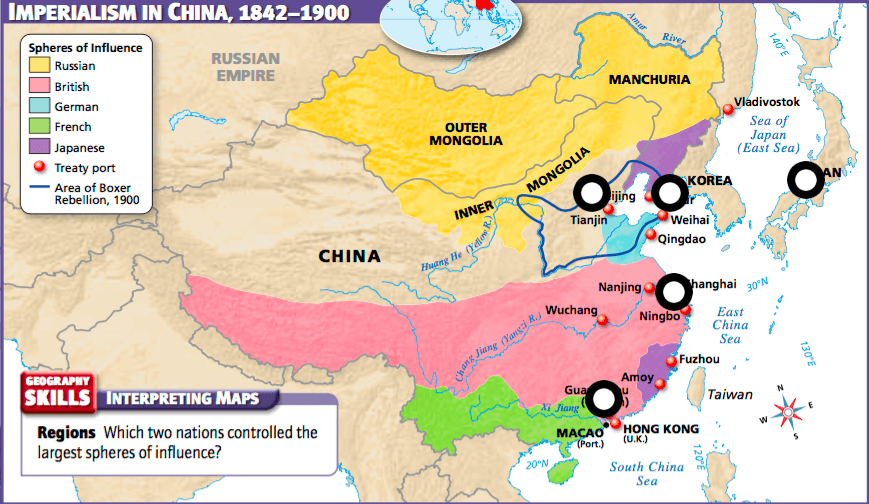
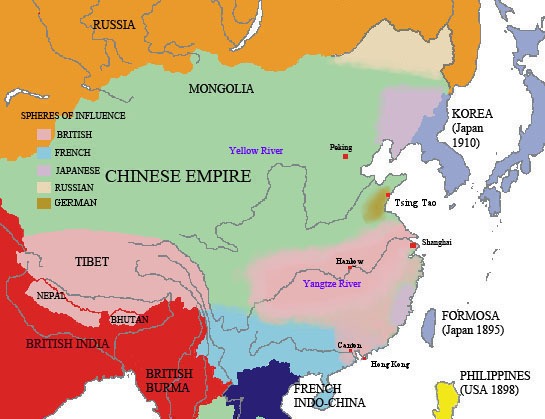
Japan asserted its nationalist pride and gained control of which country in the Sino-Japanese War?
Indonesia
India
Korea
China
What were the main causes of the Boxer Rebellion?
Cultural exchange, technological advancement, and diplomatic relations
Foreign aid, political stability, and religious tolerance
Anti-foreign sentiment, economic hardship, and the influence of secret societies
Social equality, military strength, and educational reform
Why did the Boxers target foreigners and Chinese Christians?
They were paid by the Chinese government to do so
They were seeking revenge for past conflicts with foreigners
They believed that foreigners and Chinese Christians were the cause of China's problems and were undermining traditional Chinese values and beliefs.
They wanted to spread Christianity to China
Who were the key figures involved in the Boxer Rebellion?
French chefs, American farmers, Russian musicians
Chinese martial artists, government officials, foreign diplomats
Japanese samurais, British sailors, German engineers
Korean monks, Italian artists, Spanish architects
Name one Chinese official who supported the Boxer movement.
Empress Dowager Cixi
Sun Yat-sen
Mao Zedong
Chiang Kai-shek
How did the Boxer Rebellion impact China's relationship with the Western powers?
The Boxer Rebellion had no impact on China's relationship with Western powers.
The Boxer Rebellion led to China forming strong alliances with Western powers.
The Boxer Rebellion improved China's relationship with Western powers.
The Boxer Rebellion strained China's relationship with Western powers.
What were the long-term effects of the Boxer Rebellion on China?
No significant impact on China's political and economic landscape
Decreased foreign intervention and economic prosperity
Increased foreign intervention, heavy indemnities, and weakening of the Qing Dynasty
Peaceful resolution and strengthening of the Qing Dynasty
How did the international community respond to the Boxer Rebellion?
Signed a peace treaty with the Boxers
Formed the Eight-Nation Alliance
Ignored the Boxer Rebellion and focused on other conflicts
Provided military support to the Boxer Rebellion
Which countries formed the Eight-Nation Alliance to suppress the Boxer Rebellion?
Austria-Hungary, France, Germany, Italy, Japan, Russia, the United Kingdom, and the United States
China, India, Brazil, South Africa, Australia, Canada, Mexico, Argentina
Egypt, Greece, Turkey, Iran, Iraq, Syria, Lebanon, Jordan
Norway, Sweden, Denmark, Finland, Iceland, Netherlands, Belgium, Luxembourg
What was the outcome of the Boxer Rebellion for China?
Defeat and signing of the Boxer Protocol
Economic prosperity and increased trade opportunities
Peaceful resolution and reconciliation with the Boxers
Victory and expansion of territory
What changes did the Boxer Protocol bring to China after the rebellion?
The Boxer Protocol brought democracy to China
The Boxer Protocol brought significant changes to China after the rebellion, including the payment of a large indemnity to foreign powers, the stationing of foreign troops in Beijing, and the expansion of foreign influence in China.
The Boxer Protocol led to the establishment of a communist government in China
The Boxer Protocol resulted in the expulsion of all foreign powers from China


What was the purpose of the Open Door Policy in China?
End the Boxer Rebellion
Make sure there were trading rights with China
Win leaseholds in China
Establish a sphere of influence

China and Britain fought a war over:
the Korean peninsula
conquests along the Nile River
opium production and distribution
the elimination of the samurai
The Opium War was caused by Britain continuing to sell opium to China.
True
False

NAME the entity that represented Great Britain in China.
The British East India Trading Company
The European Tea Corporation
The Chinese-European Organization
The British-Chinese Conglomerate
DESCRIBE the Boxers.
Pro-China Chinese revolutionaries.
Pro-China European revolutionaries.
Pro-Europe Chinese revolutionaries.
Pro-Europe European revolutionaries.
TRUE or FALSE: China was a weak, incapable nation before trading with Britain.
True
False
DESCRIBE the beliefs of the Boxers.
"God save the Queen."
The Chinese Emperor must be removed."
"Trade with Europe should be encouraged."
"Death to all foreign invaders."
After Europe entered China, China as an independent superpower became...
Stronger
Weaker
Unchanged
Before imperialism, how did China feel about trade with foreign powers?
Enthusiastic
Not interested
Indifferent
Which of the following concerning the relationship between the 6 great powers in late 19th century to early 20th century is correct?
France allied with Germany in exchange for the right to exercise ruling power over Alsace and Lorraine
Russia and Austria-Hungary and Germany were competing for the market in Balkans
Germany relied on Italy to maintain strong
Britain and Germany was competing for Alsace and Lorraine in the early 20th century
France had been involved in Morocco since 1871. Why?
French loved the sensory
Morocco was highly industrialised area
Morocco held rich mineral (礦物) which France would like to trade for
French government was friendly to Sultan Aziz
How did Germany react to France acquiring Morocco ?
Accepted this peacefully
Showed interest towards economic rights in Morocco
The Ottoman Empire was centered out of
Greece
Egypt
Turkey
Russia
European competition in South Africa between the British and the Dutch resulted in
the Crimean War.
the Boxer Rebellion.
the Opium War.
the Boer War.
The vision and creation of a railway from the Cape to Cairo added more competitive tension among European nations. The idea for this railway belonged to
Cecil Rhodes
Kaiser Wilhelm II
Queen Victoria
the British East India Company
What was a long term result of the Fashoda Crisis?
The Suez Canal was built in Egypt.
Morocco was declared independent from the French.
A railway was constructed to connect South Africa to Egypt.
A French and British alliance was formed.
Which 2 countries formed the Entente Cordiale?
Germany
Austry-Hungary
France
Britain
Which countries were the members of the Triple Entente?
Britain, France, Russia
Britain, U.S., France
Germany, Austria-Hungary, Italy
Germany, Russia, Austria-Hungary
Anti-Austrian sentiment in Serbia was partly a result of
Austria's persecution of Christian minorities
Serbia's alliance with the Ottoman Empire
The 1st Balkan War
Austria's annexation of Bosnia-Herzegovina
What was the result of the Bosnian Crisis?
World War I started.
The tension between Serbia and Austria-Hungary increased.
Germany and Austria-Hungary fought.
Bosnia became part of Turkey.
In 1911 their was a conference to discuss Morocco. What was decided?
Germany would be given Morocco and France would be given land in Central Africa.
France would be given Morocco and Germany would be given land in Central Africa.
Morocco would be independent and France and Germany would have land in Central Africa.
Britain would control everywhere because they had the biggest navy.
In 1907, following the first Moroccan Crisis three European countries formed an alliance. Which three countries?
Italy, Germany and Austria-Hungary
Britain, France and Italy
Britain, France and Russia
Austria-Hungary, Serbia and Turkey
In 1906 an international conference was held to discuss the issues in Morocco. In which place was it held?
Algeciras
Algeria
Abu Dhabi
Agadir


The first Balkans War resulted in Austria Hungary taking Bosnia
True
False
Serbia believed Bosnia was rightly theirs
True
False
The second Morocco crisis was a "tie" for Germany resulting in them gaining worthless land in the Congo and the French and British alliance becoming stronger.
True
False
In 1905-1906, Germany was forced to back down from the disputation he had with France over Morocco. Where did Germany had to surrendered?
In the Agadir conference
In the peace conference
In Algeciras conference
in the Versailles conference
When was the entente Cordiale firstly established?
1904
1882
1907
1905
In 1882 the first dual alliance had developed into the triple alliance. Mention the countries involved in the triple alliance.
Germany, Italy and Russia
Germany, Italy and France
Germany, Italy and Serbia
Germany, Italy and Austia-Hungary
The only nation to successfully resist European dominance and remain independence.
Ethiopia
China
Japan
Egypt
An international incident and the climax of imperialist territorial disputes between Britain and France in East Africa, occurring in 1898. It brought them on the brink of war, but resulted in a diplomatic victory for Britain when France agreed to withdraw.
The Fashoda Incident
The Great Rebellion/Sepoy Mutiny
The Meiji Restoration
The South African War/Boer War
Which of the following events documents Germany instigating more tension in competition between European nations for colonies?
Boer War
Moroccan Crises
Crimean War
Taiping Rebellion
Which country was also interested in Morocco? OR in other words, which country did not want France to get control over Morocco?
Germany
Italy
Ottoman Empire
United States
What was the significance of the First Moroccan Crisis?
France and Britain grew closer while Germany became more isolated
Germany succeeded in taking Morocco from the French
It was the spark that ignited WWI
It solidified France's position in the Triple Alliance
Which of these was NOT a reason European powers colonized Africa and Asia?
They wanted to acquire power and prestige
They wanted to gain access to natural resources such as gold, rubber, timber, and metals
They had a mission to civilize "inferior races"
They wanted to protect weaker nations from other foreign influences

During the 1911, France had his influence over Morocco. There was a rebellion front surfacing in one of the city in Morocco that forced France to send troops over the city which later arose Germany's suspicion. What is the name of the city where the rebels fought the France troops?
Agadir
Fez
Tangier
Rabat
The second Morocco crisis was a "tie" for Germany resulting in them gaining worthless land in the Congo and the French and British alliance becoming stronger.
True
False
There was an international peace keeping organization prior to 1920
True
False
What was NOT a main factor in the fall of the Qing Dynasty in China?
Corruption
Rapid population growth
Foreign influence
Military revolution
Extraterritoriality...
A financial term for using your money in another country
As a result of the Opium War...
China was opened up to western influence.
Opium was banned in China.
China embraced opium as a cash crop.
China was isolated from foreign influence.
What was the Tai Ping Rebellion?
A response the Opium War siding with the Qing Dynasty
A series of labor revolts against the oppressive Qing Dynasty
A military campaign led by the Mongols to conquer the Qing Dynasty
A peasant revolt against the Qing Dynasty
What was the result of the Boxer Rebellion?
The rebels were defeated and the government had to pay other countries
What was the primary goal of the Hague Conference?
To establish international trade agreements
To promote disarmament and peaceful conflict resolution
To create a global environmental policy
To form a new economic union
Which event is considered the starting point of the Eastern Crisis?
The assassination of Archduke Franz Ferdinand
The Russo-Turkish War
The Crimean War
The Greek War of Independence
What was a significant outcome of the First Sino-Japanese War?
Japan gained control of Taiwan
China annexed Korea
Russia gained influence in Manchuria
The United States intervened in East Asia
How did the Hague Conference contribute to international law?
By establishing the International Criminal Court
By creating the Permanent Court of Arbitration
By drafting the Geneva Conventions
By forming the League of Nations
Analyze the impact of the Eastern Crisis on the balance of power in Europe.
It strengthened the Ottoman Empire's influence
It led to the decline of the Ottoman Empire
It resulted in the unification of Germany
It caused the dissolution of the Austro-Hungarian Empire

