

wayground logo

Free Printable Worksheets

NEW

Font size

S
M
L
XL
Worksheets

Biodiversity

Total questions: 59

Worksheet time: 1hrs 4mins
Name
Class
Date
1.
Which of the following situations is MOST HARMFUL to an ecosystem's food web or food chain?
a)
introduction of a similar producer
b)
loss of one of the top consumers
c)
increase in the population of producers
d)
disease killing the producers
2.
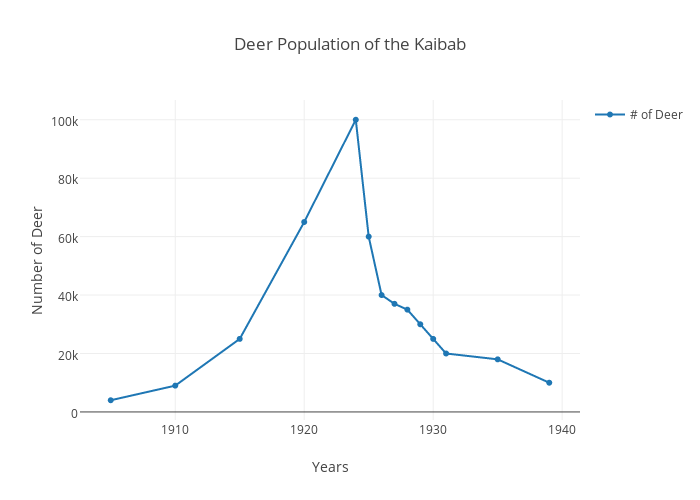
The graph above shows the variation in the deer population in the Kaibab Plateau from 1905 to 1939. Between 1907 and 1923, the natural predators of deer were eliminated from the area by hunters. What was the most likely reason for the decline in the deer population after 1924?
a)
The deer stopped competing for resources because they had no predators.
b)
The increased number of deer led to increased competition for resources.
c)
A large number of deer left the region in search of new predators.
d)
The removal of predators caused fewer resources to be available to the deer.
3.
In a particular habitat, owls eat mice and mice eat grass. If the owl population suddenly grows, then most likely
a)
the number of mice will decrease and the amount of grass will not change.
b)
the number of mice will increase and the amount of grass will increase.
c)
the number of mice will increase and the amount of grass will not change.
d)
the number of mice will decrease and the amount of grass will increase.
4.
All living and nonliving things that surround an animal are part of its
a)
food chain
b)
life cycle
c)
atmosphere
d)
habitat
5.
Deer usually travel in groups of 2-3 sometimes more. How does staying in a group increase one deer’s chance to pass on his genes to the next generation?
a)
It increases the deer’s chances of survival.
b)
It protects the deer from the cold.
c)
It allows the deer to eat.
d)
It gives the deer time to think.
6.
Which habitat exhibits the greatest biodiversity?
a)
A habitat with 15 different species with about 300 individuals each
b)
A habitat with 10 different species with about 75 individuals each
c)
A habitat with 4 different species with about 150 individuals each
d)
A habitat with only one species with about 2000 individual
7.
What is the MOST likely consequence if a fungal disease killed the grass in this WOODLAND ECOSYSTEM?
a)
Only the rabbits would be affected, because they are the ones who eat the grass.
b)
The blueberry bush would begin to grow wild, because it would have more space to grow.
c)
Nothing would happen; the animals would eat something else.
d)
The ecosystem would most likely be disrupted, because the grass is one of its primary producers
8.
Currently sharks are on a rapid decline due to overfishing. If sharks go extinct will this affect the biodiversity of the ocean?
a)
No, sharks are not important.
b)
No, sharks will only affect the seal populations.
c)
Yes, it will disrupt the entire food chain in the ocean.
d)
Yes, but only a little.
9.
Some students are studying a vacant city lot as a small ecosystem. Which of the following yields the most information for evaluating the biodiversity of this ecosystem?
a)
identifying all of the species found living in the ecosystem
b)
testing the speed of decomposition of organic matter in the ecosystem
c)
creating a food-web diagram among key species in the ecosystem
d)
observing the feeding habits of the insect predators in the ecosystem
10.
How can humans best help an endangered species avoid extinction?
a)
they can feed the animals
b)
they can put the animals in a zoo
c)
they can protect the animal’s habitat
d)
they can take the animal to new habitats
11.
Why is biodiversity so important?
a)
Because all species depend on each other to survive, so if one becomes extinct another species that relies on it could go extinct as well
b)
Because it’s better to have only one variation of each species.
c)
Because it better to only have a few species on Earth.
d)
Honestly, I have no idea what biodiversity is!
12.
What factor does NOT affect biodiversity?
a)
Urbanization
b)
Planting Native Plants
c)
Overfishing
d)
Pollution
13.
What is the name of the rate at which organisms leave a population?
a)
the rate of mutation
b)
the immigration rate
c)
the emigration rate
d)
the death rate
14.
A Wildlife Biologist is photographing only the deer in the meadow. Another way of saying this would be that the Wildlife Biologist is photographing the deer____________________ in the meadow.
a)
Organism
b)
Ecosystem
c)
Community
d)
Population
15.

Biodiversity, aka biological diversity, usually refers to

a)

the same species in a general location

b)

the number of different species in a given area

c)

the number of animal species in a given area

d)

the number of plant species in a given area

16.
What is the difference between biotic and abiotic?
a)
Biotic are non-living things
b)
Abiotic are living organisms
c)
Biotic is life,
Abiotic is non-living
d)
Biotic is non-living, Abiotic is living
17.
What does biodiversity mean?
a)
Only one species in an area.
b)
The different amount of species in an area
c)
All abiotic life
d)
Nitrogen fixation
18.

Great Biodiversity = Great Sustainability

a)

True

b)

False

19.

Biodiversity is best described as...

a)

the amount of different species of organisms (plants and animals) living in the same area.

b)

when only a few species inhabit an area.

c)

when only one organism (plants and animals) is found living in one area.

20.

Why is "A" less biodiverse than "B"?

a)

Image "A" is more biodiverse.

b)

Image "A" has many corn plants and this makes it have high "rich" biodiversity.

c)

Image "A" has a lot more plants than image "B"

d)

Even though "A" has a lot of corn plants they are all the same species and makes this a low "poor" biodiverse area.

21.
High biodiversity is 
a)
having a lot of the same organism.
b)
having a few of the same organism.
c)
having a lot of variety of different organisms.
d)
only having one of each organism. 
22.

Species that are clearly critical to the functioning of an ecosystem are known as

a)

biodiversity

b)

keystone species

c)

main species

d)

native species

23.

A species that is likely to become extinct if protective measures are not taken immediately is known as

a)

threatened species

b)

endemic species

c)

keystone species

d)

endangered species

24.

A community is

a)

Several different populations scattered across several states.

b)

Several different organisms in the same geographic area

c)

One type of organism in the same geographic area

d)

Several different populations in the same geographic area

25.
Which of the following describes the importance of biodiversity to an ecosystem?
a)
a. People like to be able to see all the different plants and animals
b)
b. If there aren�t all the different species, there will be resources that aren�t being used
c)
c. Biodiversity is not as important as many people think
d)
d. Biodiversity can help minimize the effects of losing a species.
26.
A plant nursery only grew one type of tomato. All of their tomatoes died from the same disease. What was most likely true of the tomato plant population?
a)
a. It had too little biodiversity
b)
b. It had a lot of resistance to disease
c)
c. It had a few plants that were resistant to disease
d)
d. It had too much genetic variation
27.
What is the main suspected environmental problem associated with the burning of fossil fuels?
a)
a. Depletion of fresh water
b)
b. Depletion of ozone
c)
c. Global cooling
d)
d. Global warming
28.
Which human activity would be most destructive to the biodiversity of the biosphere?
a)
a. The burning of wood and coal in rural areas
b)
b. The release of species of freshwater trout in lakes
c)
c. The removal of plants from the food webs they support
d)
d. The removal of erosion barriers from forest boundaries
29.
What two human activities contribute the most to global warming?
a)
a. Burning fossil fuels and deforestation
b)
b. Mining and vehicle exhaust
c)
c. Burning fossil fuels and agriculture
d)
d. Deforestation and agriculture
30.
If global warming continues, which of the following will most likely NOT happen?
a)
a. Increased intensity of storms
b)
b. Rises in ocean levels
c)
c. Loss of biodiversity
d)
d. Increase in available resources
31.
What affect will continued rise in global temperature most likely have on worldwide biodiversity?
a)
a. It will have no effect as there is plenty of time for organisms to adapt
b)
b. It will increase due to warmer temperatures
c)
c. It will increase due to greater plant production from more CO2
d)
d. It will decrease due to massive habitat destruction
32.
In what way are humans most impacting the biodiversity of ecosystems around the world?
a)
a. We are putting too many organisms in zoos or keeping them as pets
b)
b. We are increasing biodiversity by breeding new species
c)
c. We are destroying the habitats of a large number of species
d)
d. Recreational hunting
33.
Which of the following results in the breakdown of the ozone layer?
a)
a. CFCs
b)
b. Acid Rain
c)
c. Carbon Dioxide
d)
d. Nitrogen Oxides
34.
Why are invasive species such a problem in their new ecosystem?
a)
a. The new ecosystem isn�t adapted to their presence
b)
b. The new ecosystem is probably weaker than the native one
c)
c. They have mutations making them more adapted to the new ecosystem
d)
d. They cause mutations in the native species
35.
What does biodiversity mean?
a)
Only one species in an area.
b)
The different amount of species in an area
c)
All abiotic life
d)
Nitrogen fixation
36.
Environments always have both living and _________.
a)
nonliving factors
b)
bio-geochemical cycles
c)
nutrients
d)
ecosystem
37.
Biodiversity is the variety of ________ in a community.
a)
genes
b)
population
c)
species
d)
community
38.
 Which biome is more likely to survive a change in the environment?
a)
High (rich) biodiversity
b)
Low (poor) biodiversity
39.
Biodiversity includes 3 components, Ecosystem Diversity, Species Richness and Genetic Diversity
a)
True
b)
False
40.
According to the idea of "evenness" discussed in class, which sample is considered to be more even?
a)
Sample 1
b)
Sample 2
c)
They are both equally biodiverse
d)
None of the above
41.
The total number of species found in Ecoregion 1 and Ecoregion 2 is_________
a)
605
b)
615
c)
600
d)
607
42.
"Evenness" is __________
a)
higher in Ecoregion 1
b)
higher in Ecoregion 2
c)
lower in Ecoregion 1
d)
the same in both Ecoregions 
43.
Scientists think people have directly caused the extinction of some species through ______________.
a)
habitat destruction
b)
poaching
c)
pollution
d)
All of these
44.
Which of the following is NOT a type of  biodiversity?
a)
species
b)
genetic
c)
ecosystem
d)
individual
45.
What is the difference between biotic and abiotic?
a)
Biotic are non-living things
b)
Abiotic are living organisms
c)
Biotic is life,
Abiotic is non-living
d)
Biotic is non-living, Abiotic is living
46.
Which biome is more biodiverse?
a)
Desert
b)
Sand
c)
Tundra
d)
Rainforest
47.
Which option is abiotic?
a)
Plants
b)
Bacteria
c)
Water
d)
Fungi
48.
Which option is abiotic?
a)
Plants
b)
Rocks
c)
Animals
d)
Fungi
49.
Which option is biotic?
a)
Light
b)
Water
c)
Salt in the water
d)
Angel fish
50.
 Which biome is more likely to survive a change in the environment?
a)
High (rich) biodiversity
b)
Low (poor) biodiversity
51.
What does biodiversity mean?
a)
Only one species in an area.
b)
The different amount of species in an area
c)
All abiotic life
d)
Nitrogen fixation
52.

Image "B" shows more biodiversity than image "A". Why?

a)

Because "B" shows more different species than image "A"

b)

Because image "B" has less different species than "A"

c)

"A" has a greater number of same species plants so this statement is wrong.

d)

Both images show the same biodiversity

53.

Biodiversity is important to keep an area (biome) healthy. In this example "Food Web A" is sustainable. Why is sustainability important for an ecosystem in "Food Web A".

a)

If one organism is removed the food web can still operate (work) with little or no negative effect.

b)

If an organism is removed the food web will collapse and will affect the environment.

54.

Food Web B is an example of...

a)

Low biodiversity and low sustainability. If the producer dies then all the food web will suffer.

b)

High biodiversity and high sustainability. If an organism is removed the food web will continue with no effect.

55.

Soccer fields are most often made of one single type of grass. What type of biodiversity do sports fields show?

a)

High "Rich" biodiversity because there is only one type of producer.

b)

Low "Poor" biodiversity because there is only one type of producer.

56.

Great Biodiversity = Great Sustainability

a)

True

b)

False

57.

In this food web example you can see that rain forests have many producers consumer and predators. How would you describe the rain forest biome?

a)

It has high "rich" biodiversity

b)

It has low "poor" biodiversity.

58.

Biodiversity is best described as...

a)

the amount of different species of organisms (plants and animals) living in the same area.

b)

when only a few species inhabit an area.

c)

when only one organism (plants and animals) is found living in one area.

59.

Why is "A" less biodiverse than "B"?

a)

Image "A" is more biodiverse.

b)

Image "A" has many corn plants and this makes it have high "rich" biodiversity.

c)

Image "A" has a lot more plants than image "B"

d)

Even though "A" has a lot of corn plants they are all the same species and makes this a low "poor" biodiverse area.
