wayground logo

Free Printable Worksheets

Font size

S
M
L
XL
Worksheets

Sound & Light Waves, Density

Total questions: 112

Worksheet time: 56mins

Name
Class
Date
1.
Where can matter be found?
a)
Everywhere
b)
On Earth only
c)
In a solid and liquid only
2.

How does the mass of a shoe on Earth compare to its mass on the moon?

a)
The mass will be greater on the moon
b)
The mass will be less on the moon
c)
The mass will stay the same
3.
What is the formula for density?
a)
density = mass x volume
b)
density = mass / volume
c)
density = mass + volume
d)
density = mass - volume
4.

Sabina has a rock. The rock has a mass of 14 g and a volume of 2 cm3. What is the density of the rock?

a)
7 mL
b)
7 g/cm3
c)
28 g/cm3
d)
1/7 g/cm3
5.

Lena has an eraser. It has a mass of 4 g, and a volume of 2 cm3. What is its density?

a)
8 g/cm3
b)
2 g/cm3
c)
1/2 g/cm3
d)
24 g/cm3
6.

Hamza has a paper clip. It has a mass of 9g and a volume of 3cm3. What is its density?

a)
3 g/cm3
b)
1/3 g/cm3
c)
27 g/cm3
d)
39 g/cm3
7.

Naged has a gel pen. The gel pen has a mass of 8g and a volume of 2cm3. What is the density of the pen?
a)
4 g/cm3
b)
16 g/cm3
c)
.25 g/cm3
d)
64 g/cm3
8.
Why do some substances float on water?
a)
they are warmer than water
b)
they are cooler than water
c)
they are more dense than water
d)
they are less dense than water
9.
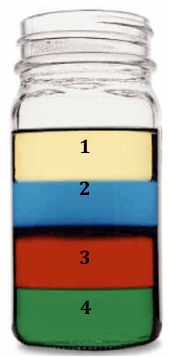
Put the liquids in order from most dense to least dense?
a)
4, 3, 2, 1
b)
1, 2, 3, 4
c)
3, 4, 2, 1, 
d)
4, 3, 1, 2
10.
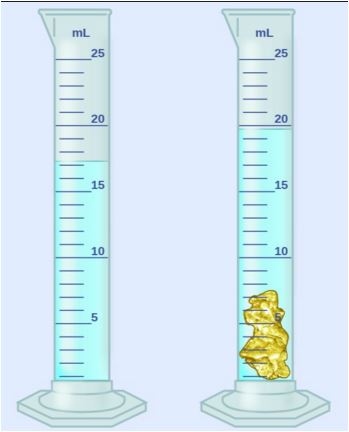
What is the volume of Object X?
a)
10.0 cm3
b)
15.0 cm3
c)
20.0 cm3
d)
25.0 cm3
11.
Helium balloons rise on earth because
a)
helium is less dense than air
b)
helium is more dense than air
c)
helium is cooler than air
d)
helium is warmer than air
12.
What is the measuring unit for mass?
a)
centimeter 
b)
millimeter 
c)
grams 
d)
pounds
13.
What units are used to measure Density?
a)
cm3/g
b)
g
c)
g/cm3
d)
cm3
14.

A toy has a mass of 10g and volume of 5 mL. What is the density?

a)
30 g/mL
b)
15 g/mL
c)
1 g/mL
d)
2 g/mL
15.

What is the formula for Mass?

a)

Mass/Volume

b)

Density x Volume

c)

Mass/Density

16.
An object with which of the following densities will float on water?
a)
0.7 g/cm3
b)
1.2 g/cm3
c)
3.5 g/cm3
d)
11.4 g/cm3
17.

Yousef has a rock. The rock has a mass of 14g and a volume of 2cm3. What is the density of the rock?
a)
7 mL
b)
7 g/cm3
c)
28 g/cm3
d)
1/7 g/cm3
18.
Which lab tool might you use to measure the volume of a liquid?
a)
electric scale
b)
bunsen burner
c)
test tube
d)
graduated cylinder
19.
Density is...
a)
the amount of mass in an object
b)
the amount of space an object takes up
c)
the amount of mass in a given space
d)
the weight of an object
20.
An irregularly shaped piece of gold was lowered into a graduated cylinder holding a volume of water equal to 17 ml. The height of the water rose to 20 ml. If the mass of the gold was 27 g, what was its density?
a)
9 g/mL
b)
10.5 g/mL
c)
6.5 g/mL
d)
8 g/mL
21.

Find the volume if a substance has a density of 19.3g/cm3 and a mass of 10g.

a)

.52cm3

b)

193cm3

c)

1.93cm3

d)

29.3cm3

22.
A lead cylinder has a mass of 540 grams and a volume of 2.70 mL.  Calculate the density of the lead cylinder. Remember to move the decimal on both sides of the problem.
a)
15 g/mL
b)
19 g/mL
c)
20 g/mL
d)
12 g/mL
23.
Find the volume of the given figure.
a)
308.9 cm3
b)
308.2 cm3
c)
312.8 cm3
d)
302.9 cm3
24.
Find the Volume
a)
428.4 cm3
b)
412.8 cm3
c)
404.2 cm3
d)
400 cm3
25.

An object is is placed into 45 mL of water. The water rises to 48 mL. What is the volume of the object?

a)

3 mL

b)

93mL

c)

8 mL

d)

83 mL

26.
The tool used to measure the mass of a substance or object is a ______________.
a)
balance
b)
graduated cylinder
c)
ruler
d)
thermometer
27.

Rayan finds a gold colored rock in a river.  It has a mass of 9.65 grams and a volume of 0.5 cm3.  What is the density of the rock?

a)
10.15 g/cm3
b)
19.3 g/cm3
c)
9.15 g/cm3
d)
4.825 g/cm3
28.

Calculate the density in the following question: A flower pot has a mass of 95 g and a volume of 92 mL.

a)

1.03 g/mL

b)

0.97 g/mL

c)

1.01 g/mL

d)

0.99 g/mL

29.

displacement

a)

a procedure used to measure volume of a solid object by placing it in a known amount of liquid

b)

measures how much matter is present in a substance

c)

a metric unit of measurement used to measure small volumes of liquid

30.

The mass and dimensions of a rectangular solid are shown below. What is the density of this object?

a)

0.25 g/cm³

b)

0.5 g/cm³

c)

25 g/cm³

d)

50 g/cm³

31.

The density of a 100-g sample of lead is approximately 11 grams per cubic centimeter. If the sample is cut into two 50-g pieces, what is the density of each half?

a)

11 g/cm³

b)

5.5 g/cm³

c)

1.1 g/cm³

d)

0.5 g/cm³

32.

Which material has the greatest density?

a)

A

b)

B

c)

C

d)

D

e)

E

33.

What would happen to the density of each piece if you were to cut the cylinder below in half?

a)

the density would decrease

b)

the density would increase

c)

the density would remain the same

34.

Robin and Ali have an eraser. It has a mass of 4g, and a volume of 2cm3. What is its density?

a)
8 g/cm3
b)
2 g/cm3
c)
1/2 g/cm3
d)
24 g/cm3
35.
Calculate the density of the cube.
a)
2 g/cm3
b)
4 g/cm3
c)
6 g/cm3
d)
8 g/cm3
36.
What is the volume of the fish?
a)
18.0 cm3
b)
6.0 cm
c)
38.0 cm3
d)
32.0 mL
37.
The density of this material is 2 g/cm3.
There are 24 cm3  Find the total mass.
a)
12 grams
b)
48 grams
c)
12 g/cm3
d)
48 g/cm3
38.

What do all waves transfer?

a)

Matter

b)

Heat

c)

Electricity

d)

Energy

39.

What is the number of complete waves passing a fixed point in a given amount of time?

a)

Amplitude

b)

Intensity

c)

Wavelength

d)

Frequency

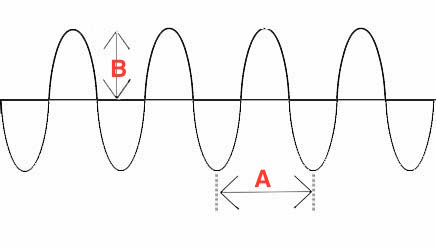
40.

What kind of wave is pictured below?

a)

compressional wave

b)

transverse wave

c)

sound wave

d)

mechanical wave

41.
What property of this wave is represented by the letter "A"
a)
amplitude
b)
crest
c)
trough
d)
wavelength
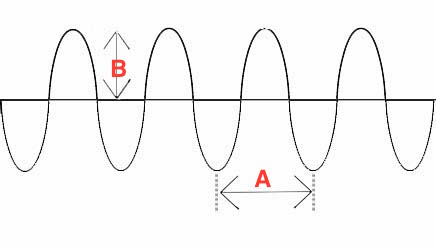
42.
What property of the wave is represented by the letter "B"?
a)
amplitude
b)
crest
c)
trough
d)
wavelength
43.
A wave carries...?
a)
energy only
b)
matter only
c)
energy and matter
d)
neither
44.
What type of wave move a slinky back and forth?
a)
longitudinal
b)
transverse
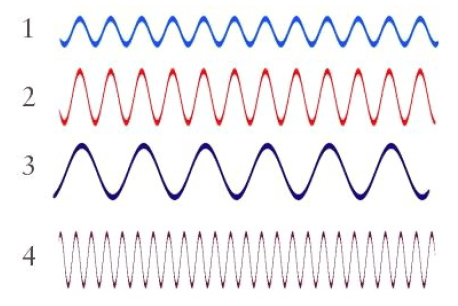
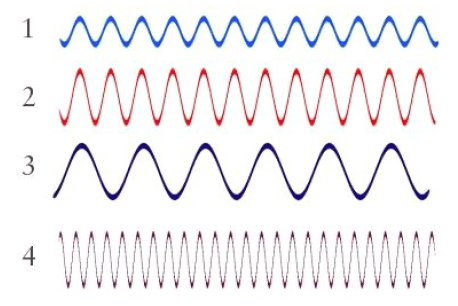
45.
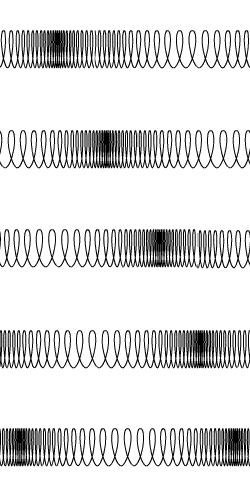
Which wave in the diagram has the greatest frequency?
a)
1
b)
2
c)
3
d)
4
46.
Which wave in the diagram has the greatest wavelength?
a)
1
b)
2
c)
3
d)
4
47.
Which of the following can sound travel through?
a)
solid
b)
liquid
c)
gas
d)
all of the above
48.
What type of wave is this?
a)
Longitudinal
b)
Transverse
49.

This is the distance between two peaks. What is this called?

a)

amplitude

b)

wavelength

c)

longitude

d)

trough

50.

The lowest point on a transverse wave is the

a)

compression

b)

crest

c)

rest position

d)

trough

51.
Transverse waves are ___.
a)
Parallel
b)
Perpendicular
c)
Weird
52.
Longitudinal waves are ______.
a)
Parallel
b)
Perpendicular
c)
Crazy
53.

Why is the school library covered with carpet?

a)

to help absorb water

b)

to help absorb sounds to keep it quiet

c)

because it looks good

54.

A sound reflection, in which sound bounces off of an object, is called an ___.

a)

sound wave

b)

echo

c)

refraction

55.

When Mr. Albbert yells his name in a cave, the sound reflects off the walls of the cave and travels back to his ears. What is this called?

a)

refraction

b)

echo

c)

excretion

56.
Soft surfaces _______ sound waves. 
a)
Reflect
b)
Absorb
57.
Sound moves in a _________.
a)
Transverse wave
b)
Longitudinal wave
58.
What medium does sound travel through slowest?
a)
gas
b)
solid
c)
liquid
d)
trees
59.
Sound waves travel the FASTEST through _____________.
a)
gases
b)
liquids
c)
solids
60.

Examine the wave.


Which region on this wave would correspond to rarefaction?

a)

W

b)

X

c)

Y

d)

Z

61.

The diagram shows a research vessel using sonar to map the ocean floor.


Upon which basic behavior of sound waves does this technology depend?

a)

absorption

b)

compression

c)

reflection

d)

refraction

62.
How does a sound wave interact with a human ear?
a)
vibrates the ear drum
b)
bounces off the ear canal
c)
rotates the ear drum
d)
vibrates the ear canal
63.

Sound travels FASTEST through which of these materials?

a)

A type of gas, like helium

b)

Empty space

c)

A metal such as iron

d)

Water

64.
Which of the following would produce the highest pitch?
a)
phone
b)
whistle
c)
truck horn
d)
dog's growl
65.
When a sound is louder what measurement gets bigger?
a)
Frequency 
b)
Amplitude 
c)
Wavelength 
d)
Crest
66.
Sound is a form of _________________ that travels as waves through a ________________.
a)
light/ transparency
b)
energy/ vibration
c)
energy/ medium
d)
frequency/ medium
67.
A sound with a high frequency has a _____ pitch. A sound with a ____ frequency has a low pitch.
a)
high, low
b)
low, high
c)
medium, high
d)
high, medium
68.
Why is sound able to travel faster through a solid than a gas?
a)
Gas molecules are packed tightly.
b)
Sound does not travel faster through a solid than a gas.
c)
Solid molecules are packed tightly.
d)
Gas molecules move slowly.
69.

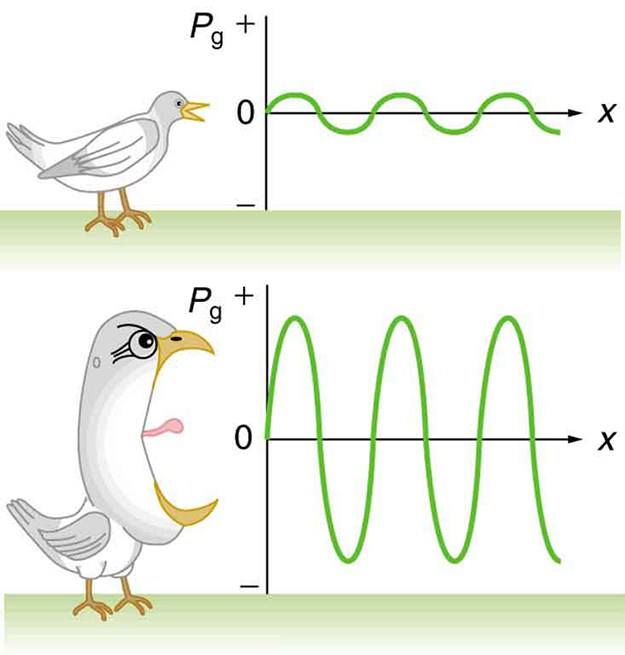
The red wave will be ___________________ than the blue wave

a)

lower in pitch

b)

higher in pitch

c)

louder in volume

d)

quieter in volume

70.

Which BEST describes this sound?

a)

Starts low pitch and quiet and gets higher pitch and louder

b)

Starts low pitch and loud and gets higher pitch and quieter

c)

Starts high pitch and quiet and gets lower pitch and louder

d)

Starts high pitch and loud and gets lower pitch and quieter

71.
A light year is...
a)
The speed light travels
b)
How long it takes light to get to you from the sun
c)
The distance light can travel in a year
d)
How many years it takes light to be emitted
72.
What does reflection mean?
a)
bending light
b)
bouncing light
73.
What type of waves does light travel in?
a)
transverse
b)
compression
c)
high and low waves
d)
waves like the ocean
74.
When we look into a glass mirror, light...
a)
Bends as it passes through
b)
Bounces back in a random order
c)
Hits the mirror and is absorbed
d)
Bounces back at the same angle it strikes the mirror at
75.
When we looked at our pencil in a beaker of water it looked bent, why?
a)
The light bends the pencil
b)
Light reflects off of the water
c)
Light changes direction in the water
76.
A prism and a flashlight could help you demonstrate what?
a)
That light travels in a straight line until it strikes an object.
b)
That light travels in a straight line until it travels into a new medium.
c)
That light bounces off of the surface of shiny objects.
d)
That light can travel through anything.
77.
A shiny piece of metal will __________ light.
a)
reflect 
b)
refract
78.
Opaque means...
a)
No light passes through it
b)
All light passes through it
c)
Some light passes through it
79.
A region that contains few or no particles
a)
Vacuum
b)
Velocity
c)
Velcro
d)
Volcano
80.
The bending of waves as they pass from one substance into another.
a)
Reaction
b)
Reflection
c)
Refraction
d)
Repost
81.
The term for any wave that hits a surface and bounces off
a)
Transparent
b)
Translucent
c)
Refraction
d)
Reflection
82.
Blurs light as it passes through
a)
Transparent
b)
Translucent
c)
Opaque
d)
Refraction
83.
Allows most light through
a)
eflection
b)
Refraction
c)
Translucent
d)
Transparent
84.
a)
A
b)
B
c)
C
d)
D
85.
a)
A
b)
B
c)
C
d)
D
86.
a)
A
b)
B
c)
C
d)
D
87.
When waves bounce off of a surface
a)
refraction
b)
diffraction
c)
reflection
88.
Which property of light makes the the pen  in a glass looks broken?
a)
reflection
b)
refraction
c)
absorption
d)
brightness
89.
What property of light is represented by the picture?
a)
reflection
b)
diffraction
c)
refraction
d)
absorption
90.

Tsunamis are caused by

a)

underwater disturbances such as earthquakes, landslides, and volcanoes.

b)

wind and the gravitational pull of the moon.

91.

If a tsunami is head to your area which of the following should you do?

a)

Climb a tall tree

b)

Go underground to a basement

c)

Go to higher ground like a hill or mountain

d)

Just stay and don't move from your area

92.
The most devastating tsunami that killed the most people occurred in...
a)
2004- Indian Ocean
b)
2011 - Japan
c)
1960 - Chile
d)
79 - Pompeii
93.

Which word do we use to describe how big an earthquake is?

a)

seismic

b)

meteorologic

c)

lithosphere

d)

magnitude

94.

The scale that we measure magnitude is ...

a)

The Reinhart Scale

b)

The Roosevelt Scale

c)

The Richter Scale

d)

The Rose Scale

95.

Why do tsunami waves get so big?

a)

Seismic energy is released in the water

b)

The further the waves go from the epicentre, the bigger they get

c)

As the waves get closer to shore, friction lowers the speed but raises the height

96.

Which statement is accurate regarding tsunamis in the open ocean?

a)

The wave is very high, compared to the surrounding water.

b)

The water is lifted, but barely noticeable in deep water.

97.

Tsunami occurs when major fault under the ocean floor suddenly slips. The displaced rock pushes water above it like a giant paddle, producing powerful water waves at the ocean surface. The ocean waves spread out from the vicinity of the earthquake source and move across the ocean until they reach the coastline, where their height increases as they reach the continental shelf, the part of the earth crust that slopes, or rises, from the ocean floor up to the land.


A tsunami washes ashore with oftendisastrous effects such as severe flooding, loss of lives due to drowning and damage to property.


A tsunami is a very large sea wave that is generated by a disturbance along the ocean floor. This disturbance can be an earthquake, a landslide, or a volcanic eruption. A tsunami is undetectable far out in the ocean, but once it reaches shallow water, this fast traveling wave grows very large.


Tsunami happened because of.....

a)

The displaced rock pushes water above it

b)

The ocean waves spread out from the vicinity of the source

c)

A tsunami is undetectable far out in the ocean

d)

A major fault under the ocean floor slips suddenly

e)

The waves moves across the ocean until they reach the beach

98.

Sound waves travel the fastest in

a)

solid

b)

liquid

c)

gas

d)

vacuum of empty space

99.

If a light waves moves from a gas to a liquid, the light wave will

a)

speed up

b)

slow down

c)

not change speed

100.

An ambulance is driving towards you as you stand on the sidewalk. What happens to the pitch of the siren as it comes towards you?

a)

It increases

b)

It decreases

101.

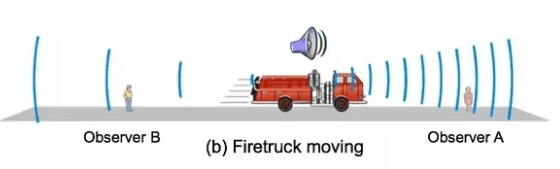
Look at the picture. Who is experiencing a higher pitched sound?

a)

Observer A

b)

Observer B

c)

There's no difference

102.

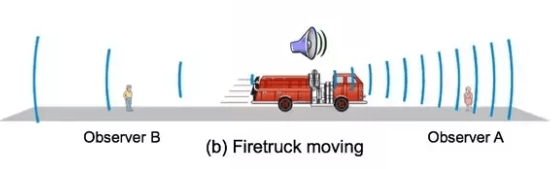
Look at the picture. Who is experiencing a lower pitched sound?

a)

Observer A

b)

Observer B

c)

There is no difference

103.

What is the Doppler Effect?

a)

A change in frequency due to the relative motion of a wave source and an observer

b)

When a wave overlaps with another wave

c)

When a wave bounces off of another object

d)

When a wave bends due to traveling through a different medium

104.
A tuning fork starts to vibrate when a certain note is played on the piano, This is an example of _______.
a)
resonance
b)
refraction
c)
diffraction
d)
reflection
105.
You cannot hear ultrasound because it is:
a)
too loud
b)
too quiet
c)
high frequency
d)
low frequency
106.
 The sonar that boats use for ultrasound is to determine the distance that an object is underwater.
a)
True
b)
False
107.

The most common unit to express sound is the _________________

a)

Hertz

b)

Decibel

c)

Newton

d)

Meter

108.

A(n)_________________________ is a reflected sound wave.

a)

echo

b)

Arc

c)

vibration

d)

rarefaction

109.

What part is #1?

a)

Pinna

b)

Ear Canal

c)

Ear Drum

d)

Oval Window

110.

What are the three little bones is the middle ear called?

a)

stirrup

b)

cochlea

c)

ossicles

d)

eardrum

111.

What does the Auditory nerve do?

a)

Carries the message to the brain

b)

Carries the message to the Semi-Circular canal

c)

Send the message to the Eustachian tube
112.

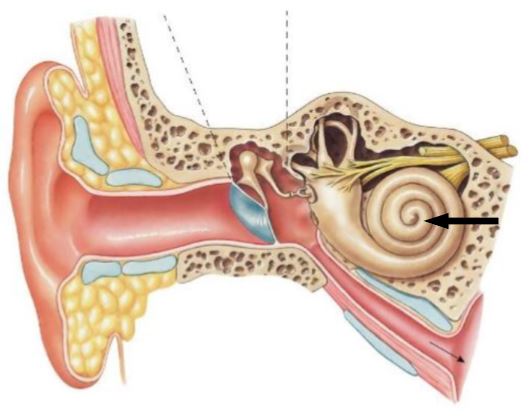
What is this?

a)

Pinna

b)

Hearing Nerve

c)

Cochlea

d)

Ear Drum

e)

Anvil