
 Worksheets
U.S Court System/ U.S. Supreme Court
Total questions: 52
Worksheet time: 1hrs 7mins
This was the first African American appointed to the Supreme Court.
Thurgood Marshall
Lyndon Johnson
Sandra Day O'Connor
Ronald Reagan
Friend of the Court.
amicus curiae
opinion
writ of certiorari
brief
Supreme Court written decisions.
amicus curiae
opinions
writ of certiorari
brief
This is the court of last resort in all questions of federal law.
district court
territorial court
Supreme Court
appellate court
Supreme Court Justices and all other Federal Judges reach the judiciary through _________________.
Electoral vote
senatorial appointment
presidential nomination
popular vote
Justices are appointed for how long?
2 years
4 years
10 years
life
Explanation for the Supreme Court's decision is called __________.
a legal draft
an opinion
litigation
judicial referee
The vast majority of cases heard by the Supreme Court reach the Court _____________________.
from congressional hearings
because of jurisdiction
are appeals from lower court decisions
because of presidential requests
New York is in which district of the federal court circuit?
2nd
5th
9th
12th
A court of appeals has ___________________.
original jurisdiction
grand jury jurisdiction
appellate jurisdiction
concurrent jurisdiction
One or more justices who agree with the majority's conclusions about a case, but do so for different reasons, write a _______________.
majority opinion
unanimous opinion
dissenting opinion
concurring opinion
The Chief Justice of the Supreme Court is _______________.
Clarence Thomas
John Roberts
Sonia Sotomayor
Samuel Alito
The first Hispanic justice on the court is _____________________.
Sandra Day O'Conner
Ruth Bader Ginsburg
Sonia Sotomayor
Alexandra Ocasio-Cortez
10+2
12+2
11+2
14+2
What was the impact of the Marbury v Madison case?
The case gave the Supreme Court the power of judicial review, it also allowed them to make laws and passed by Congress to be unconstitutional.
The case impacted nothing
It gave the courts power
Who was the FIRST African-American Supreme Court Justice ?
Thurgood Marshall
Clarence Thomas
Ketanji Brown Jackson
Samuel Alito
Who was the FIRST female Supreme Court Justice ?
Sandra Day O'Connor
Ruth Bader Ginsberg
Elana Kagen
Amy Coney Barrett
ALL the following contribute to a Supreme Court Justice's decision making process on a given case EXCEPT.......
Intent of ther Framers of the Constitution
Previous Court Cases/ Precedent
Current social/political needs of the nation
the opinion of the President and/or Congress
All of the following people are CURRENT Suprem Court Justices EXCEPT..........
Samuel Alito
Neil Gorsuch
Elena Kagen
Brett Kavanaugh
Ruth Bader Ginsberg
Which of the following is a constitutional requirement the be a Supreme Court Justice or a Fedral Judge ?
A natural born citizen
age 35 or older
all of these choices
none of these choices. There are no requirements
a practicing lawyer
When talking about Supreme Court case procedure, STARE DECISIS means............
the lower courts decision has been overturned
the lower courts decision stands
the court decides to hear the case
the court makes a unanimous decision
How many Supreme Justices must agree to hear a case ?
ALL
6
4
5
7
Who helps Supreme Court Justices screen eligible cases, conduct case precedent research ,and write opinions ?
U.S. Attorney
Clerks
Members of Congress
Nobody. They do it all themselves
Approximately how many cases reach the U.S Supreme each year for consideration ?
10,000
1,000
100,000
100
10
What is the average amount of cases the Supreme Court agrees to hear each year ?
850
1,800
85
185
200
The 2nd Circuit U.S. Court of Appeals is located in
Albany
Hartford
Long island
Buffalo
Manhattan
When does each annual session of the U.S. Supreme Court begin ?
First Tuesday in November
January 1st
January 20th
First Monday in September
First Monday in October
Which of the following is not a court in the Federal Court System.
Supreme Court
Appellate Court
General Trial Court
District Court
What are the justices in an appellate court trying to determine?
If there is missing evidence from the original decision
If the lower court applied the law correctly in the original decision
If the lower court needs to be sued for their original decision
If the case can go up to the Supreme Court
The Judicial Branch of government does ALL the following except.....
enforce laws
The majority opinion, issued by the Supreme Court as the final decision of a case, becomes the standard or guide that will be followed in deciding similar cases in the future. This standard or guide is known as a
precedent
brief
argument
decision
The judicial philosophy that advocates the courts' active role in policymaking is called
strict constructionist
judicial activism
loose constructionist
judicial restraint
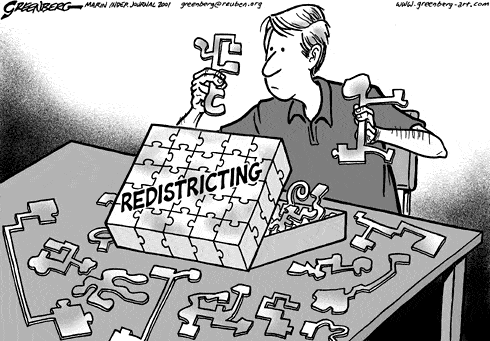
What is redistricting?
the process of establishing the number of representatives in the U.S. Senate
the process of re-drawing United States and state electoral district boundaries
the idea that all states should have an equal number of people in Congress
the use of the Census to determine who should run for office
How often does the census occur?
Every 4 years
Every 8 years
Every 10 years
Every 25 years
The original gerrymander was likened to which animal?
Ox
Spider
Reptile
Turtle
Gerrymandering is:
When district boundaries are drawn in order to benefit the party in power and help it stay in power
When seats in the House of Representatives are redistributed among states because of changes in population
When district boundaries are redrawn to reflect changes in population.
A measurement of the US population that occurs every ten years
What is the main concern with gerrymandering?
It reduces the chance of a district favoring one political party
It allows politicians to pick their voters
It creates fair and competitive elections
It increases voter turnout
Who is responsible for redrawing districts in the United States?
European countries
Third-party organizations
State legislators
Independent commissions
What is packing in the context of gerrymandering?
When districts are created by state legislators
When districts are redrawn to favor one political party
When like-minded voters are stacked into a few districts
When like-minded voters are spread across many districts
What is cracking in the context of gerrymandering?
When like-minded voters are spread across many districts
When like-minded voters are stacked into a few districts
When districts are redrawn to favor one political party
When districts are created by state legislators

