Wayground logo

Free Printable Worksheets

Font size

S
M
L
XL
Worksheets

Homeostasis

Total questions: 59

Worksheet time: 37mins

Name
Class
Date
1.

Osmosis is what type of transport?

a)

Active

b)

Passive

2.

Osmosis needs _____ energy.

a)

zero

b)

a lot of

c)

10 kilowatts

d)

some

3.

Osmosis is the movement of

a)

Sugar

b)

CO2

c)

Water

d)

Proteins

4.

Osmosis is the movement of

a)

water from high concentration to low concentration

b)

water from low concentration to high concentration

c)

sugar from high concentration to low concentration

d)

sugar from low concentration to high concentration

5.

_____ is the amount of a given substance contained in a solution

a)

concentration

b)

equilibrium

c)

diffusion

d)

facilitated diffusion

6.

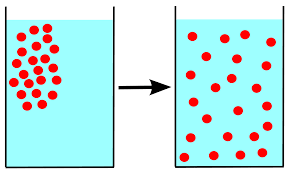
If the dots represent sugar which is more concentrated

a)

Inside the cell

b)

Outside the cell

c)

Neither they are equal (equilibrium)

7.

If the dots represent sugar, what direction will water flow?

a)

Into the cell

b)

Out of the cell

c)

Into and out equally (equilibrium)

8.

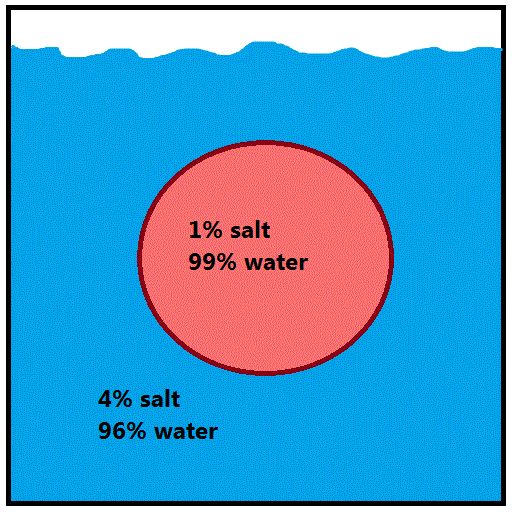
If the percentage represents sugar, what direction will water flow?

a)

Into the cell

b)

Out of the cell

c)

Into and out equally (equilibrium)

9.

If the miligrams are referring to the amount of sugar, what direction will water flow?

a)

Into the cell

b)

Out of the cell

c)

Into and out equally (equilibrium)

10.

Which cell would water move into?

a)
b)
c)
d)
11.

A substance that can dissolve a solute to create a solution.

a)

Solvent

b)

Solute

c)

Solution

12.

A substance that can be dissolved by a solvent to create a solution

a)

Solvent

b)

Solute

c)

Solution

13.

What are TWO ways you can predict the movement of water?

a)

from a [High] of water to a [Low] of water

b)

towards the [Lower] of solutes

c)

towards the [Higher] of solutes

d)

from a [Low] of water to a [High] of water
14.
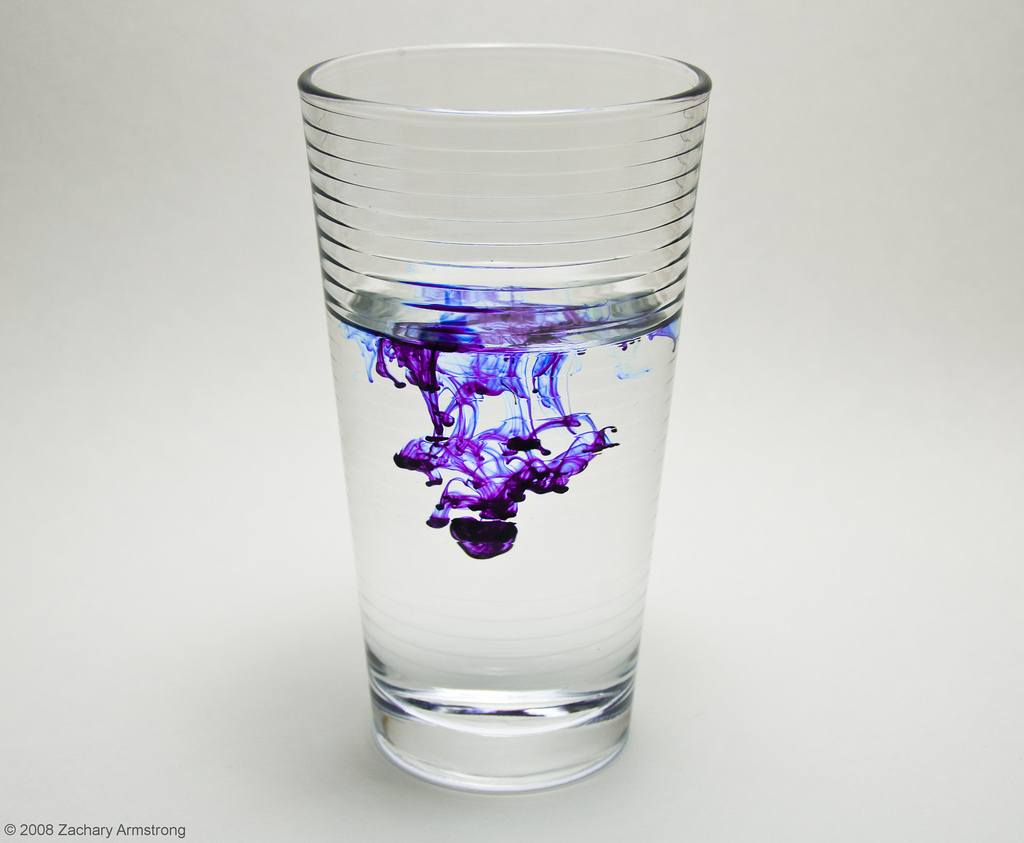
Where is there a low concentration of dye?
a)
at the bottom of cup
b)
in the color
c)
at the top of cup 
d)
no concenteraion gradient
15.
What is diffusion?
a)
when molecules move 
b)
when molecules move from a high concentration to a low.
c)
no movement 
d)
molecules move everywhere
16.
The picture below is an example of _________________.
a)
osmosis
b)
isotonic
c)
diffusion
d)
active transport
17.
Where is there a high concentration of water?
a)
in the flower
b)
cannot be determined by picture.
c)
in the vase
d)
in the leaves
18.
Where is there a low concentration of perfume?
a)
in the bottle
b)
on the hand
c)
in the room
d)
in the top
19.
When both inside and outside of a cell have the same amount of water it is said that the cell has reached a state of
a)
Osmosis
b)
Diffusion
c)
Equilibrium
20.
A person would never have pure water put into their veins in a hospital because their cells would...
a)
Shrink/Dehydrate
b)
Expand
21.
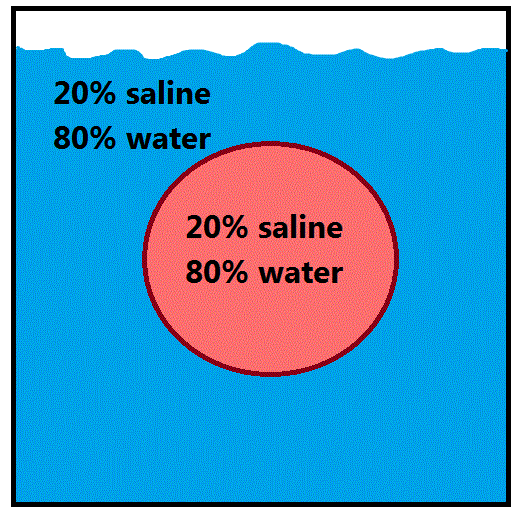
Where will the water go?
a)
Into the cell
b)
Out of the cell
c)
Equally in & out - it's isotonic
d)
There is no water
22.
A blood cell is placed into the jar, as seen. Where will the water go?
a)
Into the cell
b)
Out of the cell
c)
Equally in & out - it's isotonic
d)
The water is a lie
23.
ISO means...
a)
Low
b)
A lot
c)
Equal
d)
Mammal
24.
HYPO means...
a)
Low
b)
High
c)
Equal
d)
Fat
25.
What happens if someone gives you a 90% salt saline drip?
a)
Your cells will shrivel and you'll die
b)
Your cells will swell and you'll die
c)
Nah you'll be fine.
26.
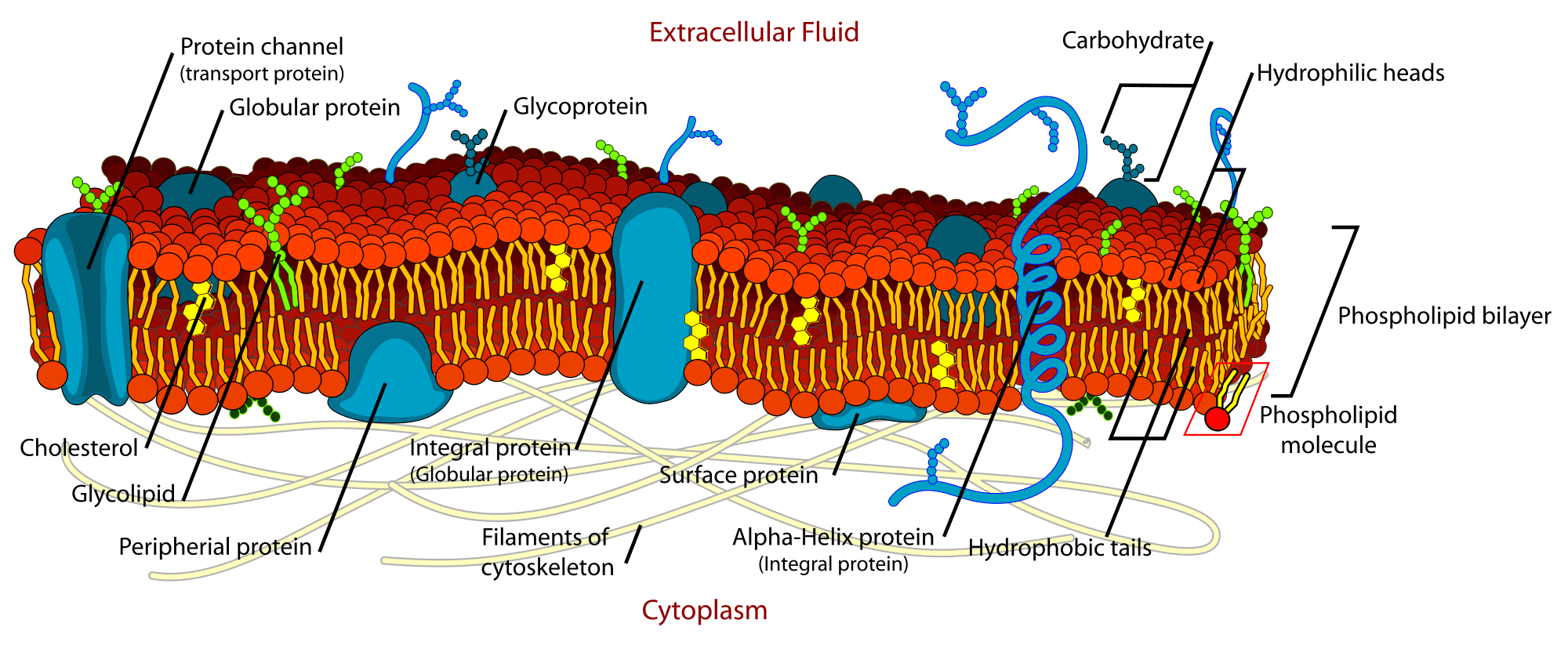
What is this image?
a)
cell membrane
b)
proteins
c)
carbohydrates
d)
lipids
27.
The function of the plasma membrane is....
a)
to regulate what enters and leaves the cell.
b)
fight bacteria and viruses that enter the cell.
c)
provide rigid support and protection to the cell.
d)
make sure each cell can move
28.
What does "bilayer" mean?
a)
one layer
b)
two layers
c)
laminated
d)
bilateral
29.
Most of the cell membrane is made of...
a)
Lipids
b)
Carbohydrates
c)
Proteins
d)
Nucleic acids
30.
What do the brown structures represent?
a)
Phospholipids
b)
Glycoproteins
c)
Channel Proteins 
d)
Cyctoskeleton Filaments
31.
What forms the channels and pumps in the phospholipid bilayer?
a)
carbohydrates
b)
proteins
c)
hydrophilic heads 
d)
lipids
32.
Hydrophilic means...
a)
water-loving
b)
water-fearing
c)
nonpolar
d)
lipid soluble
33.
Hydrophobic region of the cell membrane?
a)
E
b)
B
c)
C
d)
A 
34.
Hydrophilic portion of cell membrane?
a)
A
b)
C
c)
D
d)
E 
35.

The three functions of the cell membrane are to:

a)

protect the contents of the cell

b)

control all the functions of the cell

c)

control what enters and leaves the cell

d)

signal to other cells and communicate

36.

This is a

a)

cell

b)

cholesterol

c)

lipid

d)

phospholipid

37.

How many layers of phospholipids are in a cell membrane?

a)

one

b)

two

c)

three

d)

four

38.

The head of a phospholipid is

a)

hydroblast

b)

hydrophobic

c)

hydrophilic

d)

hydropump

39.

The tail of a phospholipid is

a)

hydrophilic

b)

hydroblast

c)

hydrophobic

d)

hydropump

40.

The arrow is pointing to the

a)

hydrophobic head

b)

hydrophilic head

c)

hydrophobic tail

d)

hydrophilic tail

41.

The arrow is pointing to the

a)

hydrophilic head

b)

hydrophobic head

c)

hydrophilic tail

d)

hydrophobic tail

42.

The prefix hydro- means

a)

earth

b)

water

c)

sun

d)

cells

43.

The suffix -philic means

a)

hating

b)

loving

c)

cells

d)

Philis

44.

The suffix -phobic means

a)

fear

b)

loving

c)

pho

d)

phone

45.

The _______________ of the phospholipids in a cell membrane face inward towards each other.

a)

heads

b)

tails

c)

stems

d)

sticks

46.

Which two molecules are embedded in the cell membrane?

a)

chlorophyll

b)

cholesterol

c)

glycolipids

d)

glycogen

47.
What is the function of ATP in living things?
a)
provides energy for cells
b)
stores genetic information
c)
provides structure in the nucleus
48.
Which structures shown in the Figure make up the ADP molecule?
a)
A and B
b)
A, B and C
c)
A, B, C, and D
d)
C and D
49.
What does the "TP" in ATP stand for?
a)
2 phosphates
b)
tri (3) phosphates
c)
Two proteins
d)
tri (3) proteins
50.
Which bond of the ATP molecule is broken in order to release energy?
a)
A
b)
B
c)
C
d)
D
51.
Which structures shown in the Figure make up the ATP molecule?
a)
A and B
b)
A, B and C
c)
A, B, C, and D
d)
C and D
52.
Which of the following results in the storage of energy in terms of the ATP/ADP cycle?
a)
The breaking of the bond between the 5-carbon sugar and the 1st phosphate group
b)
The addition of a phosphate group
c)
The removal of a phosphate group
d)
The addition of glucose 
53.
Where is the energy stored in ATP molecules
a)
In the Ribose Sugar
b)
In the Adenine group
c)
In the Phosphate bonds
d)
In the Bank
54.
What type of macromolecule is ATP/ADP?
a)
Carbohydrate
b)
Nucleic Acid
c)
Lipid
d)
Protein
55.
Which type of transport requires an input of energy?
a)
Passive Transport
b)
Osmosis
c)
Simple Diffusion
d)
Active Transport
56.
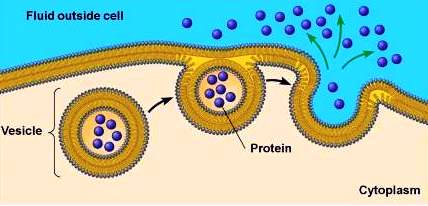
Which form of active transport is being shown?
a)
Facilitated Diffusion
b)
Exocytosis
c)
Endocytosis
d)
Protein Pumps
57.
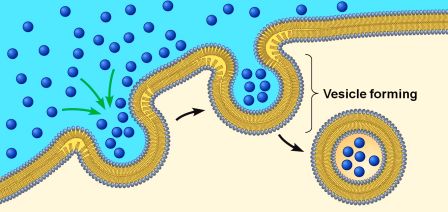
Which form of active transport is being shown?
a)
Pinocytosis
b)
Endocytosis
c)
Exocytosis
d)
Osmosis
58.
Which does NOT require energy to occur?
a)
Passive Transport
b)
Active Transport
c)
Endocytosis
d)
Exocytosis
59.
What is the difference between active and passive transport?
a)
Active does not need energy and passive uses ATP (energy)
b)
Active uses ATP (energy) and passive does not need energy
c)
Active stores transport proteins and passive releases 
d)
Active uses hormones and passive does not