
Font size
 Worksheets
Space Science Quiz
Total questions: 38
Worksheet time: 19mins

What imaginary line is drawn around the earth’s center?
equator
axis
prime meridian

How do the seasons happen?
Earth's distance away from the sun
Earth's distance towards the sun
Earth's tilted axis

How often does a solstice happen in a year?
three times
once
twice

When does the summer solstice happen?
June 23rd
June 21st
December 21st

When does the winter solstice happen?
December 21st
December 22nd
June 21st

What is an equinox?
This is the time in the year that is halfway between the solstices.
This is the time in the year that is a quarter between the solstices.

An equinox happens twice a year.
false
true

What does the vernal equinox mark the start of?
fall
spring
winter
summer
This is what Earth's axis is always pointed at.
North Star (Polaris)
Sun
Moon
Big Dipper


What season is the northern hemisphere in at position D
winter
spring
summer
fall

In what position would the northern hemisphere need to be at to be in winter?
D
V
W
X

If it's spring in the northern hemisphere at V, what season will the northern hemisphere be in at X?
winter
spring
summer
fall
What causes a hemisphere to be in the summer season?
It's closer to the sun.
It's receiving the direct rays of the sun.
It's tilted away from the sun.
The axis is pointed towards the north star.
1. Which diagram shows how the Earth’s axis is tilted when it is summer in the Southern Hemisphere?


Which diagram shows the position of the Earth in relation to the Sun’s rays during a winter in the Northern hemisphere?


In the diagram below, the Northern hemisphere would be in what season at position A?
Fall or Autumn
Spring
Winter
Summer

In the diagram, Earth’s southern hemisphere in position 1 is experiencing___
Spring
Fall
Summer
Winter

The Northern hemisphere experiences the beginning of spring when Earth is in
Position 1
Position 2
Position 3
Position 4
Comets make there way around the sun in an elliptical orbit.
TRUE
FALSE


I am located between Mars and Jupiter.
Comet belt
Asteroid belt
Meteor belt
Stars
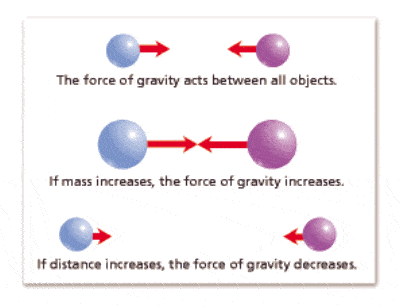
What two things determine the gravity of an object?
mass & weight
mass & distance
density & mass
volume & distance
Match the galaxies.
Irregular
A galaxy with no set shape
Spiral
A galaxy with arms protruding out of the center
Elliptical
A galaxy shaped like a ball

What galaxy is this?
Spiral
Irregular
Elliptical


What type of galaxy is pictured here?
Elliptical
Irregular
Spiral

What type of galaxy is pictured here?
Elliptical
Irregular
Spiral

