
Font size
 Worksheets
AP Physics 1 - Dynamics Review (Unit 2 & 3)
Total questions: 36
Worksheet time: 25mins

Is this object in equilibrium?
Yes and it's moving right
Yes and its at rest
No, it's accelerating right
No, it's at rest
Which of these is a correct sum statement for Fx?
Fa - Ff = ma
Fnet = Ff
Fn/Fg
Fa = ma

Is it possible for the normal force to be equal to the gravitational force?
Yes. If the surface is horizontal.
Yes. If the surface is vertical
No. FN will always be less than Fg
No. Fg will be less than FN.

Here are 3 FBD diagrams for an elevator. Consider them to be A, B, C. Which one shows an elevator accelerating upward?
A
B
C
none of these
Here are 3 FBD diagrams for an elevator. Consider them to be A, B, C. Which one shows an elevator at rest?
A
B
C
none of these
Here are 3 FBD diagrams for an elevator. Consider them to be A, B, C. Which one shows an elevator moving upward but braking?
A
B
C
none of these
Here are 3 FBD diagrams for an elevator. Consider them to be A, B, C. Which one shows an elevator moving at a constant rate of 2.5 m/s?
A
B
C
none of these

Is it possible for the object in the diagram to be moving to the right and have this FBD?
Yes. It's possible that the x forces were just left off the diagram.
Yes. It could be moving at a constant velocity.
No. The FBD shows that the system is in equilibrium.
No. An FBD shows all F.
True or False
Forces cause motion.
True. Every motion requires a force.
True. Every force causes motion.
False. Motion can occur when there is no net force
False. Only net forces cause motion.
True or False
Forces cause acceleration.
True. Every acceleration requires a force.
True. Every force causes acceleration.
False. Acceleration can occur when there is no net force
False. Only net forces cause acceleration.
A tennis ball is thrown upward by a student so that it leaves their hand at 5.29 m/s. After it leaves their hand, what keeps it moving up?
The initial force of their hand overcame gravity
Nothing. The ball simply has inertia.
gravity keeps it moving up.
It is not actually moving up. That is a construct.
Your mother is standing on a concrete floor in flat shoes. When she lifts one foot, what happens to the normal force?
it does not change
it drops to half
it doubles
If the sum of all the forces acting on a moving object is zero, the object will _____.
slow and stop
immediately stop
accelerate uniformly
continue with its present velocity
Acceleration is _____.
inversely proportional to mass
inversely proportional to force
directly proportional to mass
directly proportional to momentum
True or False
An object can enact a force on itself.
True
False
Which object has the most inertia?
A 5kg tennis ball traveling at 10m/s.
A 30kg book resting on a desk.
A 0.2kg leaf falling from a tree.
A 20kg brick thrown at 15m/s.

A block of weight W is pulled along a horizontal surface at constant speed v by a force F, which acts at an angle Θ with the horizontal, as shown. The normal force exerted on the block by the surface has magnitude_____.
greater than W
greater than 0 but less than W
equal to W
0
An object falling through the air at terminal speed experiences ______.
a net force of 0
equilibrium
no acceleration
all of the above

Rank the tensions experienced by the strings.
TA > TB > TC
TB > TA = TC
TB > TC > TA
Cannot be determined
An object sliding across a surface will experience ______ friction.
static
potential
kinetic
no
Terry enacts an applied force on a wall. The wall will enact a(n) ______ force on Terry.
tension
normal
electromagnetic
applied

Two bricks are stacked on a floor. A student draws the force diagram for brick 2, as shown above. The forces are an upward normal force, a downward force exerted by brick 1, and a downward gravitational force. How many of the forces, if any, in the force diagram are contact forces caused by microscopic interactions?
Zero
Only one
Only two
All three
A tennis ball is thrown against a vertical concrete wall that is fixed to the ground. The ball bounces off the wall. How does the force exerted by the ball on the wall compare with the force exerted by the wall on the ball?
The force exerted by the ball is greater.
The forces exerted by the ball and the wall have the same magnitude.
The force exerted by the ball is smaller.
The relative magnitudes of the forces cannot be determined without knowing how long the ball and the wall are in contact.

The force diagram above shows a box accelerating to the right on a horizontal surface of negligible friction. The tension T is exerted at an angle of 30° above the horizontal. If μ is the coefficient of kinetic friction between the box and the surface, which of the following is a correct mathematical equation derived by applying Newton’s second law to the box?


Two blocks, with masses indicated in the figure above, are at rest on a horizontal surface and connected by a string of negligible mass and a compressed spring. There is negligible friction between the blocks and the surface. The string is cut, and the spring pushes the blocks away from each other. Which of the following statements are true about the motion of the blocks immediately after the string is cut? Select two answers
The velocity of the center of mass of the two-block system is zero.
The velocity of the center of mass of the two-block system is directed toward the right.
The magnitude of the acceleration of the left block is equal to that of the right block.
The magnitude of the acceleration of the left block is greater than that of the right block.

Three blocks are connected by strings and pulled to the right by a force with magnitude F0, as shown in the figure above. All frictional forces are negligible. The tension in the right and left strings have magnitudes T1 and T2, respectively. Taking the positive direction to be toward the right, which of the following is a correct equation of motion for the block of mass m2?
T1 + T2 = m2a
T1 - T2 = m2a
T1 + F0 - T2 = m2a
T1 = m2a
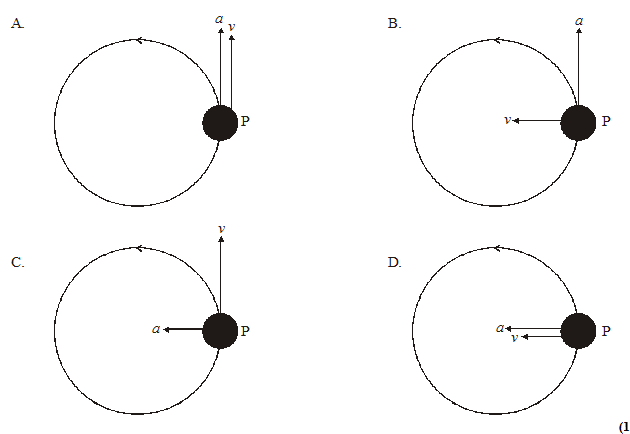

A curved groove is place on the top of a level table as shown in the diagram. A ball is pushed in the groove at P so that it leaves at Q. Which picture shows how the ball will move when it leaves the groove at Q?


A satellite of mass m and speed v orbits the Earth at a distance r from the center of the Earth. The gravitational acceleration due to the Earth at the satellite is equal to.
v/r
v2/r
mv/r
mv2/r

Which of the following ranks the tensions in the strings from highest to lowest?
A>C>D>B
B>D>C>A
B>C>A>D
D>A>C>B

