wayground logo

Free Printable Worksheets

NEW

Font size

S
M
L
XL
Worksheets

ReTEKs EOC Review

Total questions: 60

Worksheet time: 1hrs 10mins

Name
Class
Date
1.
Viruses are made of
a)
Nucleic Acids and DNA
b)
Nucleic Acids and Proteins
c)
Proteins and Bacteriophages
d)
Proteins and Capsids
2.
A Pathogen is a
a)
disease causing agent
b)
endospore
c)
bacteria
d)
virus
3.
What is the process by which a bacteria cell replicates its DNA and divides in half?
a)
Lysis
b)
Binary Fission
c)
Conjugation
d)
Prophage
4.
Obligate Anaerobes _____
a)
need oxygen
b)
prefer nitrogen
c)
can only survive in an oxygen free environment
d)
are endospores
5.
What is letter A pointing to?
a)
Flagellum
b)
Pili
c)
Capsid
d)
DNA
6.
The picture here is a :
a)
Eubacteria
b)
Eukaryote
c)
Virus
d)
Fungus
7.
What is pictured?
a)
T4 Bacteriophage
b)
Prion
c)
Tobacco Mosaic Virus
d)
Prophage
8.
The top arrow is pointing to...
a)
Capsid
b)
Cell Wall
c)
DNA
d)
Flagellum
9.
During Lysogenic Infections..
a)
the host cell is copied many times over
b)
the host cell is destroyed
c)
the host cell is unaffected
d)
the virus dies
10.
What is the piece of DNA that is embedded in the host's DNA called?
a)
Prion
b)
Prophage
c)
Pili
d)
Pathogen
11.
What is NOT an example of controlling bacteria?
a)
Nitrogen Fixing
b)
Disinfecting
c)
Antibiotics
d)
Food Storage and Processing
12.
Which of these could successfully be treated with antibiotics?
a)
HIV
b)
Strep Throat
c)
Influenza
d)
Common Cold
13.
Retroviruses are made of
a)
RNA only
b)
Proteins Only
c)
DNA and a protein coat
d)
RNA and a protein coat
14.
What cycle involves newly formed viruses being released from a bursting host cell?
a)
Lytic Cycle
b)
Lysogenic Cycle
c)
Bacterial Cycle
d)
Nitrogen Cycle 
15.
What is ecological succession?
a)
A slow change in an environment
b)
A change that takes days in an environment
c)
No change
d)
Abiotic change
16.
What are examples of pioneer species in a primary succession?
a)
Bushes and Shrubs
b)
Oak trees
c)
Mossess and Lichens 
d)
A rose Bush
17.
A pioneer species is...
a)
a large organism
b)
the first organisms to adapt to a new environment 
c)
The best organism 
d)
Abiotic organisms 
18.
What is the most important function of pioneer species?
a)
To create rocks
b)
To create soil and add nutrients to the environment 
c)
To look nice
d)
Food for animals 
19.
A climax community is ….
a)
the beginning of a new ecological succession.
b)
the rocks in a new environment.
c)
the fire that will cause destruction.
d)
an area that reaches its greatest growing potential.
20.
What is the difference between primary and secondary succession?
a)
Primary succession already has soil.
b)
Primary has soil and secondary does not
c)
soil is present in both
d)
primary has no soil and secondary has soil
21.
A large tree forest is an example of ...
a)
a small community
b)
a abiotic community
c)
a climax community
d)
a pioneer species 
22.
Why does primary succession take longer to reach climax community?
a)
Because trees do not perform photosyntheses.
b)
Because climax community is in a forrest.
c)
Because primary succession already has soil
d)
Because primary succession does not have soil
23.
Which is the correct order in primary succession?
a)
Rocks, Lichens & Mosses, Bushes & Shrubs, Trees
b)
Lichens & Mosses, Rocks, Trees, Bushes & Shrubs 
c)
Trees, Bushes and Shrubs, Lichens & Mosses, Lichens & Mosses
d)
Rocks, Grass, Trees, Bushes & Shrubs
24.
First species to arrive in an area
a)
invasive species
b)
abiotic components
c)
pioneer species
d)
parasites
25.
First species occuring in areas of primary succession are mosses and
a)
grasses
b)
wildflowers
c)
trees
d)
lichens
26.
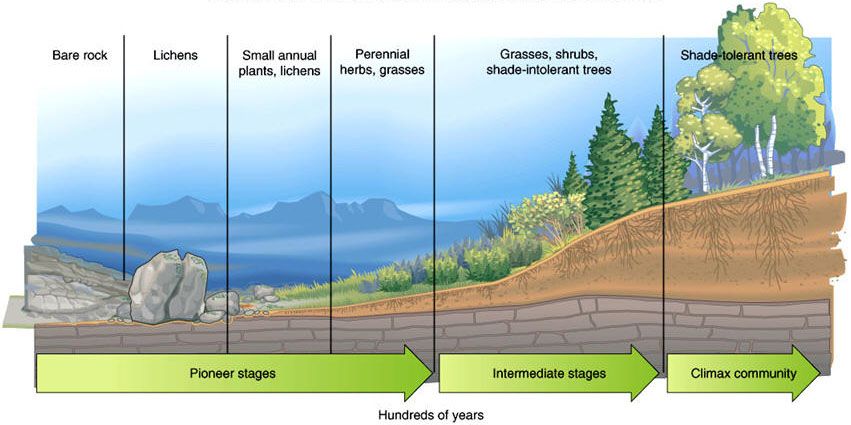
The picture shows what type of succession?
a)
primary
b)
secondary
c)
tertiary
d)
quadanary
27.
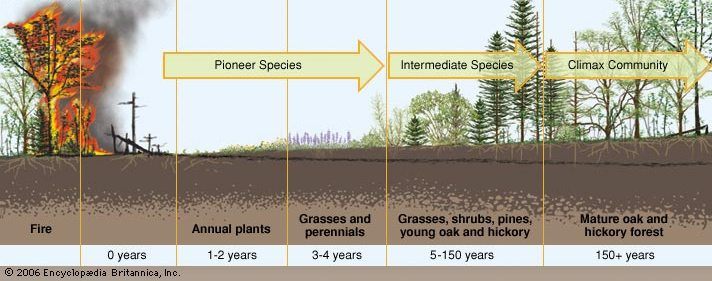
The picture shows what type of succession?
a)
primary
b)
secondary
c)
tertiary
d)
quadanary
28.
After a volcanic eruption, lava covers the land. What is the order that plants grow to repopulate the area?
a)
Lichens → Shrubs → Grasses → Trees
b)
Lichens → tree → shrubs→Grasses
c)
Grasses → Lichens → Shrubs → Trees
d)
Lichens → Grasses → Shrubs → Trees
29.
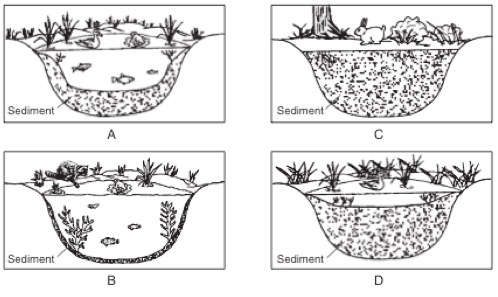
What is the correct order from oldest (happened first) to youngest (happened last) in this pond succession?
a)
A, B, C, D
b)
D, C, B, A
c)
B, A, D, C
d)
C, D, A, B
30.
What is the first species you will see after a primary succession? (in picture)
a)
lichens
b)
grasses
c)
small plants
31.
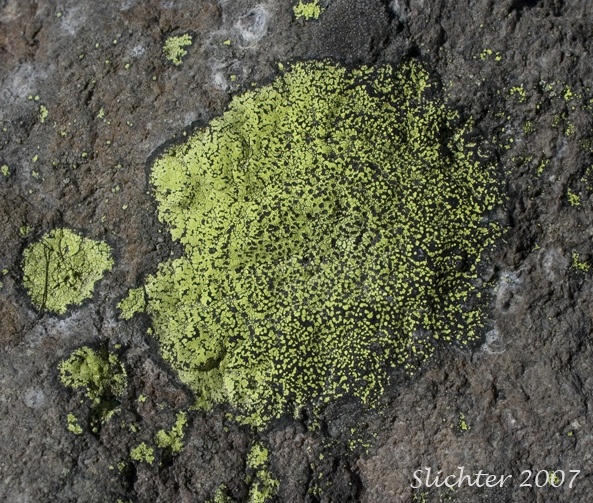
This is an example of...
a)
Climax communities
b)
Secondary succession
c)
Lichen
d)
Pioneer species
32.
A pioneer species is...
a)
a large organism
b)
the first organisms to adapt to a new environment 
c)
The best organism 
d)
Abiotic organisms 
33.
What is the most important function of pioneer species?
a)
To create rocks
b)
To create soil and add nutrients to the environment 
c)
To look nice
d)
Food for animals 
34.
Succession that occurs in an area with NO SOIL
a)
ecological succession 
b)
primary succession 
c)
secondary succession
d)
pioneer speciles
35.
 Invasive plant species affect the interactions of living and nonliving components of an ecosystem, so the removal of invasive plants is often necessary. The goal of most plant-control methods is to disrupt or inhibit the function of different plant systems. For example, insects can be used to chew through roots in order to reduce a plant’s ability to absorb water.
Which of these functions would be most immediately affected by a reduction in water uptake by roots?
a)
Disease resistance 
b)
Seed dispersal
c)
Sunlight absorption
d)
Photosynthesis 
36.
A student reads this advertisement for a product containing a plant micronutrient that can be added to soil.
Based on this information, the student can conclude that boron is absorbed by plant roots from soil and then —
a)
transported to reproductive tissues by the plant’s shoot system
b)
stored in plant stems until the flowers are pollinated
c)
concentrated in the roots until the plant’s reproductive tissues mature
d)
transported by the phloem to the stomata in leaves, where it attracts pollinators
37.
 A student conducted an investigation to study phototropism in grasses. The only difference between the control group and the experimental group was light conditions. The control group was provided full light, while the experimental group was shaded on one side. The diagrams show the average heights and positions of blades of grass in the investigation.
Which statement best explains why the grass tips of the experimental group bent toward the light?
a)
Water evaporated faster on the side of the plant having full light
b)
Light sensors in the grass tips stimulated a hormone in the shoot system.
c)
The xylem in the root system absorbed more nutrients from the shaded side.
d)
The side facing the light has a greater chance of absorbing carbon dioxide from the atmosphere.
38.
A student studying interactions between body systems constructs this table. The student plans to fill out the table with phrases that describe an interaction between each pair of systems. 
Which of these phrases could be placed in the position marked with an X? 
a)
Provides nutrients to kidney cells
b)
Provides nutrients to brain cells
c)
Provides nutrients to nerve cells
d)
Provides nutrients to muscle cells 
39.
 Recent studies in bone research indicate that using ultrasound on a broken bone can decrease the healing time by 25%. Which of these are the most basic levels of organization involved when a bone heals? 
a)
Cells and tissue
b)
Cells and organ system
c)
Organ system and organism
d)
Tissue and organ system
40.
Which of the following is an example of the endocrine system directly interacting with the nervous system?
a)
The vertebrae protect the spinal cord from injury.
b)
Hormones provide feedback that affects neural processing.
c)
Sensory receptors in bones send signals about body position to the brain. 
d)
The brain sends signals that control the speed at which food moves through the intestines.
41.
The diagram demonstrates a feedback process involving antidiuretic hormone (ADH). ADH increases the permeability of parts of the nephrons of the kidney, resulting in less water in the urine.
This feedback loop is likely to be activated when — 
a)
the body experiences dehydration
b)
blood glucose levels are stable
c)
body temperature drops
d)
the urinary tract is infected
42.
The picture shows bean-shaped glands called nodes. The clusters of cells in nodes include macrophages that break down viruses and other potentially harmful materials. Nodes also contain cells that produce protein particles capable of capturing harmful materials that flow in tissue fluid through the nodes. Different parts of the body are drained by nodes in different regions of the body.
Which body systems are directly responsible for regulating these nodes and protecting the body from harmful materials in tissue fluid?
a)
Immune and lymphatic systems
b)
Digestive and nervous systems
c)
Endocrine and digestive systems
d)
Circulatory and nervous systems
43.
 The surface of the stomach is lined with epithelial cells called surface mucous cells. These cells produce a thick mucus that coats the epithelium on the inside surface of the stomach. What is the purpose of the mucous coating?
a)
It allows the epithelium to aid in the process of digestion.
b)
It causes the epithelium to expand as food enters the stomach.
c)
It protects the epithelium from the acid content of the stomach.
d)
It traps nutrients inside the epithelium as food passes through the stomach
44.
Cytokinins are a class of plant hormones that help regulate growth by promoting cell division. Cytokinins are produced mainly in meristematic tissue, where most plant growth occurs. Which system carries cytokinins produced in the roots to the rest of the plant?
a)
Vascular system
b)
Dermal system
c)
Reproductive system
d)
None of these
45.
Scientists studying illnesses caused by chemically contaminated food conduct research to minimize the effects of these diseases on society. These chemicals harm the body through interactions between the digestive system and the immune system. Scientists conducting this research are likely to describe which of these interactions between the digestive and immune systems? 
a)
Chemicals enter the immune system through a break in the skin. The chemical contamination is then passed to the digestive system by the circulatory system.
b)
The immune system transforms the chemicals in the contaminated foods into harmless chemicals. These harmless chemicals are then broken down by the digestive system.
c)
When contaminated foods are eaten, the immune system prevents the chemicals from entering the digestive system.
d)
Chemicals enter the digestive system through contaminated foods. Once in the body, the chemical contaminants impair the body’s ability to fight off infectious diseases.
46.
Several structures work together to allow flowering plants to reproduce. The diagram shows a typical flower.
Which table correctly identifies the function of each structure or group of structures in the reproduction of the plant?
a)
X Pollen production
Y Pollen transfer
Z Production of eggs
b)
X Attraction of pollinators
Y Production of male sex cells
Z Egg production and embryo development
c)
X Protection for embryo
Y Supply nourishment to embryo
Z Place of embryonic development
d)
X Photosynthesis
Y Production of cells that protect internal organs
Z Production of egg and sperm
47.
The graph models core body temperature during a rapid change in environmental conditions.
Which statement explains the pattern in the graph?
a)
Body temperature varies in a predictable pattern during the day.
b)
Body temperature is controlled by an internal feedback mechanism.
c)
Vasodilation and vasoconstriction are dependent on the time of day.
d)
Vasodilation and vasoconstriction trigger an immediate increase in body temperature.
48.
Plants called sundews have rounded green leaves with many hair-like structures. The ends of these structures contain enzymes in a sticky liquid that looks like nectar or moisture, as shown in the picture. The hairs do not react to dust or nonliving material but will bend inward when insects get caught in the sticky liquid. Sundews digest trapped insects over a period of a few days.
Based on this information, what functions do the specialized leaves of sundews perform?
a)
Provide water to the plant and perform photosynthesis
b)
Respond to stimuli and anchor the plant
c)
Provide nutrients to the plant and respond to stimuli
d)
Release pollen to insects and perform photosynthesis
49.
 During the final stages of human gestation, receptors for the hormone oxytocin increase on the smooth muscle cells of the uterus. The release of oxytocin during labor stimulates the smooth muscle tissue in the wall of the uterus. The vigorous contraction of the uterine smooth muscle helps push the baby through the birth canal so that delivery can occur. This process involves the interaction of which organ systems? 
a)
Endocrine and muscular only
b)
Endocrine and reproductive only
c)
Endocrine, muscular, and reproductive
d)
Endocrine, reproductive, and excretory
50.

A lion eating a zebra is an example of:

a)

predation

b)

mutualism

c)

commensalism

d)

parasitism

51.

A tick living on the body of a deer

a)

predation

b)

mutualism

c)

commensalism

d)

parasitism

52.

A bee eating the flower's nectar and picking up the flower's pollen

a)

predation

b)

mutualism

c)

commensalism

d)

parasitism

53.

A barnacle living on a whale's skin

a)

predation

b)

mutualism

c)

commensalism

d)

parasitism

54.

A tapeworm living in a person's intestines

a)

predation

b)

mutualism

c)

commensalism

d)

parasitism

55.

An aphid providing food to an ant in exchange for protection

a)

predation

b)

mutualism

c)

commensalism

d)

parasitism

56.

Competition occurs when organisms attempt to use the same resources

a)

True

b)

False

57.

If two species of bacteria are grown in the same culture, one species will always outcompete the other.

a)

True

b)

False

58.

Members of the same species will tend to divide resources instead of competing over them

a)

True

b)

False

59.

Competition between members of the same species is known as INTERspecific competition

a)

True

b)

False, INTRAspecific

60.

The competitive exclusion principle states that no two organisms can occupy exactly the same niche in exactly the same habitat at exactly the same time

a)

True

b)

False, species