
 Worksheets
Kingdom Plantae Review
Total questions: 60
Worksheet time: 30mins

mosses, no vascular tissues, must have water to reproduce
Bryophytes
Seedless Vascular
Seed Vascular
Gymnosperm
Angiosperm

ferns, vascular tissues, must have water to reproduce (release spores)
Bryophytes
Seedless Vascular
Seed Vascular
Gymnosperm
Angiosperm
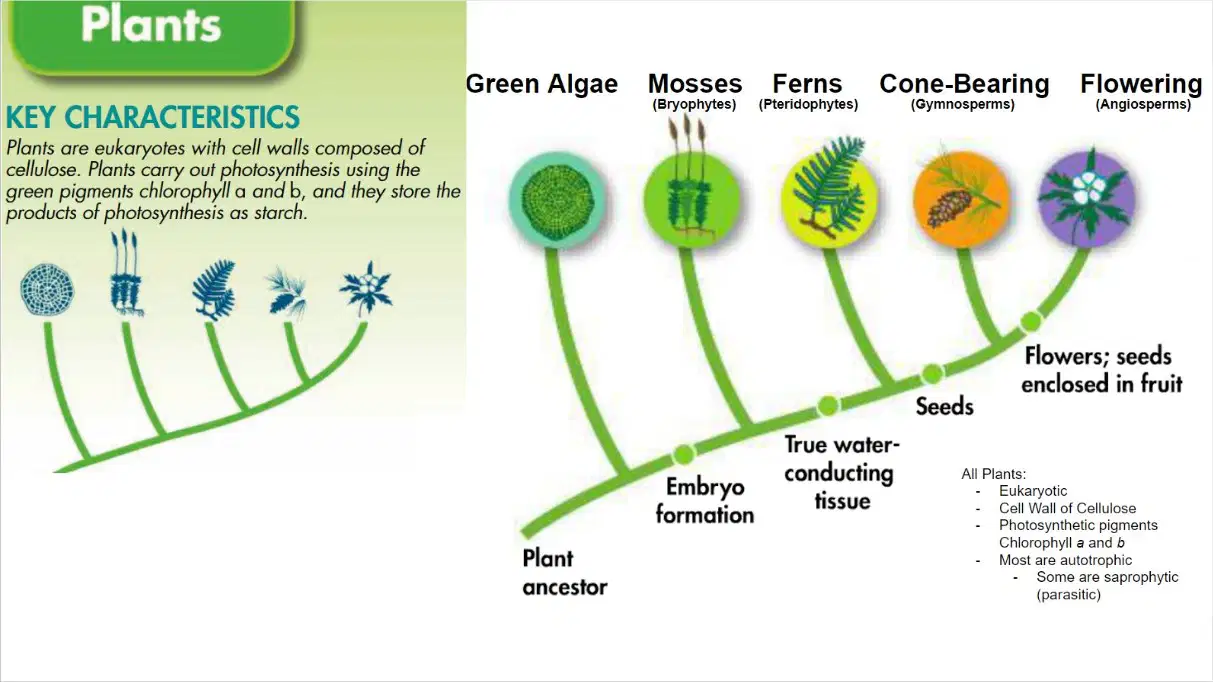
vascular tissues, do NOT need water to reproduce
Bryophytes
Seedless Vascular
Seed Vascular
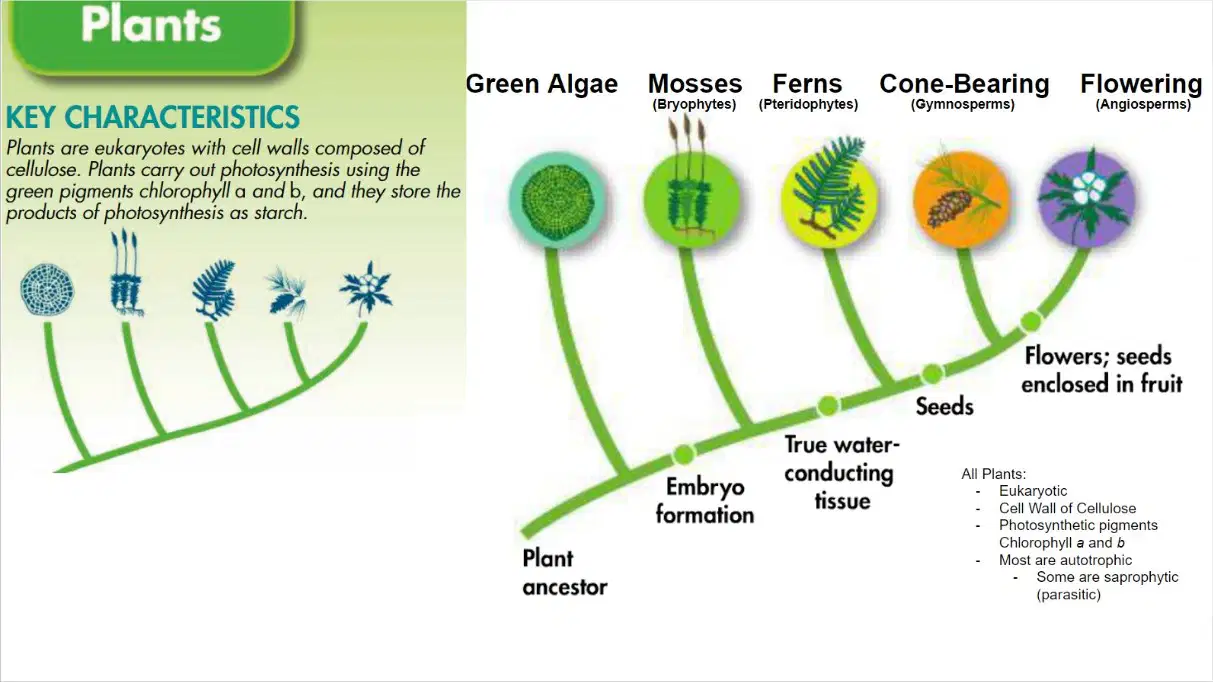
Seed vascular plants that do not need water to reproduce via cones, not flowers
Gymnosperms
Angiosperms
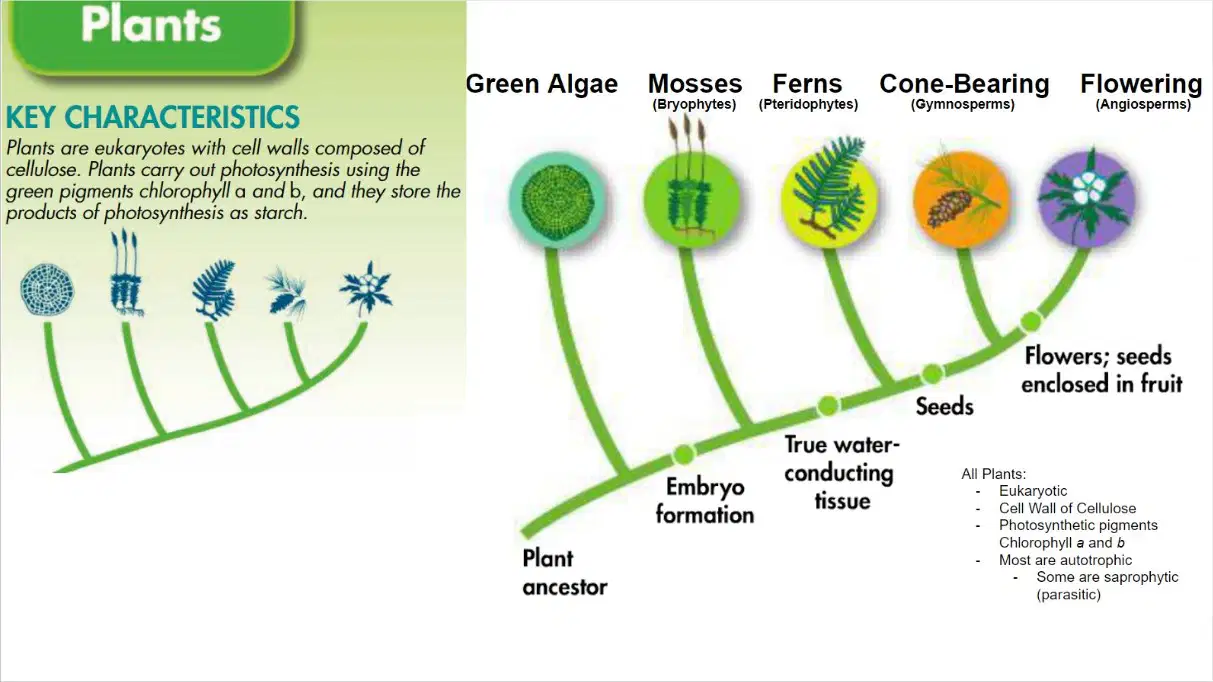
Seed vascular plants that do not need water to reproduce via flowers, not cones
Gymnosperms
Angiosperms
flowering plants (angiosperms) with one seed leaf, parallel venation, fibrous roots, flower parts in multiples of 3
Monocots
Dicots
flowering plants (angiosperms) with two seed leaves, branched venation, taproots, flower parts in multiples of 4 or 5
Monocots
Dicots
It was difficult for plants to adapt to land because they had to figure out how to:
reproduce with water
reproduce without water
manage water loss
transport sugars/water
Bryophytes must remain small and live in wet areas because:
they need water to reproduce
they do not need water to reproduce
they do not have vascular tissues
they have vascular tissues
A region of very active cell division (plant can grow taller and/or wider)
meristem
vein
mesophyll
stomata
These increase surface area of roots
root hairs
vascular bundles
veins
cambium
These plants produce seeds
Ferns
Mosses
Angiosperms
Gymnosperms
Select the main organs of plants.
Roots
Stems
Leaves
Cork
Wood
Vascular Tissue that transports water/minerals
Xylem
Phloem
Vascular Tissue that transports sugars
Xylem
Phloem
Select the three main parts of a leaf.
Petiole
Blade
Veins
Stem
Cork Cambium
In alternation of generations, the gametophyte that is male and produces sperm.
Antheridia
Archegonia
In alternation of generations, the gametophyte that is female and produces an egg.
Antheridia
Archegonia
Large, deep root. Easily visible in dicots.
Taproot
Fibrous roots
Small, shallow roots. Found in monocots.
Taproot
Fibrous roots

One cotyledon (seed leaf)
Monocot
Dicot
Two cotyledons (seed leaves)
Monocot
Dicot
Rings of vascular bundles
Monocot
Dicot
Scattered vascular bundles
Monocot
Dicot
Fibrous Roots
Monocot
Dicot
Taproots
Monocot
Dicot
Flower parts = multiples of 4 or 5
Monocot
Dicot
Flower parts = multiples of 3
Monocot
Dicot
Leaves with parallel venation
Monocot
Dicot
Leaves with net venation
Monocot
Dicot

Identify #1
petal
sepal
pistil (carpel)
stamen
xylem
Identify #2
petal
sepal
pistil (carpel)
stamen
xylem
Identify #3
petal
sepal
pistil (carpel)
stamen
xylem
Identify #4
petal
sepal
pistil (carpel)
phloem
xylem
Identify #5
petal
sepal
pistil (carpel)
phloem
xylem

The _____ of flowers are the tiny sacs that produce the male gametophytes (pollen) of angiosperms.
anthers
filaments
ovaries
sepals
The female structure of a flower that can be made up of a single carpel or two or more fused carpels is a _____.
stamen
anther
filament
pistil
The small female gametophyte of an angiosperm, contained within an ovule.
embryo sac
carpel
flower
style

Identify #1 of this pistil (carpel)
ovary
style
ovules
stigma
Identify #2 of this pistil (carpel)
ovary
style
ovules
stigma
Identify #3 of this pistil (carpel)
ovary
style
ovules
stigma
The transfer of pollen to the female portion of the flower.
pollination
fertilization
double fertilization
meiosis

Pollination occurs when pollen grains land on the _______ of a flower.
stigma
style
ovary
petal
Angiosperms can be pollinated via
wind
animals
water
Most angiosperms are pollinated via
wind
animals
water

The food storage tissue resulting from double fertilization in angiosperms.
zygote
ovule
seed
endosperm
Identical offspring is produced by a single parent.
vegetative reproduction
pollination
fertilization
sexual reproduction
A method of vegetative reproduction, propagating many identical woody plants using the buds from a desirable plant.
grafting
fertilization
double fertilization
pollination

Fruits develop when the walls of a(n) ______ thicken as seeds mature.
stigma
style
ovary
How can seeds be dispersed?
Animals
Water
Wind
none of these
A period of time during which a plant embryo does not grow.
dormancy
photoperiodism
meristem
cellular division
The growth stage of a plant embryo.
germination
dormancy
pollination
double fertilization
A substance that targets specific receptors of specific cells/tissues.
pollen
hormone
chemotropism
antheridium
A plant hormone that cause stem and fruit growth, as well as seed germination.
Gibberellins
Abscisic Acid
Auxin
Cytokinins
This hormone causes the ripening of fruits
Ethylene
Auxin
Cytokinins
Abscisic Acid
This hormone controls apical dominance.
Auxin
Gibberellin
Cytokinin
Ethylene
This hormone stimulates growth in shoot (stem) tips and growth of new roots.
Auxin
Ethylene
Gibberellins
Cytokinins
This plant hormone speeds up cell division.
Cytokinin
Auxin
Abscisic Acid
Ethylene

A plant that flowers after a long period of darkness.
Short-Day Plant
Long-Day Plant

A plant that flowers after a short period of darkness.
Short-Day Plant
Long-Day Plant
![NC Biology EOC [2019 released]](https://cf.quizizz.com/image/image-loader.svg)
