
 Worksheets
End of Year Science Review
Total questions: 113
Worksheet time: 2hrs 33mins
What could they do to make sure their results are valid?
Which would be the best way for him to perform his experiment?

of the following statements best describes the students' data?
) Louis is dropping a large rubber ball and a small rubber ball from the same height to determine which ball will bounce the most. Louis hypothesizes that the larger rubber ball will have the greatest number of bounces. As he conducts his experiment, he records the number of bounces each ball makes in ten trials in his data table. After he finishes, he studies his data, summarizes his results, and discusses his findings.
Louis tries to make sense out of his data to determine if he can make any claims about his hypothesis. What is this process called?
writing a report
making a conclusion
collecting data
developing a question
Gina's grandparents have a small orange grove. Gina wants to find out if planting clover around the base of the orange saplings will help them grow. To find out, she plants clover around three rows of saplings. Gina does not plant any clover around the last row of saplings.
Why does Gina leave the fourth row of saplings without any clover?
The last row is the control in Gina's investigation.
Clover is too expensive to put around all the trees.
The trees aren't able to reproduce with clover planted around them.
Clover attracts predators that will keep animals from living in the trees.
) Billy's class is studying the Moon. He is curious about how craters are formed. His teacher has the class do an investigation to find out if rocks dropped from different heights will make craters that are different in depth.
The class decides to drop a rock from 50 centimeters, 1 meter, and 1.5 meters. In scientific terms, what do we call each of the three different heights that the rock is being dropped from?
control
graph
hypothesis
variable

Rafael loves to blow bubbles in the summer. He spends hours exploring different materials in order to create the largest bubbles possible. He performs an experiment in which he creates bubbles using different materials like string, wire hangers and straws. He repeats the experiment five times. The results are shown in the table.
What should Rafael do to improve his experiment?
He should add variables to his experiment.
He should perform fewer trials to save time.
He should measure the bubbles the same way in each trial.
He should perform experiments using more different materials.
Avi is comparing two brands of batteries. He uses two identical flashlights to see which battery lasts longer. What is the best reason for this experiment to be repeated?
to check whether the results are consistent
to make sure the flashlights were not broken
to check that no one turned off one of the flashlights
to make a prediction about a different brand of battery

Harry is investigating magnets. He wants to find out whether a magnet can pick up a paper clip through paper, glass, and other materials. What is the best reason for recording his steps and results carefully?
No one will question his conclusions
Someone else can repeat the experiment
People might think he just made up the results
He may not remember what materials he tested

Fred is experimenting with electrical circuits. He connects three bulbs to a battery using this set up. What is the best reason for Fred to make an accurate drawing of his experimental set up?
so he will not get an electrical shock
so that all three bulbs will light up together
so someone else can repeat the experiment
so he can make a prediction before he starts
Everything that exists, including space, time, the galaxies, planets, stars, dust, and gases.
universe
galaxy
world
What galaxy do we live in?
The Universe
The Solar System
Milky Way
Which of the following is true of the sun?
The sun is the closest star to Earth.
The sun is the largest star in the Milky Way.
The sun is the largest planet in our Solar System.
The sun is an example of a galaxy that gives off light energy
Peter has learned that many stars are actually larger than the sun. If this is true, why do these stars appear like points of light in the sky?
These stars are hotter than the sun.
These stars have less mass than the sun.
These stars are farther away from Earth than the sun is.
These stars are made of different chemicals than the sun.
Which of the following best describes what makes up a galaxy?
gas, dust, and many stars
a star and planets orbiting the star
one planet and a moon orbiting the planet
a group of several stars that make a shape in the sky
Which answer describes how the inner planets are similar to each other?
They are all the same size.
They all have solid surfaces.
They all have at least one moon.
They all have a thick atmosphere.
Which of the inner planets listed below is closest to the sun?
Earth
Mars
Mercury
Venus
Of the outer planets, which one is closest to the sun?
Jupiter
Neptune
Saturn
Venus
There are lots of objects in our solar system, but only 8 of them are planets. What do ALL planets have in common?
They are all made of rock or ice.
They all have rings or moons as satellites.
They all are nearly round, and orbit the Sun.
They all rotate on an axis, and orbit the Earth.
How many long does it take for the Earth to complete one revolution around the Sun?
24 hours
365 days
1 Week
30 Days
Which of the following best defines a rotation?
The Earth spinning on its axis
The Earth moving around the Sun
The Sun moving around the Earth
The planets moving around the Sun
Which of the following best describes Earth's axis?
An invisible line that runs from the United States to Japan
An invisible line that runs from South America to Hawaii
An invisible line that runs from Europe to Asia
An invisible line that runs from the North Pole to the South Pole
Marsha places a sealed plastic bottle of water in a freezer. The next day she discovers that the water has frozen and split the sides of the bottle. What process does this phenomenon best represent?
chemical weathering
deposition
mountain building
physical weathering
Which mineral property is identified by the color of the powder left behind when the mineral is rubbed across a rough surface?
Hardness.
Streak.
Luster.
Color.

What can you infer about graphite from the fact that you can scratch it with just your fingernail?
It's not very lustrous.
It's not very hard.
It's streak is black - colored.
It has fracture.

Trees are renewable resources.
True
False

Coal is a renewable resource.
True
False

This natural resource is...
nonrenewable solar
renewable solar
nonrenewable wind
renewable water
Runoff means...
water vapor cooling to form clouds
water running downhill
water falling from the sky
water heating up and rising as gas
Condensation means...
water vapor cooling to form clouds
water running downhill
water falling from the sky
water heating up and rising as gas
Evaporation means...
water vapor cooling to form clouds
water running downhill
water falling from the sky
water heating up and rising as gas
Water falls from the sky in...
evaporation
condensation
precipitation

A student made the object below. What weather condition is the object designed to measure?
rainfall
windspeed
humidity
air pressure
A weather report predicts that it will be a sunny and dry day. What weather condition best explains the predicted weather?
high precipitation
high humidity
low air pressure
high air pressure
Bridget tells her friend Alexis that she thinks the humidity is high because her hair is more curly than normal. Which tool could Alexis use to determine if the humidity is high?
a barometer
a wind vane
a hygrometer
a thermometer
A cold front forms when a mass of cold air moves under warm air. As a cold front passes over an area, the air pressure drops and the area becomes a low-pressure zone. Which type of weather are you most likely to see when a cold front passes over an area?
thunderstorms
clear skies
light winds
short showers

Mindy found two seashells when she went to the beach. They appear to be almost the same size, but they have different shapes. How could she figure out if their volume is the same?
weigh each one on a scale to see which is heaviest
take the temperature of each one to see which has the most heat
measure the length of each one with a measuring tape to see which is longest
drop each one in a beaker of water to see which raises the water level to the highest level
Which of the following properties of solids, liquids, and gases IS measurable?
color
texture
volume
taste
Which of the following properties of solids, liquids, and gases is NOT measurable?
magnetic attraction
volume
temperature
mass

Which of the following tools would be needed to determine the volume of an irregular-shaped object?
a meter stick
a graduated cylinder
a scale
a thermometer

The two objects shown are the same size. However, one object is made of wood, and the other object is made of plastic. Which of the following properties of the objects will be the same?
mass
texture
volume
weight
Which of the following would be the best way to separate the salt and the iron filings?
Which of the following would be the best way to remove the water so that you're left with only salt?
Which of the following describes an example of a material undergoing a chemical change to become another material with different characteristics?
Iron turns to rust when it is exposed to oxygen.
When water boils, it turns into vapor, which is a gas.
Oxygen can become liquid at a very low temperature.
Gold can be spread out very thin to cover a large area.
Which answer describes a way that a liquid can be turned into a gas?
Apply enough heat to cause evaporation.
Apply freezing temperatures to cause condensation.
Lower the temperature of the container to allow vaporization.
Maintain a constant temperature over a long enough time to cause freezing.

Sameh put a mixture of yeast, water, and sugar into a balloon. The picture shows his balloon when he started and what it looked like 1 hour later.
What kind of change did he observe?
physical change
chemical change
scientific change
geological change

When an egg is cracked and put in a hot pan, it flows easily. After it cooks for a minute, the egg becomes solid.
Why does the egg change?
Breaking the shell is a physical change in the egg that makes it solid.
Breaking the shell is a chemical change that makes the egg become solid.
Heating the egg on the stove causes the egg to evaporate and become solid.
Adding heat causes a chemical change in the molecules of the egg that makes it solid.
What other form of energy does the burning match give off?
What form of energy must solar energy be changed into in order to run household appliances?
What type of energy is being used to power Bobbie's car?
get stronger over time
changes from one form to another
wind energy
mechanical energy
zigzag line
straight line
bounces back
bounces back
in taken in
looks like it bounces back
looks like it bends
looks like it goes into objects
looks like it stops
on water
on black object
long vibrations
fast vibrations
sound
thermal
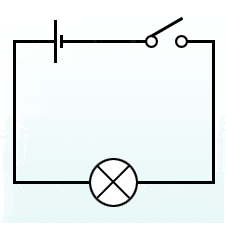
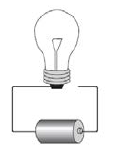


Is this circuit a closed or open circuit?
Closed Circuit
Open Circuit
Shari is using two toy cars to experiment with force and motion. The cars have different masses. Car A has a mass of 100 grams. Car B has a mass of 300 grams. Shari pushes each car forward using the same amount of force. Which car will travel farther?
Car A will travel farther.
Car B will travel farther.
The cars will travel at the same distance.
It is not possible to predict which car will travel farther.
Sam was riding his bike up a hill. His pedaling caused the bike to move. What type of force did Sam apply to the pedals to make his bike move?
friction
gravity
pull
push
As part of a science project, Samuel slides several different objects down a ramp. The objects Samuel uses are a magnet, a marble, a wooden block, and a metal car. Which two forces are acting on all the objects as they slide down the ramp?
Gravity moves the objects, and friction slows them down.
Friction moves the objects, and gravity slows them down.
Magnetism moves the objects, and gravity slows them down.
Gravity moves the objects, and a pulling force slows them down.
Mr. Brown gave Jen's lab group a ramp and a toy car. He placed large sheets of waxed paper, plastic wrap, glass, and artificial grass on a table. The group was asked to cover its ramp with the material they thought would slow down the car the most. Which material should they use?
artificial grass
glass
plastic wrap
waxed paper

Mr. Gates mops the gymnasium floor every day. When he finishes mopping, he puts up the sign below. The effect of which force is weakened when the floor is wet?
friction
gravitation
inertia
magnetism

Bar magnets have a north pole (N) and a south pole (S). Latisha places a bar magnet on three small straws so that it can roll. Her setup is shown below. Placing which of the following objects at point X will cause the bar magnet to move away from point X?
An iron nail
an aluminum can
the north end of another bar magnet
the south end of another bar magnet
In order to win a game of tug-of-war, what must happen?
The teams must pull with increasing force.
Both teams must pull with a force equal to the other.
One team must pull with a greater force than the other.
Both teams must pull with decreasing force.

Why does a book on a table not move?
No forces are acting on the book
Forces of the table pushing up and gravity pulling down are balanced
Gravity is the only force acting on the book
Are forces balanced or unbalanced when a marble rolls down a ramp?
Balanced
Unbalanced
What is the function of the heart?
to grind up food for the body
to pump blood throughout the body
to control blood sugar through the release of chemicals
to control muscle groups through the release of chemicals
Which organ filters the blood in the body?
heart
liver
skin
stomach
Which of these is NOT a function of the skin?
to protect the body against outside invaders
to keep the body at a constant temperature
to release chemicals that control blood sugar
to allow the body to feel when something is touching it
The small intestine is located under the stomach and is where the human body digests most substances. Which human organ provides digestive enzymes to the small intestine?
bladder
kidneys
liver
pancreas
Jenny plays on a soccer team. She uses the muscles in her legs to kick the soccer ball into the goal. What job do her muscles do?
Her muscles make energy for her legs.
Her muscles carry blood to her legs.
Her muscles move the bones in her legs.
Her muscles store minerals in her legs.
What is the function of the lungs?
to circulate blood to the body
to break down food in the body
to provide nutrients for the body
to provide gas exchange for the body
In the human body, which of the following organs connects to the sensory organs through nerves, allowing an individual to utilize their senses?
brain
heart
lungs
muscles
Which organ stores urine until the body is ready to release it?
kidneys
bladder
small intestines
large intestines
Which organ takes in oxygen and releases carbon dioxide?
stomach
heart
lungs
bladder
Which system provides support for the body?
muscles
skin
skeleton
brain
Which organ digests and absorbs nutrients from food?
small intestines
large intestines
stomach
pancreas
Which organ absorbs water at the end of digestion?
small intestines
large intestines
pancreas
liver
The scales of fish and the feathers of birds are both made from the same protein, called keratin. What is another characteristic birds and most fish share?
Both are animals that lay eggs.
Both are animals that have teeth.
Both are animals that have cold blood
Both are animals that care for their young

Moths and Praying Mantises both go through stages of metamorphosis. Which stage are both the moth and mantis able to reproduce?
egg
larva
nymph
adult

Frogs go through a form of metamorphosis similar to butterflies. What stage do frogs and butterflies both start their life cycles?
egg
larva
tadpole
adult

Which stage is missing from this butterfly's life cycle?
egg
larva
pupa
adult

