
 Worksheets
Chapter 47 Review (Respiratory)
Total questions: 25
Worksheet time: 15mins
The vocal cords are in the:
nasal passage
pharynx
alveoli
larynx
The pharynx
is made of cartilage rings
is what allows us to talk
is a muscular tube where the respiratory and digestive systems meet
is where gas exchange occurs
This part of the respiratory system is made of cartilage rings
pharynx
trachea
nasal passage
bronchial tubes
1. larynx
2. nasal cavity
3. pharynx
4. trachea
Which of the following is the correct order that air would flow during inhalation.

What keeps your bronchi and bronchiole tubes open?
cartilage rings
ligament squares
ciliated cells
muscle
"Movements of the rib cage and diaphragm make the thoracic cavity smaller and cause the air pressure in the thoracic cavity to increase"
The situation happens during....
inhalation
exhalation
excretion
blood circulation
Which vertebrate(s) use positive pressure breathing to put air in their bodies?
Amphibians
Reptiles
Mammals
Birds
Which of the following have the most evolved respiratory systems?
Amphibians
Reptiles
Mammals
Birds
How do humans breath?
Negative pressure breathing
Positive pressure breathing
Isotonic breathing
Hypoglycemic breathing
The air we breath is approximately _____% oxygen
70
20
1
0.03
The air we breath is approximately _____% carbon dioxide
70
20
1
0.03
Why do we need help breathing at high altitudes?
The human heart does not function well at high altitudes
There is less oxygen at high altitudes
There is less oxygen pressure at high altitudes
The alveoli in lungs collapse at high altitudes
In a certain part of the body, the O2 pressure is 80 in the tissues and 40 in the blood. How will the oxygen move?
It will move from the tissues into the blood
It will move from the blood into the tissues
You need more information to answer this question - you need to know the CO2 pressures
The oxygen will not move in this situation because the difference in pressures is not high enough (must be >100).
Is vaping completely safe for your lung health?
Yes
No
Which of the following is NOT a respiratory disease?
Asthma
UTI
Pneumonia
Cystic Fibrosis
This genetic disease causes mucous build-up in the body, including in the lungs. It is treated with double lung transplants, but individuals rarely survive past age 45.
Asthma
Pneumonia
Emphysema
Cystic Fibrosis
Smoking causes
Lung cancer
Emphysema
Hypertension
All of the above
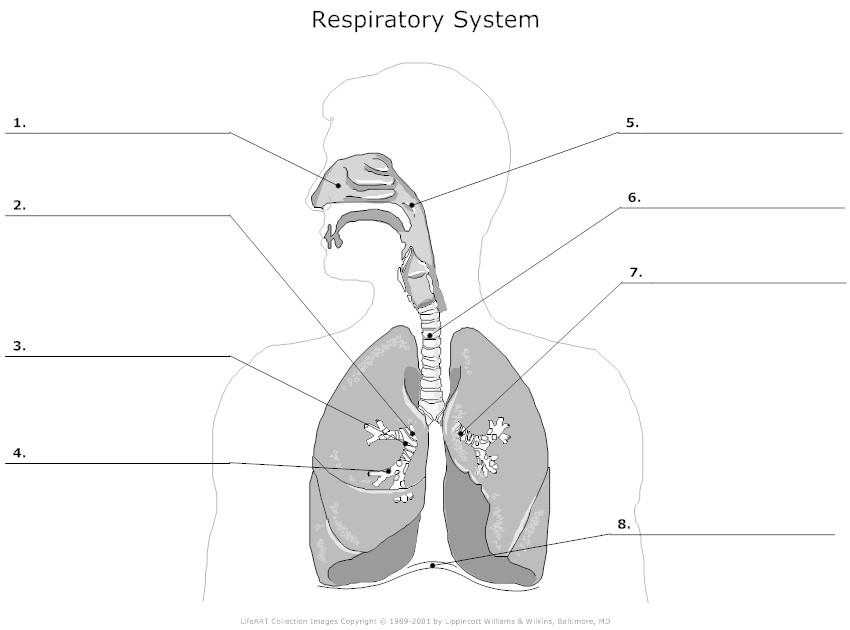
Name the structure labeled 5
pharynx
bronchus
A molecule of oxygen inhaled into the body will pass through the following organs in which order?
1. Alveoli
2. Bronchus
3. Bronchioles
4. Pharynx
5. Larynx
6. Nose
7. Trachea
6, 2, 3, 4, 5, 7, 1
6, 4, 5, 7, 2, 3, 1
6, 7, 5, 4, 3, 2, 1
6, 4, 7, 5, 3, 2, 1
Internal Respiration is
The exhange of gas between an organism and its environment
The exchange of gas between two different tissues in the body
The way mitochondria in the cells convert stored chemical energy (glucose) into ATP
All of these are correct
External Respiration is
The exhange of gas between an organism and its environment
The exchange of gas between two different tissues in the body
The way mitochondria in the cells convert stored chemical energy (glucose) into ATP
All of these are correct
Which of the following is voluntary?
External respiration
Internal Respiration
Cellular Respiration
All forms of respiration are voluntary
Oxygen is transported by
Iron (Fe) atoms in hemoglobin proteins in RBCs
Calcium (Ca) atoms in hemoglobin proteins in RBCs
Iron (Fe) atoms in hemoglobin proteins in WBCs
Iron (Fe) atoms in myoglobin proteins in RBCs

