
 Worksheets
Biology EOC Second Semester
Total questions: 42
Worksheet time: 49mins

Which molecule would be found within the nucleus?
mRNA
tRNA
DNA

Which molecule is able to go between the nucleus and ribosomes found within the cytoplasm?
DNA
mRNA
tRNA
How does natural selection affect populations?
By creating variation in individuals that allows them to better adapt to changing environmental conditions.
By increasing the rate of beneficial mutations which allow individuals to increase their rate of reproduction.
By reducing variation between individuals in a population thereby making the population more homogenous and likely to survive.
By acting on variations between individuals that make some better adapted to their environment and more likely to survive and reproduce.
In most species, scientists have observed that related individuals share about 80% of the same genes. Cheetahs today, however, are known to share 99% of the same genes.
What does this lack of genetic diversity imply about the history of the cheetah population?
Cheetahs never have experienced mutations.
Cheetahs have experienced the bottleneck effect
Cheetahs interbred with other large cat species.
Cheetahs share a common ancestor with other large cat species.
The European corn borer is a pest whose larvae cause damage to corn crops in the United States. Pesticides can be used to control the larvae. As an alternative, scientists have developed a genetically engineered form of corn called the Bt strain. It produced a toxin in its cells called Bt, which is poisonous to the corn borer larvae. Farmers who plant fields of Bt corn are required by law to plant fields of non-Bt corn nearby as well.
Which statement explains why farmers would be required to plant non-Bt corn near the Bt corn?
to provide controls for Bt toxin experiments with corn borers
to keep corn borers from cross-pollinating Bt and non-Bt corn
To slow reproductive selection for a Bt toxin-resistant corn borer
To prevent movement of corn borers from Bt to non-Bt corn fields

In Labrador Retriever dogs, the black coat color allele (B) is dominant over the chocolate coat color allele (b). However, some litters produce dogs that have a yellow coat color. Scientists have determined this is because of a second gene that can influence coat color. If this eumelanin gene is recessive for both alleles (e), the dog's coat will be yellow regardless of the alleles for the other coat color gene.
A dog breeder sets up a cross between two dogs that are heterozygous for both coat color (Bb) and eumelanin (Ee).
What percentage of the dogs will be yellow?
56%
18%
25%
6%

Scientists collect data on the size and number of worms that three bird species prefer to eat. The feeding preference data of three bird species are shown.
Which statement is supported by the data?
no competition for food exists within any of the three bird species
at least three different species of worms are eaten by the three bird species
selection pressure from the three bird species will result in a worm population with only small and large worms
less competition between the three bird species will be observed if a range of differently sized worms is available.
Which statement describes crossing over as it occurs in meiosis?
the alleles of a gene separate
spindle fibers pull apart sist chromatids
genes move to opposite ends of the chromosomes
homologous chromosomes exchange segments of DNA
Which molecule was coded for by the longest piece of DNA?
A protein with 25 amino acids
A polysaccharide with 60 sugars
An mRNA molecule with 20 codons
An mRNA molecule with 45 nucleotides

A
B
C
D
Which type of macromolecule stores energy and provides thermal insulation for the body?
Nucleic acid
Protein
Lipid
Carb

The diagram shows four different cells from the SAME animal.
Which statement about the cells is accurate?
Cell 3 and Cell 4 have the longest DNA sequences because they have longer shapes.
The four cells have identical DNA sequences.
The four cells are different shapes because they come from different organisms.
Cell 1 and Cell 2 have all the same active genes even though they are from different body systems.

The diagram depicts the process of crossing over, which occurs between homologous chromosomes during gamete formation.
What is the result of this process?
an increase in offspring variation
the deletion of amino acids in proteins
an increase in mutations in genetic material
the production of gametes that are genetically identical

Which rat would be a sibling or parent to rat A?
Rat B
Rat C
Rat D
How could genetic engineering be used to produce a more successful crop in a hot, dry climate?
RNA from a variety of nonagricultural plants could be added to the genomes of the crop plants.
DNA from plants adapted to dry areas could be added to genomes of the crop plants.
mRNA transcripts of genes from dry weather crops could be added to the fertilizer used on the crop
A scientists studies a population of lizards to determine whether or not the population is evolving.
Click on the condition(s) that would cause a population to be in Hardy-Weinberg equilibrium.
Mating is random
The lizard population is small.
No lizards migrate in or out of the population.
A new mutation occurs within the population.
Natural selection is not occuring in the population
How many nucleotides equal 1 amino acid?
1
2
3
4
TRANSCRIBE this DNA sequence: TACGTTACT
AUGCAAUGA
ATGCAATGA
AUGGATUGA
TACGTTACT
What mutation has occurred here?
T-G-A-C-C-A
T-G-A-G-C-A
Substitution
Deletion
Insertion
Frameshift
DNA molecule segment is : TTACGCAAG
The mutated DNA segment is TTCGCAAG. This is an example of ___ mutation.
Substitution
Deletion
Insertion
Inversion
A mutation is defined as:
A change in the cell's structure
Anything that changes in an embryo
Any change in the physical features of a human
A change in the DNA sequence

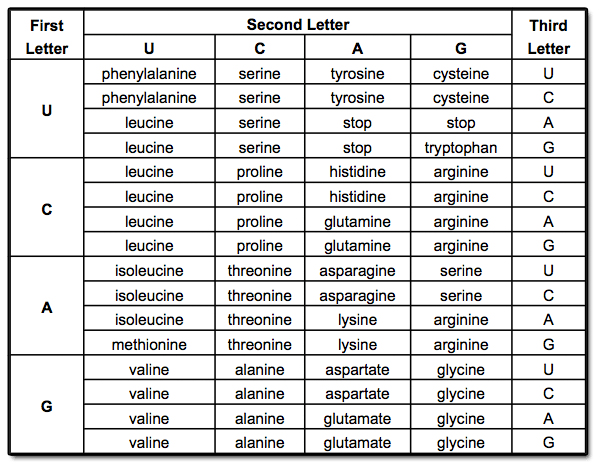
Which mutation will cause translation to stop?
Mutations 1 and 3 only
Mutation 1 only
Mutation 2 only
Muations 1, 2, 3



What happens if a population grows past its carrying capacity?
The population keeps growing
The population starts to die off
The entire species will go extinct
The carrying capacity just increases

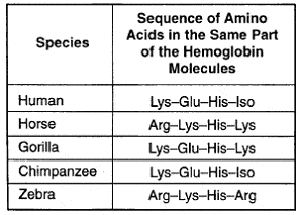
A geneticist examines part of a gene sequence in four different but related species. For each species, the bases in the sequence are indicated in the chart below.
She then determines that the common ancestor of these four species has a DNA strand of
A C C T A G G T G A G C
Based on this data, which species is most closely related to the common ancestor?
1
2
3
4

Scientists hypothesize that modern cheetahs have experienced two genetic bottlenecks. Scientists estimate the first occurred during the last ice age and the second occurred during a time of rapid agricultural growth in cheetah habitats. The graph shows the population size before and after the first bottleneck event occurred and just before the second bottleneck event.
What do you think happened to the genetic diversity of the cheetah population following the bottleneck event ?
The diversity increased.
The diversity decreased.

Scientists hypothesize that modern cheetahs have experienced two genetic bottlenecks. Scientists estimate the first occurred during the last ice age and the second occurred during a time of rapid agricultural growth in cheetah habitats. The graph shows the population size before and after the first bottleneck event occurred and just before the second bottleneck event.
Select three statements that explain how bottleneck event 2 may have affected the cheetah's ability to adapt to variable environmental conditions.
There is a decrease in the minimum viable population size.
There is less genetic uniformity.
There is a greater chance of the species surviving a genetic disease.
There is a decrease in the ability to adapt ro environmental changes.
There is a greater chance of a harmful recessive gene impacting the population.
The best indicator of an organism's evolutionary fitness is the number of
individuals in its population
years in its natural lifespan
mating partners it has over its life span
offspring it produces that survive to reproductive age
The sand goby is a small fish found in Europe's Baltic Sea. During mate selection, females overwhelmingly choose males with large body sizes. In some parts of the Baltic, algae overgrowths are causing the water to become increasingly cloudy. In the cloudy water, females have trouble identifying the larger males.
What can you predict will happen if female sand gobies continue to have difficulty identifying larger males during mate selection?
There will be a change in how often genes for large size occur in the population.
There will be an increase in resource competition between large and small males.
There will be an immigration of a new sand goby population from a different habitat.
There will be a mutation in the genes for eyesight that will improve vision in the females.
Researchers studying hummingbirds in the Andes Mountains of Ecuador made several observations.
- There are many species of hummingbirds.
- The species are not separated by any physical barrier.
- Unique hummingbird species are found at different elevations in the Andes.
Which hypothesis is based on these observations?
Conditions at each elevation favor different hummingbird traits.
All hummingbird species are able to interbreed at every elevation.
Elevation changes cause hummingbirds to develop new methods of transportation.
Individual hummingbirds choose food sources based on their preferences for specific plants.

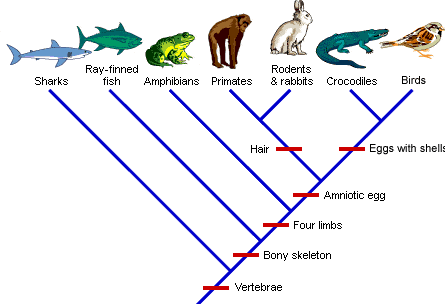
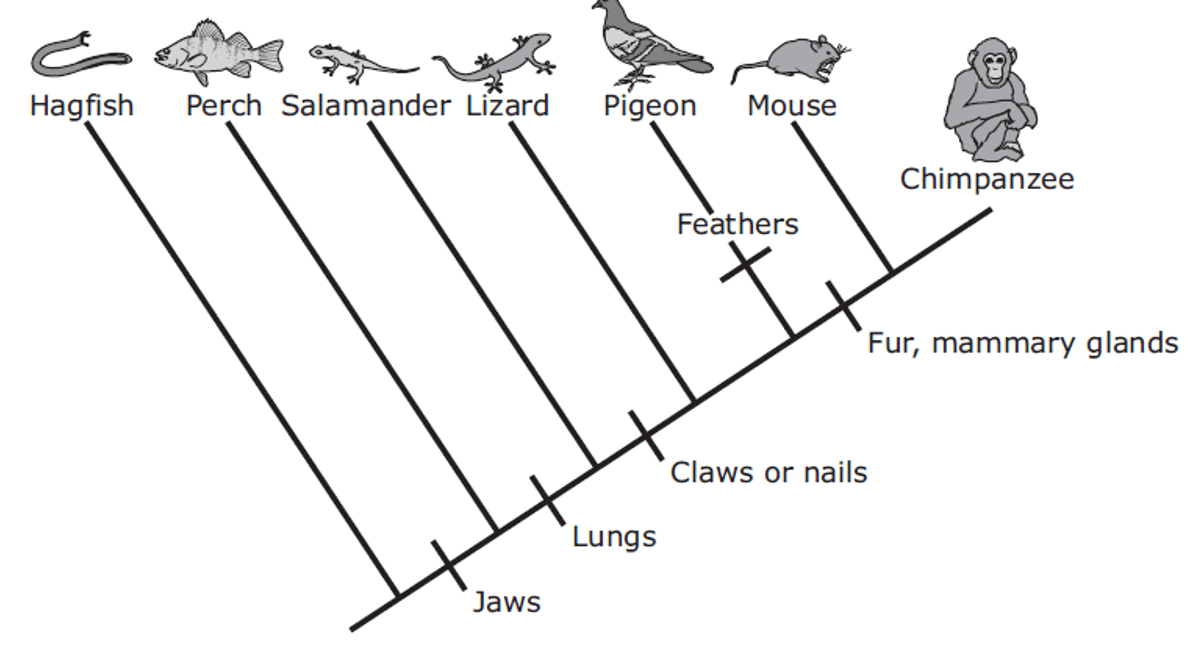
A table shows information about several traits displayed by different groups of plants.
Which statement explains the relationships among gingko, spruce and wheat?
These three plants are all equally related.
Gingkos are most ancient than spruce or wheat.
A group that contains gingko and spruce is the ancestor of wheat.
Spruce share an ancestor with a group that contains gingko and wheat.

