
 Worksheets
AP 1 Review Quiz ONE
Total questions: 56
Worksheet time: 1hrs 22mins
It's an example of vector quantity
Distance
Displacement
Energy
Mass
Which one of these options is NOT a vector quantity
Force
Displacement
Momentum
Energy

Vector F in the x-component is ....
F sin 30o
F cos 30o
F sin 60o
F tan 60o

Vector F in the y-component is ....
F sin 30o
F cos 30o
F cos 60o
F tan 30o
direction
A deer running 15 meters per second due west


Along line segment B, the object is:
Not moving
Moving at a constant velocity
Changing direction
Experiencing acceleration

Given this x-t graph, what will the v-t graph look like?
Sloped line
Parabola
Flat line
Flat line at 0

Given the following a-t graph, what would the v-t graph look like?
Sloped line
Parabola
Flat line
Flat line at 0


What is happening between 4 and 5 seconds?
The object is slowing down in a negative direction (opposite direction).
The object is slowing down in a positive direction.
The object is slowing down in a negative direction (opposite direction).
The object is speeding up in a negative direction (opposite direction).

distance or displacement units
m/s
m/s2
m2/s2
m
Slope of a position time graph gives you:
change in position
velocity
acceleration
y=mx+b!!!
time units (that we use in physics)
s
min
hr
year
gravity is a(n)
acceleration
initial velocity
final velocity
distance
Select all that are correct: In free fall, if I drop an object
the initial velocity is 0 m/s
the final velocity is 0 m/s
the acceleration is 10 m/s2
it speeds up as it falls


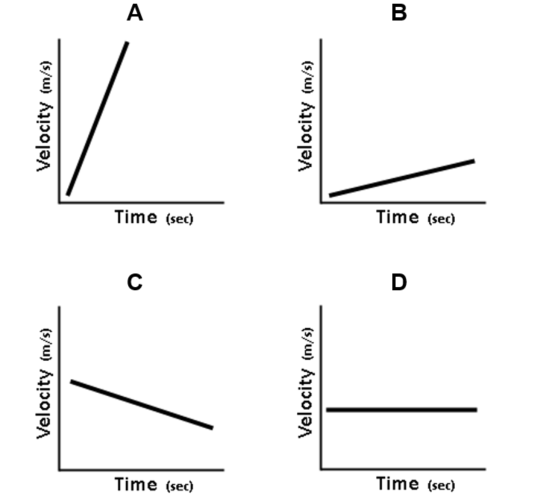


A person walking along a straight line moves such that her velocity as a function of time can be represented by the graph above. At what time does the person have the same position as she had at time t = 0?
At t = 5 s
During the interval 5 s < t < 8 s
At t = 8 s
During the interval t > 8 s
When an object starts from rest, what is its original velocity?
Depends on the problem
0
Always positive
Always negative
If an object comes to a stop in a problem, what is its final velocity?
Depends on the problem
0
Always positive
Always negative
If an object starts from rest, what is its final velocity?
Depends on the problem
0
-9.8m/s2
Always positive

A stone is thrown vertically upward with a speed
of 15.5 m/sec from the edge of a cliff 75 m high.
What total distance did it travel?
12.26 m
62.74 m
87.26 m
99.52 m
A ball is dropped from rest from a height 6 m above the ground.
The ball falls freely and reaches the ground 1.1 seconds later.
What is the average speed of the ball?
6.1 m/sec
6.6 m/sec
5.5 m/sec
11 m/sec
A kingfisher is a bird that catches fish by plunging into water from a height of several meters .If a kingfisher dives from a height of 7 m with an average speed of 4 m/sec, how long does it take for it to reach the water?
6 sec
1.8 sec
9 sec
3.6 sec
A dog running with an initial speed of 7.5 m/s comes to a stop in 5 seconds. What is the dog's displacement?
0 m
7.5 m
37.5 m
18.8 m
A ball is thrown straight up into the air at 20.0 m/s. What is its velocity at its highest point?
0 m/s
-9.81 m/s
20 m/s
-20 m/s
A ball is thrown straight up into the air at 20.0 m/s. What is its velocity as it returns to its initial height?
0 m/s
-9.81 m/s
20 m/s
-20 m/s
Consider a ball thrown up from the surface of the earth into the air at an angle of 300 above the horizontal. Air friction is negligible. Just after the ball is released, its acceleration is:
Upwards at 9.8 m/s2
Upwards at 4.9 m/s2
Downwards at 9.8 m/s2
0 m/s2
None of the above

In a lab experiment, a ball is rolled down a ramp so that it leaves the edge of the table with a horizontal velocity v. If the table has a height h above the ground, how far away from the edge of the table, a distance x, does the ball land? You may neglect air friction in this problem.


A rock is thrown into the air at an angle relative to the vertical, and follows the path shown here. Consider air friction to be negligible. What is the direction of the net acceleration of the rock at point D?
to the left
to the right
straight up
straight down
there is no net acceleration at point D
A projectile is fired horizontally from a height of 20 m above the ground, with an initial velocity of 7.0 m/s. How far does the projectile travel horizontally before it reaches the ground?
7m
14m
140m
3.5m
20m

