
 Worksheets
Vibrations and Waves Quiz
Total questions: 43
Worksheet time: 1hrs 2mins
The time needed for an object to complete one full cycle of a periodic motion is the _____
period
frequency
wavelength
. amplitude
The number of times a periodic motion repeats a cycle each second is the _____ of the motion.
period
velocity
frequency
amplitude

Which letter represent the amplitude
A
B
C
D
What does a wave carry with it as it travels through a medium?
particles
wind
energy
water
Simple Harmonic Motion is a type of periodic motion where the restoring force is _________ to the displacement of the body from its equilibrium position.
equivalent
proportional
inversely proportional
not equal
At which position is the speed of a particle executing SHM greatest?
It's extreme position
at its equilibrium position
at its maximum displacement
somewhere between amplitude and equilibrium position
Write true or replace the underlined word:
Mechanical waves can travel through a vacuum.
(a)
What determines the period of a pendulum?
Mass
Length
Amplitude
What determines the period of a spring? Choose all that apply.
Amplitude
Mass
Spring Constant
Length of Spring
Which type of waves do the particles vibrate perpendicular to the energy?
surface
transverse
mechanical
longitudinal
What is the wavelength of a wave?
the size of the disturbance
the distance between two crests of a wave
the amount of time that occurs in one full cyle
the amount of cycles that occur in a given time
The lowest point on a wave is the :
amplitude
trough
crest
wavelength
The number of wavelengths that pass a point in a given amount of time is:
frequency
longitudinal
period
transverse

Which wave in the diagram has the greatest wavelength?
1
2
3
4
Amplitude reflects the amount of _______________ in a wave.
energy
speed
number of cycles
number of troughs

The higher the frequency of a wave, the ______________ the wavelength
shorter
longer

Musical notes travel through the air as waves. Higher frequency notes travel _________ lower frequency notes.
faster than
at the same speed as
slower than
An observer counts 4 complete water waves passing by the end of a dock every 10. seconds. What is the frequency of the waves?
0.40 Hz
2.5 Hz
40. Hz
4.0 Hz
The vibrations in a longitudinal wave are (a) to the direction of energy transfer.
Sound waves are (a) waves.
Sound waves can travel through a vacuum because they don't require particles.
True
False

What type of wave is pictured?
Transverse wave
Longitudinal wave
Wave, what wave?
Slinky wave

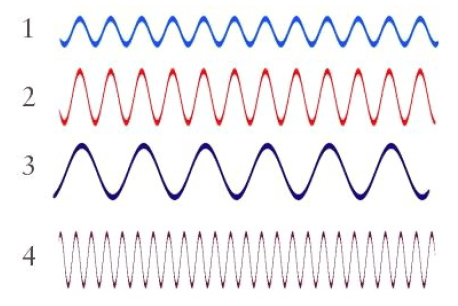
Which wave in the diagram has the greatest frequency?
1
2
3
4
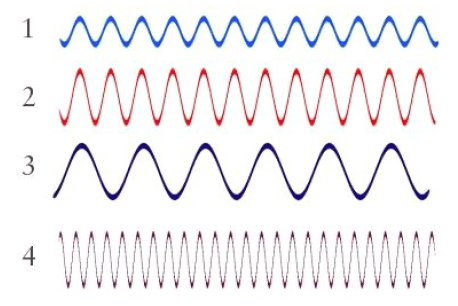
Which wave in the diagram has the longest wavelength?
1
2
3
4
Which of the following can a mechanical wave travel through (select all that apply)?
solid
liquid
gas
empty space
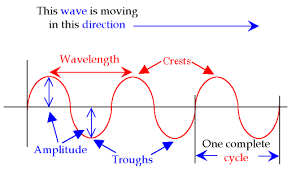
One hertz is equal to:
1 cycle or wave per second
the distance from crest to crest or trough to trough
the distance from one rarefaction to the next rarefaction.
the maximum displacement of the wave
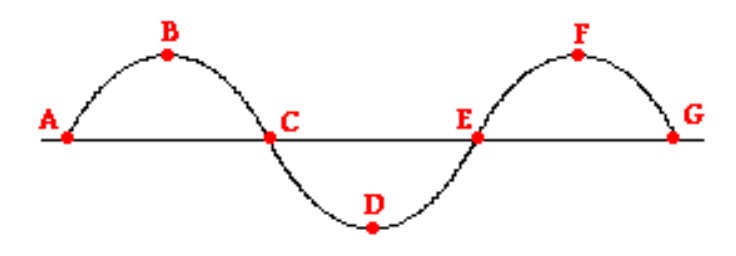
Which letter(s) represent the rest position of the wave (select all that apply)?
A & C
B & F
E & G
D
The acceleration of a particle in SHM is:
always zero
always constant
maximum at amplitude
maximum at the equilibrium position
The maximum velocity occurs where the ____.
potential energy is a maximum
kinetic energy is a minimum
displacement from equilibrium is equal to
the amplitude of 0.4 𝑚
displacement from equilibrium is equal to
zero
A pendulum makes 33 complete back and forth cycles of vibration in 11 seconds. Its period is
3.0 s
3.0 Hz
0.33 s
0.33 Hz
When a wave pulse hits the end of the rope that is fixed (known as a fixed boundary), the pulse returns with no change of phase.
True
False
When a wave pulse hits the end of the rope that is free to move (known as a free boundary), the pulse returns with no change of phase.
True
False

What is the wavelength of this wave?
1 cm
2 cm
4 cm
8 cm
The ______ of a sound depends on the medium through which it's moving.
pitch
vibration
speed
loudness
Amplitude affects which characteristic of sound waves?
frequency
pitch
loudness
wave speed
Which of the following ranks the speed of sound waves in various mediums.
Gas > Liquid > Solid
Solid > Liquid > Gas
Gas > Solid > Liquid
Liquid > Gas > Solid

