wayground logo

Free Printable Worksheets

Font size

S
M
L
XL
Worksheets

Geometry EOC Exam Review

Total questions: 150

Worksheet time: 7hrs 35mins

Name
Class
Date
1.
An example of 2 non-collinear points.
a)
D, E
b)
C, B
c)
M, E
d)
F, B
2.
What is the term for a part of a line with two endpoints?
a)
point
b)
ray
c)
angle
d)
line segment
3.
Points that lie on the same plane are ________. 
a)
collinear
b)
coplanar
c)
parallel
d)
perpendicular
4.
Points that lie on the same line are _________.
a)
coplanar
b)
collinear
c)
parallel
d)
perpendicular
5.
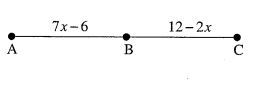
B is the midpoint of AC.  Find AB.
a)
2
b)
16
c)
8
d)
4
6.
a)
8
b)
12
c)
-4
d)
-8
7.

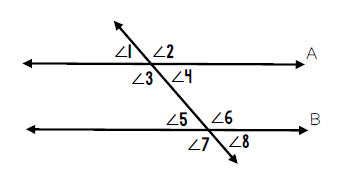
∠1 and ∠2 form a linear pair.

If m∠1 = (5x + 9)° and m∠2 = (3x + 11)°, find m∠1.

a)

m∠1 = 110°

b)

m∠1 = 109°

c)

m∠1 = 70°

d)

m∠1 = 71°

8.
Find the value of ∠A.
a)
25 degrees
b)
30  degrees
c)
35 degrees
d)
90 degrees
9.
Find KL.
a)
18
b)
15
c)
6
d)
20
10.

∠K and ∠L are complementary angles.

If m∠K = (3x + 3)° and m∠L = (10x -- 4)°, find the measure of each angle.

a)

m∠K = 24° and m∠L = 66°

b)

m∠K = 66° and m∠L = 24°

c)

m∠K = 40° and m∠L = 50°

d)

m∠K = 30° and m∠L = 60°

11.

∠1 and ∠2 form a linear pair.

If m∠1 = (5x + 9)° and m∠2 = (3x + 11)°, find the measure of each angle.

a)

m∠1 = 110° and m∠2 = 70°

b)

m∠1 = 109° and m∠2 = 71°

c)

m∠1 = 70° and m∠2 = 110°

d)

m∠1 = 71° and m∠2 = 109°

12.
Find the midpoint between the two points: (-4,4) and (5,-1)
a)
(4,5)
b)
(3,4)
c)
(1/2, 1 1/2)
d)
(7,2)
13.
Find the midpoint between the two points: (-1,1) and (5,-5)
a)
(3,-3)
b)
(2,-2)
c)
(4,-4)
d)
(4,5)
14.

What is the distance between (-5, 3) and (4, -5)?

a)

145\sqrt{-145}

b)

145\sqrt{145}

c)

145

d)

-145

15.
Find the distance between ( 1, 3) and (5, 6) 
a)
3
b)
4
c)
5
d)
6
16.
Given the points A(-1,2) and B(7,14), find the coordinates of the point P on directed line segment AB that partitions AB into a ratio 1:3. 
a)
(1,5)
b)
(3,7)
c)
(4,4)
d)
(5,8)
17.
Given the points A(-1,2) and B(7,14), find the coordinates of the point P on directed line segment AB that partitions AB into a ratio 1:3. 
a)
(1,5)
b)
(3,7)
c)
(4,4)
d)
(5,8)
18.
1. Find X 
a)
28
b)
5
c)
55
d)
40
19.
3. Find ∠NOQ
a)
31
b)
59
c)
180
d)
149
20.

Angle 1 and Angle 5 are examples of which type of angle pair?

a)

Alternate exterior angles

b)

Alternate interior angles

c)

Vertical angles

d)

Corresponding angles

21.

Angle 3 and Angle 6 are examples of which type of angle pair?

a)

Alternate exterior angles

b)

Alternate interior angles

c)

Vertical angles

d)

Corresponding angles

22.

Angle 6 and Angle 7 are examples of which type of angle pair?

a)

Alternate exterior angles

b)

Alternate interior angles

c)

Vertical angles

d)

Corresponding angles

23.

Which of the following angles would NOT be congruent to the measure of 7\angle7 ?

a)

2\angle2  

b)

3\angle3  

c)

6\angle6  

d)

8\angle8  

24.

Which of the following is an example of corresponding angles?

a)

8 and 4\angle8\ and\ \angle4  

b)

5 and 7\angle5\ and\ \angle7  

c)

1 and 7\angle1\ and\ \angle7  

d)

3 and 5\angle3\ and\ \angle5  

25.

Which of the following is NOT an example of supplementary angles?

a)

7 and 8\angle7\ and\ \angle8  

b)

2 and 3\angle2\ and\ \angle3  

c)

1 and 7\angle1\ and\ \angle7  

d)

6 and 4\angle6\ and\ \angle4  

26.

If the  m7 = 115°,m\angle7\ =\ 115\degree,  find the measure of  2.\angle2.  

a)

115°115\degree  

b)

65°65\degree  

c)

180°180\degree  

d)

Cannot be determined

27.

If the  m5 = 63°,m\angle5\ =\ 63\degree,  find the measure of  3.\angle3.  

a)

63°63\degree  

b)

117°117\degree  

c)

180°180\degree  

d)

Cannot be determined

28.

If the  m1 = 57°,m\angle1\ =\ 57\degree,  find the measure of  6.\angle6.  

a)

123°123\degree  

b)

57°57\degree  

c)

180°180\degree  

d)

Cannot be determined

29.

Find the value of x if the  m1 = 11x  9°m\angle1\ =\ 11x\ -\ 9\degree and the  m5 = 7x +9°m\angle5\ =\ 7x\ +9\degree .

a)

-4.5

b)

4.5

c)

1

d)

0

30.
a)
41°
b)
65°
c)
102°
d)
115°
31.

What are the different parts of an isosceles triangle?

a)

1 leg, 2 vertex angles, 1 base, and 2 base angle

b)

1 leg, 2 vertex angles, 2 bases, and 1 base angle

c)

2 legs, 1 vertex angle, 1 base, and 2 base angles

d)

2 legs, 1 vertex angle, 2 bases, and 1 base angle

32.

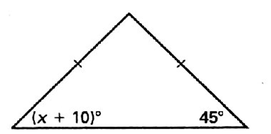
Find x.

a)

72

b)

67

c)

65

d)

54

33.
Determine x
a)
93
b)
71
c)
81
d)
55
34.
What is the value of x?
a)
51
b)
49
c)
78
35.
Find x
a)
90
b)
45
c)
22
d)
35
36.

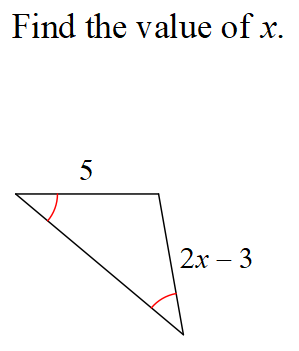
Find the value of x.

a)

1

b)

4

c)

5

d)

8

37.

What is the measure of angle b?

(a)  

38.

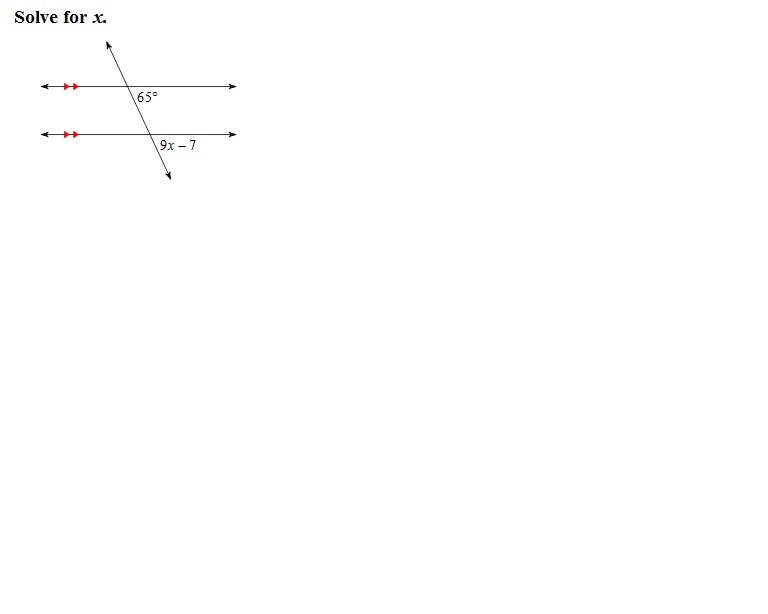
Solve for x.

(a)  

39.

Find the measure of each angle indicated.

(a)  

40.

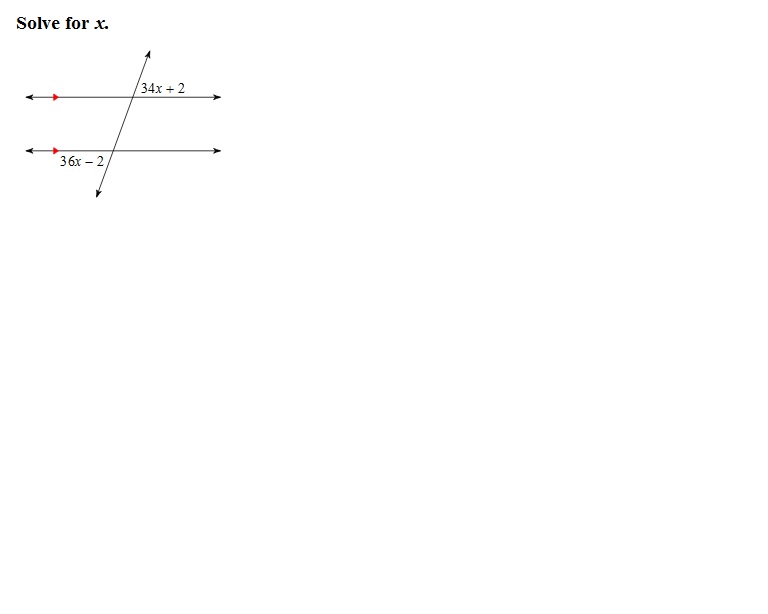
Solve for x.

(a)  

41.

Solve for x.

(a)  

42.
a)

5

b)

7

c)

8

d)

-4

43.
a)

2

b)

11

c)

7

d)

5

44.

Translate the blue shape to the pink shape...

a)

5 Right

2 Down

b)

5 Left

2 Up

c)

3 Right

1 Down

d)

3 Left

1 Up

45.

Translate the green shape to the blue shape...

a)

3 Left

3 Down

b)

3 Right

3 Up

c)

2 Right

3 Up

d)

2 Left

3 Down

46.
Determine where T' would be if you translated T 3 units to the right and 6 units up.
a)
(5, 1)
b)
(2, -5)
c)
(-1, 1)
d)
(8, -2)
47.
Where would A' be if you translated A 3 units to the right and 4 units down?
a)
(-4, 4)
b)
(-1, 0)
c)
(0, -1)
48.
The image A'B'C' is a rotation of ABC.
a)
True
b)
False
49.
The new figure created from a transformation is... 
a)
Congruent 
b)
Preimage 
c)
Image 
d)
Angle 
50.
What is a transformation that turns a figure about a fixed point for a given angle?
a)
Point of Rotation 
b)
Vertex 
c)
Rotations
d)
Image 
51.
The name of the figure before the rotation is... 
a)
Congruent 
b)
Preimage 
c)
Image 
d)
The Before
52.
If you were to rotate ABCD 90° counterclockwise about the origin, what would the coordinate of A' be?
a)
(-5, 5)
b)
(-3, 5)
c)
(-5, 3)
d)
(-3, 3)
53.
Rotate the point (-3,-4) around the origin 180 degrees. State the image of the point.
a)
(-4,-3)
b)
(-4,3)
c)
(4,-3)
d)
(3,4)
54.
What is the angle of rotation for this counterclockwise rotation about the origin?
a)
90°
b)
180°
c)
270°
d)
360°
55.
Rotate the point (-3,-4) around the origin 180 degrees. State the image of the point.
a)
(-4,-3)
b)
(-4,3)
c)
(4,-3)
d)
(3,4)
56.
If you were to rotate ABCD 90° counterclockwise about the origin, what would the coordinate of A' be?
a)
(-5, 5)
b)
(-3, 5)
c)
(-5, 3)
d)
(-3, 3)
57.
Rotate the point (-5,8) around the origin 270 degrees counterclockwise. State the image of the point.
a)
(-8,5)
b)
(8,-5)
c)
(8,5)
d)
(5,-8)
58.
Rotate the point (7,8) around the origin 90 degrees counterclockwise.
State the image of the point.
a)
(-7,-8)
b)
(8,-7)
c)
(-8,7)
d)
(8,7)
59.
State the line of reflection.
a)
Reflection across y-axis
b)
Reflection across x-axis
c)
Reflection across x = 1
d)
Reflection across y = 1
60.
Find K' if the figure is reflected across the x-axis
a)
(4, 1))
b)
(-1, -4)
c)
(1, -4)
d)
(1, 4)
61.

How do you represent reflection over the x axis Algebraically?

a)

(-y, -x)

b)

(x + a, y + b)

c)

(x , -y)

d)

(ax, by)

62.

2. How many lines of symmetry does the picture have?

a)

1

b)

2

c)

4

d)

0

63.

What is the smallest degree of rotational symmetry?

a)

90°

b)

45°

c)

60°

d)

120°

64.

What is the smallest degree of rotational symmetry?

a)

90°

b)

45°

c)

60°

d)

120°

65.

What is the smallest degree of rotational symmetry?

a)

90°

b)

72°

c)

60°

d)

40°

66.

State if the triangles are congruent or not. If they are, state how you know.

a)

Yes - by SSS

b)

Yes - by ASA

c)

Yes - by HL

d)

Yes - by AAS

e)

Not congruent

67.

State if the triangles are congruent or not. If they are, state how you know.

a)

Yes - by SSS

b)

Yes - by ASA

c)

Yes - by HL

d)

Yes - by AAS

e)

Not congruent

68.

State if the triangles are congruent or not. If they are, state how you know.

a)

Yes - by SSS

b)

Yes - by ASA

c)

Yes - by HL

d)

Yes - by AAS

e)

Not congruent

69.

State if the triangles are congruent or not. If they are, state how you know.

a)

Yes - by SSS

b)

Yes - by ASA

c)

Yes - by HL

d)

Yes - by AAS

e)

Not congruent

70.

State if the triangles are congruent or not. If they are, state how you know.

a)

Yes - by SSS

b)

Yes - by ASA

c)

Yes - by HL

d)

Yes - by SAS

e)

Not congruent

71.

State if the triangles are congruent or not. If they are, state how you know.

a)

Yes - by AAS

b)

Yes - by ASA

c)

Yes - by HL

d)

Yes - by SAS

e)

Not congruent

72.

State if the triangles are congruent or not. If they are, state how you know.

a)

Yes - by AAS

b)

Yes - by ASA

c)

Yes - by HL

d)

Yes - by SAS

e)

Not congruent

73.

State if the triangles are congruent or not. If they are, state how you know.

a)

Yes - by AAS

b)

Yes - by ASA

c)

Yes - by HL

d)

Yes - by SAS

e)

Not congruent

74.

State what additional information is required in order to know that the triangles are congruent for the reason given.

a)

RSQSRS\cong QS

b)

RSQDRS\cong QD

c)

QRSQDS\angle QRS\cong\angle QDS

d)

DSSQDS\cong SQ

75.

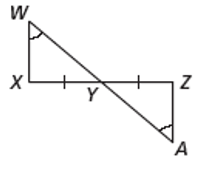
Complete the congruence statement:

ΔWXYΔ\Delta WXY\cong\Delta  

a)

ZAY

b)

YZA

c)

ZYA

d)

AZY

76.
If two figures are similar, the corresponding sides are ______________.
a)
equal
b)
congruent
c)
proportional
d)
none of these
77.
If two figures are similar their angles are______.
a)
proportional
b)
congruent
c)
supplementary
d)
complementary
78.

Calculate the value of the scale factor between the 2 triangles

a)

2.5

b)

3

c)

3.5

d)

4

79.
The pair of figures is similar. Find the missing side.
a)
x = 12
b)
x = 3
c)
x = 40
d)
x = 4
80.
What is the value of X?
a)
X=4
b)
X=6
c)
X=3
d)
X=2
81.
Are the triangles similar?
a)
Yes
b)
No
82.
Are the triangles similar?
a)
Yes
b)
No
83.
When you dilate a figure you...
a)
slide it.
b)
turn it.
c)
flip it.
d)
make it larger or smaller.
84.
Tell whether the two figures are congruent.
a)
Yes, same size and same shape
b)
No, same shape but different sizes
c)
No, different size and different shapes
85.
What is ratio of any two corresponding sides?
a)
Scale Factor
b)
Corresponding Sides
c)
Similar Figures
86.
If the scale factor is less than one, the new figure will be
a)
an enlargement
b)
a reduction
c)
a scale factor
87.
If the scale factor is greater than one, the new figure will be
a)
a reduction
b)
an enlargement
c)
a scale
d)
not proportional
88.
Solve for f.
a)
6
b)
4
c)
3
d)
8
89.
What similarity theorem would you use to prove these triangles are similar?
a)
SAS∼
b)
SSS∼
c)
AA∼
d)
BUCK∼
90.
How do these triangles appear to be similar?
(Hint: Look for non-labeled parts!)
a)
AA
b)
SAS
c)
SSS
d)
Not Similar
91.
Solve for X.
a)
2 ft
b)
3 ft
c)
4 ft
d)
6 ft
92.

Find the length of AB.

a)

36

b)

18

c)

6

d)

12

93.

The accompanying diagram shows a 24-foot ladder leaning against a building. A steel brace extends from the ladder to the point where the building meets the ground. The brace forms a right angle with the ladder.If the steel brace is connected to the ladder at a point that is 10 feet from the foot of the ladder, which equation can be used to find the length, x, of the steel brace?

a)

10x=x14\frac{10}{x}=\frac{x}{14}

b)

10x=x24\frac{10}{x}=\frac{x}{24}

c)

102+x2=14210^2+x^2=14^2

d)

102+x2=24210^2+x^2=24^2

94.

How far is it across the lake?

a)

4

b)

6

c)

9

d)

12

95.

Find the value of x.

a)

12

b)

16

c)

9

d)

6

96.

Find the value of m.

a)

10

b)

10√2

c)

20√2

d)

√2

97.

What is the perimeter of the triangle?

a)

16 + 8√2

b)

8 + 8√2

c)

24√2

d)

24

98.

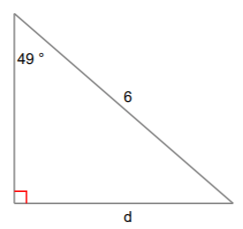
Find y.

a)

1

b)

2

c)

2√3

d)

4√3

99.

Find EF.

a)

4

b)

2√2

c)

1

d)

2

100.
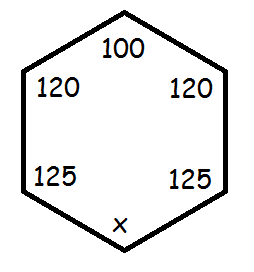
Find the value of X.
a)
100
b)
120
c)
125
d)
130
101.
Solve for x
a)
45
b)
12
c)
90
d)
2
102.
Which is true about parallelograms?
a)
Opposite sides are congruent
b)
Diagonals are congruent
c)
Consecutive angles are congruent
d)
The interior angles add to 180 degrees
103.
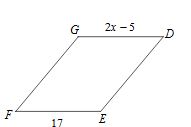
The figure is a parallelogram.  
Solve for x.  
a)
1
b)
11
c)
7
d)
6
104.
What is the value of x?
a)
132
b)
66
c)
114
d)
48
105.
______ parallelograms are quadrilaterals.
a)
All
b)
Some
c)
No
106.
______ squares are rectangles.
a)
All
b)
Some
c)
No
107.
In a parallelogram, consecutive angles are __________.
a)
congruent
b)
supplementary
c)
corresponding
d)
parallel
108.
In a parallelogram, diagonals __________.
a)
are perpendicular
b)
bisect each other
c)
are congruent
d)
are parallel
109.
Which quadrilateral has opposite sides parallel?
a)
Rectangle
b)
Rhombus
c)
Square
d)
All of these do
110.
In a rhombus, all four sides are ___________.
a)
congruent
b)
parallel
c)
perpendicular
d)
unequal
111.
A parallelogram that is both a rhombus and a rectangle is called a __________.
a)
Quadrilateral
b)
Parallelogram
c)
Trapezoid
d)
Square
112.
LMNO is a parallelogram
solve for X
a)
19
b)
20
c)
33
d)
53
113.

What is the value of x in the illustration?

a)

3

b)

4

c)

5

d)

6

114.

The diagonals in a kite __________.

a)

are congruent

b)

are supplementary

c)

are perpendicular

d)

are parallel

115.

Which trigonometric ratio should you use?

a)

Tangent Ratio

b)

Sine Ratio

c)

Cosine Ratio

d)

Any ratio

116.

Which trigonometric ratio should you use?

a)

Tangent Ratio

b)

Sine Ratio

c)

Cosine Ratio

d)

Any ratio

117.
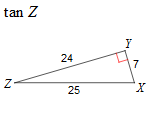
What is the correct ratio?
a)
7/24
b)
24/7
c)
7/25
d)
24/25
118.
What is tan 45⁰?
a)
1
b)
2
c)
0.5
d)
0.75
119.
What is cos 47⁰ ?
a)
0.73
b)
0.28
c)
0.68
d)
answer not shown
120.
Find x if sin 22o = 2/x.
a)
6.78
b)
0.75
c)
2.14
d)
5.34
121.
Find the length of side W?
sin 68 = 70/w
a)
186.86 m
b)
75.50 m
c)
28.28 m
d)
.01 m
122.
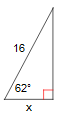
Solve for x. Round to the nearest tenth.
a)
7.5
b)
34.1
c)
14.1
123.
In the equation (x-3)2+(y-2)2=16, the center of the circle is...
a)
(3,2)
b)
(-3, -2)
c)
(-2, -3)
d)
(2, 3)
124.
In the equation (x+2)2+(y-3)2=4, the radius of the circle is...
a)
4
b)
2
c)
3
d)
16
125.
In the equation (x-4)2+(x-3)2=25, the center of the circle is at...
a)
(-3, -4)
b)
(4, 3)
c)
(-4, -3)
d)
(3, 4)
126.
Write the standard equation of the circle with the given center and radius; center (0,0) and radius: 3
a)
x2+y2=3
b)
x2+y2=6
c)
x2+y2=9
127.
If two lines are parallel their slopes are  ____________
a)
the same.
b)
negative reciprocals of each other.
128.
Are these lines parallel?
y = 12x + 4
y = 12x +14
a)
YES
b)
NO
129.

Are these lines parallel?

y = (-1/2)x + 1

y = (1/2)x - 5

a)

YES

b)

NO

130.
Write an equation of a line that passes through the point (5,-1) and is parallel to the line y = (-3/5)x -3
a)
y = (-3/5)x + 2
b)
y = (-3/5)x -2
c)
y = (3/5)x + 2
d)
y = (5/3) + 2
131.

If two lines are perpendicular to each other their slopes are ____________

a)

the same.

b)

negative reciprocals of each other.

132.
Are these lines perpendicular?
y = 4x + 2
y = (-1/4)x + 12
a)
YES
b)
NO
133.
Are these lines perpendicular?
y = (1/2)x + 2
y = -2x + 13
a)
YES
b)
NO
134.
Write an equation of a line that passes through the point (-9,2) and is perpendicular to the line y = 3x - 12
a)
y = (-1/3)x - 1
b)
y = (1/3)x - 2
c)
y = -3x + 12
d)
y = 3x - 1
135.
A line is parallel to   y = 2x - 7.
What is it's slope?
a)
-2
b)
1/2
c)
-1/2
d)
2
136.

Which of the following equations has a graph PARALLEL to the line y = 4x + 7 with a y-intercept of -2?

a)

y = 4x - 2

b)

y = 4x + 8

c)

y = 7/2x + 7

d)

y = -1/4x + 1/2

137.
Find the measure of angle ABD.
a)
14
b)
51
c)
37
d)
65
138.
What is the measure of angle 2?
a)
80
b)
45
c)
125
d)
40
139.
In the diagram, two tangents to the circle share a common external point. Solve for the value of "x"
a)
8
b)
9
c)
6
d)
5
140.
What is the volume of a cone with a radius of 3 cm and a height of 11 cm?
a)
207.35 cm3
b)
311.02 cm3
c)
69.12 cm3
d)
103.67 cm3
141.
Which formula has B correctly substituted for the volume of a cylinder?
a)
V=πr2h
b)
V=πr2
c)
V=2πrh
d)
V=rh
142.
a)

55 yd3

b)

121 yd3

c)

22 yd3

d)

330 yd3

143.

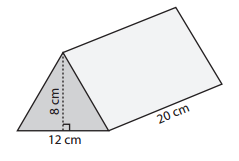
Find the volume

a)

960 cm 3

b)

240 cm 3

c)

960 cm 2

d)

1920 cm 3

144.

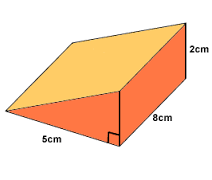
Find the volume of the figure. Round to the nearest tenth.

a)

80 cm³

b)

40 cm²

c)

80 cm2

d)

40 cm³

145.
Find the volume of the figure.
a)
126 cm3
b)
907.5 cm3
c)
605 cm3
d)
55 cm3
146.
What is the volume?
a)
16.8 cm3
b)
50.3 cm3
c)
100.5 cm3
d)
12.6 cm2
147.
Find the surface area of this figure.
a)
148 cm²
b)
120 cm²
148.

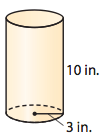
Calculate the surface area of the given shape. Round to the nearest tenth.

a)

282.7 in2

b)

56.5 in2

c)

188.5 in2

d)

245.0 in2

149.

What is the area of this trapezoid?

a)

216 cm2

b)

204 cm2

c)

156 cm2

150.
Find the perimeter.
a)
32 in
b)
32 in2
c)
50 in
d)
50 in