wayground logo

Free Printable Worksheets

NEW

Font size

S
M
L
XL
Worksheets

ICP Spring Final Review

Total questions: 80

Worksheet time: 1hrs 22mins

Name
Class
Date
1.

What is a positive ion called?

a)

anion

b)

cation

c)

isotope

d)

covalent

2.

What is a negative ion called?

a)

anion

b)

cation

c)

covalent

d)

isotope

3.

Which types of elements from cations?

a)

metals

b)

nonmetals

c)

metalloids

d)

noble gases

4.

Which types of elements from anions?

a)

metals

b)

nonmetals

c)

metalloids

d)

noble gases

5.

What is the ion formed from Sulfur?

a)

S+2

b)

S-2

c)

S+6

d)

S-6

6.

When an atom loses a valence electron, it becomes a(n) _____________ ion.

a)

positive

b)

negative

c)

neutral

7.

When an atom gains a valence electron, it becomes a(n) _____________ ion.

a)

positive

b)

negative

c)

neutral

8.
What two types of atoms make a covalent bond?
a)
2 Nonmetals
b)
1 Nonmetal and 1 Metal
c)
2 Metals
d)
2 Noble Gases
9.
What do we call a covalent bond where electrons are shared UNEVENLY or UNEQUALLY?
a)
Ionic
b)
Polar Covalent
c)
Nonpolar Covalent
d)
Van der Waals Force
10.
Covalent compounds
a)
Share electrons
b)
transfer electrons
c)
None
d)
conduct electricity
11.
What type of bond forms between two or more atoms that are charged (+/-)?
a)
Covalent bond
b)
Incomplete bond
c)
Ionic bond
d)
Metallic bond
12.
Which of the following is an example of an IONIC COMPOUND?
a)
NaCl
b)
H2O
c)
CO2
d)
NO
13.

Is the following compound ionic or covalent?

LiBr

a)

Ionic

b)

Covalent

14.

Is the following compound ionic or covalent?

PBr5

a)

Ionic

b)

Covalent

15.

Compounds composed of a ______________ and _____________ like the compound CaCl2 , are ionic compounds.

a)

metal ... metal

b)

nonmetal ... nonmetal

c)

metal ... nonmetal

16.

A physical blend of 2 or more components is called a ____.

a)

type of element

b)

mixture

c)

chemical reaction

d)

physical property

17.

What type of mixture is shown?

a)

Homogeneous

b)

Heterogeneous

18.

What type of substance is shown?

a)

compound

b)

heterogeneous mixture

c)

homogeneous mixture

d)

element

19.

What type of material is pictured?

a)

Element

b)

Compound

c)

Heterogeneous mixture

d)

Homogeneous mixture

20.

Classify milk as one of these 4 types of matter.

a)

Element

b)

Compound

c)

Homogeneous mixture

d)

Heterogeneous mixture

21.
If a mixture has components you can see it is a...
a)
solution
b)
compound
c)
homogeneous mixture
d)
heterogeneous mixture
22.
The change of state from a liquid to a solid
a)
freezing
b)
melting
c)
evaporation
d)
boiling
23.
Change of state from a solid to a liquid.
a)
sublimation
b)
deposition
c)
freezing
d)
melting
24.
What is the change of state from a gas to a liquid called?
a)
deposition
b)
sublimation
c)
evaporation
d)
condensation
25.
Change of state from a solid directly to a gas is called
a)
deposition
b)
melting
c)
evaporation
d)
sublimation
26.
What happens when my glass of water is sitting in the sun and disappears into a gas?
a)
evaporation
b)
burning
c)
melting
d)
freezing
27.
How is a gas defined?
a)
no shape, no volume
b)
Definite shape, definite volume
c)
Found in stars
d)
Definite volume, no shape
28.
Particles of a liquid
a)
are tightly packed together and vibrate in place
b)
have no viscosity.
c)
collide with one another
d)
vibrate and slide past each other
29.
Define a liquid
a)
no shape, no volume
b)
Definite shape, definite volume
c)
Found in stars
d)
Definite volume, no shape
30.
Pressure is because of the collisions between the gas particles and the walls of their container.
a)
true
b)
false
31.
If a nitrogen gas occupies a volume of 500ml at a pressure of 0.971atm. What volume will the gas occupy at a pressure of 1.50 atm, assuming the temperature remains constant?  
a)
323.6 ml
b)
728.25 ml
c)
772.39 ml
d)
None of the above
32.
In order to solve gas law calculations, temperature must be measured in:
a)
Fahrenheit
b)
Celsius
c)
Kelvin
d)
It doesn't matter 
33.
What will happen to the volume of a gas under constant temperature if the pressure increases?
a)
Increase
b)
Decrease
c)
Nothing
d)
Explosion!
34.
Each of these flasks contains the same number of gas molecules. In which would the pressure be lowest?
a)
Flask 1
b)
Flask 2
c)
Flask 3
d)
Flask 4
35.
This particle is found in the nucleus and has no charge
a)
Neutron
b)
Proton
c)
Electron
36.
This particle is found in the nucleus and has a positive charge
a)
Electron
b)
Proton
c)
Neutron
37.
This is a negatively charged particle found outside the nucleus
a)
Electron
b)
Proton
c)
Neutron
38.
This contains most of the mass of an atom
a)
Electron Cloud
b)
Nucleus
c)
Electron
39.
The first person to ever talk about an atom was
a)
Democritus
b)
Rutherford
c)
Dalton
40.
How did Rutherford discover the proton?
a)
Cathode tube ray experiment
b)
Gold Foil Experiment
c)
Planetary Model
d)
Plum Pudding Model
41.
Who stated that all atoms of the same element are excacty alike?
a)
Democritus
b)
Dalton
c)
Thomson
d)
Borh
42.
What scientist is best known for his "Plum Pudding" model of the atom?
a)
J.J. Tomson
b)
Ernest Rutherford
c)
John Dalton
d)
Democritus
43.
J.J. Thomson provided evidence that an atom...
a)
is the smallest particle of matter
b)
contains negatively charged particles
c)
has an overall negative charge
d)
has an overall positive charge
44.
Rutherford's gold foil experiment provided evidence that...
a)
negative and positive charges are spread evenly throughout the atom.
b)
alpha particles have a positive charge.
c)
gold is not a dense as previously thought.
d)
there is a dense positively charged nucleus at the center of an atom.
45.
An atom's overall charge is ________.
a)
positive 
b)
depends
c)
neutral 
d)
negative 
46.
What does the nucleus of an atom contain?
a)
Electrons and neutrons
b)
Protons and neutrons
c)
Neutrinos and positrons
d)
DNA and RN
47.
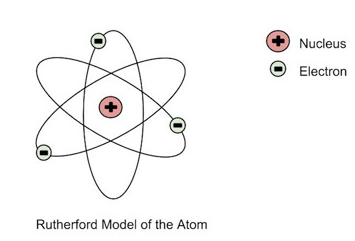
Who came up with this model of an atom?
a)
J.J. Thompson
b)
Ernest Rutherford
c)
Neils Bohr
d)
James Chadwick
48.
True or False: The majority of an atom is made up of empty space
a)
True
b)
False
49.
The atomic number tells you what?
a)
number of electrons
b)
number of protons
c)
number of neutrons
d)
both electrons and protons in an atom.
50.
Elements which are shiny, conduct electricity and heat are called
a)
metal
b)
nonmetal
c)
metalloid
d)
nonexistent
51.
Which is an alkali metal?
a)
Magnesium
b)
Iron
c)
Sodium
d)
Europium
52.
Atoms with similar properties are most likely located...
a)
in the same period.
b)
in the same group.
c)
in different periods.
d)
to the right and left of each other.
53.
The atomic number of this pictured element is
a)
28
b)
58.6934
c)
Ni
d)
Nickel
54.
Who first developed the Periodic Table?
a)
Mendeleev
b)
Mosely
c)
Mendella
d)
Murphy
55.

what is the biggest group on the table

a)

metals

b)

nonmetals

c)

metaloids

d)

halogens

56.

Which color on the image of the periodic table corresponds with the halogens.

a)

red

b)

black

c)

blue

d)

orange

57.

Which color on the image of the periodic table corresponds with the noble gases.

a)

red

b)

black

c)

blue

d)

orange

58.

Which color on the image of the periodic table corresponds with the transition metals.

a)

red

b)

black

c)

blue

d)

orange

59.

Which color on the image of the periodic table corresponds with the metalloids.

a)

bright yellow

b)

gold

c)

teal

d)

light blue

60.

Which color on the image of the periodic table corresponds with the alkaline earth metals.

a)

yellow

b)

dark yellow

c)

blue/green

d)

teal

61.
Water that is heated and changed to steam is a 
a)
Physical change
b)
Chemical change
62.
Burning wood is an example of 
a)
Chemical change
b)
Physical change
63.
Glass breaking s an example of a
a)
Chemical change
b)
Physical change
64.

What is the formula for sodium bromide?

a)

NaBr

b)

NaBr2

c)

Na2Br

d)

SoBr

65.

What is the formula for diphosphorus pentoxide?

a)

P2O5

b)

PO5

c)

P5O2

d)

Po2O5

66.

What is the name for SiCl4?

a)

silicon tetrachloride

b)

silicon quadchloride

c)

monosilicon tetrachloride

d)

silicon chloride

67.

What is the name of P₄S₁₀?

a)

phosphorous sulfide

b)

phosphorus sulfite

c)

tetraphosphorus decasulfide

d)

tetraphosphide decasulfide

68.

What is the name of the compound with the formula Ba3P2?

a)

barium phosphide

b)

barium diphosphide

c)

tribarium diphosphide

d)

barium phosphorous

69.

What are reactants?

a)

The chemicals that start the reaction.

b)

The chemicals that the reaction produced.

c)

The chemicals that are on the right side of the arrow.

70.

What are products?

a)

The chemicals that start the reaction.

b)

The chemicals that the reaction produced.

c)

The chemicals that are on the left side of the arrow.

71.

Identify the reaction type:

C2H6 + O2 --> CO2 + H2O

a)

Double replacement

b)

Synthesis

c)

Acid base

d)

Combustion

72.

Identify the reaction type for the following equation:

K + F2 --> KF

a)

Double replacement

b)

Single Replacement

c)

Synthesis

d)

Decomposition

73.

Identify the type of reaction:

ZnCl2 + Mg --> Zn + MgCl2

a)

Precipitate

b)

Single Replacement

c)

Double Replacement

d)

Decomposition

74.

Identify the reaction type:

NaCl + KOH --> KCl + NaOH

a)

Double replacement

b)

Combustion

c)

Synthesis

d)

Decomposition

75.

Identify the reaction type:

H2O2 --> H2O + O2

a)

Decomposition

b)

Synthesis

c)

Combustion

d)

Acid Base

76.
Balance this equation
_Zn+_HCl-->_ZnCl+_H2
a)
1,1,2,1
b)
1,1,1,2
c)
1,2,1,1
d)
2,1,1,1
77.
Balance this equation
_N+ _H--> _NH3
a)
1,2,3
b)
1,3,2
c)
1,1,2
d)
2,1,1
78.
What does the Law of Conservation of Mass state?
a)
Matter cannot be gained or lost in a chemical reaction.
b)
Matter can only be lost in a chemical reaction.
c)
Matter can only be gained in a chemical reaction.
d)
Matter can be gained and lost in a chemical reaction. 
79.
How many hydrogens are in 4H2O?
a)
6
b)
8
c)
2
d)
4
80.
What are the coefficient used to balance the equation below?
__Ag2O →__ Ag +___O2
a)
2,4,1
b)
1,1,1
c)
2,1,2
d)
2,2,2