Wayground logo

Free Printable Worksheets

Font size

S
M
L
XL
Worksheets

Ecology test

Total questions: 67

Worksheet time: 1hrs 7mins

Name
Class
Date
1.

The number of pythons found throughout Everglades National Park has increased in recent years. These huge snakes are not native to Florida and are believed to have been released into the wild by pet owners. Wildlife biologists have initiated attempts to capture and remove these pythons. Which statement best explains the biologists’ reason for removing these pythons from the Everglades?

a)

The pythons could upset the territorial boundaries of native organisms.


b)

The pythons could adapt to overcome diseases common to native snakes.

c)

The pythons could prey on native organisms and cause native populations to decline.

d)

The pythons could begin to interbreed with native snakes and produce a more successful species.

2.
Members of a species in a defined area
a)
Ecosystem
b)
community
c)
biodiversity
d)
population
3.
Consumer that eats plants
a)
heterotroph
b)
herbivore
c)
producer
d)
community
4.
Series of steps in which organisms transfer energy by eating and being eaten
a)
foodweb
b)
consumer
c)
food chain
d)
omnivore
5.
Organisms that relies on other organisms for food; consumer
a)
herbivore
b)
decomposer
c)
heterotroph
d)
species
6.
All the organisms in a particular location, including their nonliving environment
a)
ecosystem
b)
carnivore
c)
niche
d)
population
7.
What does fungi do to dead plants and animals?
a)
Leave them there
b)
Decompose them
c)
Wait for other animals to eat them
d)
Move away
8.
What may happen if the snowshoe hare was removed from the food web pictured?
a)
The insects in the habitat would increase.
b)
The shrew population would decrease due to being only hawk food source.
c)
The willow tree population would decrease.
d)
Foxes would dies due to no food source. 
9.
In the energy pyramid here, how much of the energy in the producers gets passed to the herbivores?
a)
10%
b)
20%
c)
80%
d)
90%
10.
Which of the following leads to a decrease in biodiversity?
a)
protection of ecosystems
b)
pollution control
c)
selective cutting
d)
introduction of exotic or invasive species
11.
A carbon "sink" is best described as:
a)
a reservoir that readily releases carbon to another reservoir
b)
a carbon reservoir that stores more carbon that it is releasing
c)
something that causes carbon to leak out to the atmosphere
d)
a carbon reservoir that is releasing more carbon than it is taking in
12.
Nitrogen fixation processes nitrogen from which of the following sources?
a)
lightning
b)
fertilizers
c)
dead plants
d)
atmosphere
13.
What is it called when water is changed from a liquid to a gas?
a)
EVAPORATION
b)
PRECIPITATION
c)
TRANSPIRATION
14.
In the food web shown, the snail would be considered...
a)
primary consumer
b)
secondary consumer
c)
tertiary consumer
d)
producer
15.
Which biome, because of its climate and amount of rainfall, has the largest number of species of plants and animals?
a)
Tundra
b)
Rainforest
c)
Desert
d)
Pineforest
16.
All these organisms share the same
a)
Biome
b)
Population
c)
Community
d)
Habitat
17.
Fungi are a  ________
a)
Autotrophs
b)
Heterotroopers
c)
Decomposers
d)
Primary Consumers
18.
Which these organism below is a primary consumer?
a)
Fungi
b)
Snake
c)
Ladybug
d)
Blue Jay
19.
The image shown is an example of _______ 
a)
Parasitism  
b)
Commensalism 
c)
Mutualism 
d)
Communism 
20.
Which is not a biome found in North America?
a)
Mojave Desert
b)
Grasslands of the Great Plains
c)
Everglades / Coastal Plain
d)
Tropical Rain Forest 
21.
All living things get their energy from which of the following sources?
a)
food
b)
water
c)
sun
22.
Which of the following is another word for a plant?
a)
autotroph
b)
heterotroph
c)
consumer
23.
Which of the following is an organism that eats only meat?
a)
herbivore
b)
carnivore
c)
omnivore
24.
Which is represented by all of the bullfrogs living around a pond?
a)
community
b)
habitat
c)
population
25.
What would most likely happen if the rabbit population was removed from the food chain grass —› rabbit —› fox?
a)
their would be more grass
b)
there would be less rabbits
c)
there would be more fox
26.
Which is an example of a parasitic relationship?
a)
a bee pollinates a flower
b)
a tapeworm takes nutrients from a dog
c)
an orchid lives in a tree but does not harm the tree
27.
In which type of relationship do both species benefit?
a)
parasitism
b)
mutualism
c)
commensalism
28.
Barnacles grow on whales.  Whales give the barnacles a place to live but the barnacles do not help or harm the whale.  Which type of relationship is this?
a)
commensalism
b)
mutualism
c)
parasitiesm
29.
An oxpecker bird eats ticks off of a zebra.  The bird gets food from eating the ticks and the zebra has harmful parasites removed.  Which type of symbiosis is this?
a)
mutualism
b)
parasitism
c)
commensalism
30.

In the wild, some alligators gets their teeth cleaned by birds. The birds gets their food from the alligators' teeth.

What type of symbiosis is this?

a)

Mutualism

b)

Commensalism

c)

Parasitism

d)

Neutralism

31.

In an ecosystem, there are populations of moose, rabbits, grass, and pine trees. Suddenly, a fire blazes through the area, which kills all of the populations. As the months go on, new species of grass begin to take root. This attracts animals, and eventually the ecosystem is restored.


What type of ecological succession happened?

a)

Primary succession

b)

Secondary succession

c)

Tertiary succession

d)

None of the above

32.

In this photo, what is an abiotic factor?

a)

Deer

b)

Grass

c)

rain

33.

What is this picture describing?

a)

It is describing natural selection.

b)

It is describing direct competition between flamingos and ducks.

c)

It is describing abiotic factors of the tundra.

d)

It is describing the niche of each bird.

34.
Study of interactions between organisms and their environment 
a)
niche
b)
community 
c)
ecology
d)
ecosystem
35.
Non-living factor that affects an ecosystem
a)
biotic factor
b)
abiotic factor
c)
food chain 
d)
biome
36.
A collection of organisms that belong to different populations but all live in the same area and interact with one another.
a)
Population
b)
Ecosystem
c)
Community
d)
Ecosphere
37.
Evaporation of water from the leaves of a plant gives of purified water to be evaporated.
a)
precipitation
b)
concentration
c)
transpiration
d)
evaporation
38.
Individuals that can breed with one another make up a
a)
species
b)
population
c)
community
d)
ecosystem
39.

What would happen within a few months after the formation of a volcanic island?

a)

pioneer species would grow

b)

no pioneer species would grow

c)

trees and large plants would grow

d)

rich, organic soil would be present

40.

What would be a good example of a primary consumer?

a)

carnivore

b)

detrivore

c)

decomposer

d)

herbivore

41.

Which organisms would be at the top or last trophic level?

a)

plant

b)

herbivore

c)

omnivore

d)

carnivore

42.

The monkey would be a

a)

decomposer

b)

producer

c)

primary consumer

d)

secondary consumer

43.

Introduced species disrupt ecosystems because they are a/an

a)

Keystone Species

b)

Endemic Species

c)

Invasive Species

d)

Native Species

44.

A lion that eats a zebra that eats grass is a

a)

primary consumer

b)

secondary consumer

c)

tertiary consumer

d)

quaternary consumer

45.

90% of the energy that gets lost as you move up a food pyramid or chain gets lost as

a)

pollution to the environment

b)

heat to the environment

c)

energy for decomposers

d)

gets recycled

46.
What factor describes when populations increase because animals are moving into a population?
a)
Emigration
b)
Limiting Factors
c)
Immigration
d)
Exponential Growth
47.
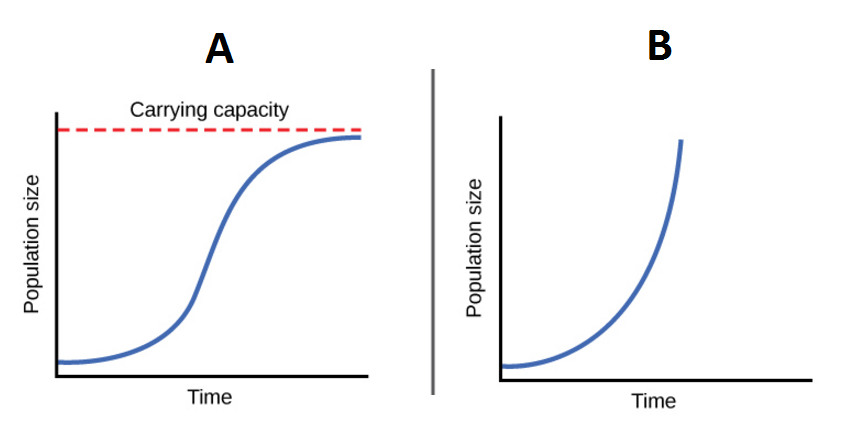
What does the graph represent?
a)
Emigration
b)
Exponential growth
c)
Immigration
d)
Logistic Growth
48.
What factor describes when populations decrease because animals are moving out of a population?
a)
Emigration
b)
Limiting Factors
c)
Immigration
d)
Exponential Growth
49.
Logistic growth has 3 phases. In Phase 1, the population grows rapidly. In Phase 2, population grows slowly. In Phase 3, growth stops. What causes growth to stop in the 3rd phase of logistic growth?
a)
Emigration
b)
Immigration
c)
Exponential Growth
d)
Carrying Capacity
50.
True or False: Limiting factors can be population dependent and population independent.
a)
True/Cierto
b)
False/Falso
51.
Which limiting factor would increase due to the number of individuals in a population?
a)
Unusual weather
b)
Natural disaster
c)
Births
d)
Disease
52.
Which limiting factor is independent of the number of individuals in a population?
a)
competition
b)
parasitism/disease
c)
stress
d)
natural disasters
53.
Human population grew exponentially after the industrial revolution. Which of the following DOES NOT help determine patterns in human population growth?
a)
age structure
b)
births
c)
deaths
d)
limiting factors
54.

What type of factor has an increasing impact as the population size increases?

a)

density-independent

b)

density-dependent

c)

cohort effect

d)

survivorship factor

55.

What type of growth model is shown in image A?

a)

Exponential

b)

Logistic

56.

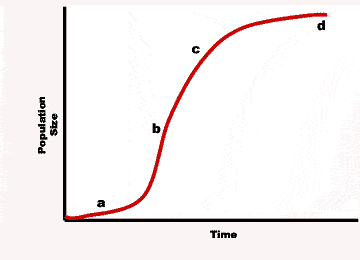
What point on the graph represents carrying capacity?

a)

a

b)

b

c)

c

d)

d

57.

The Florida Panther is a large cat that is native to the southern parts of Florida. Recently, the panther's main food source, rabbits, have been infected with a deadly disease that only affects rabbits. How would this most likely affect the population of panthers in the coming years?

a)

The panther population will decrease since they won't have access to as much food

b)

The panther population will not be affected because they will adapt to eating other food

c)

The panther population will increase because they will produce more offspring to make up the difference

d)

The panther population will decrease because they will contract the disease.

58.

Sea turtles are marine reptiles. They rely on an external heat source, which makes them ectotherms. They are commonly found in waters off the Mid-Atlantic and Northeast United States during the summer and early fall. Typically, they begin to migrate south to warmer water by late October. However, some sea turtles strand along our shores when water temperatures drop rapidly or unexpectedly. This is called “cold stunning.” Cold stunning is similar to hypothermia in humans. Initial symptoms include a decreased heart rate, decreased circulation, and lethargy, followed by shock, pneumonia and possibly death.


Based from this passage, why do sea turtles migrate?

a)

Sea turtles migrate because their food source is more abundant in the south during the fall.

b)

Sea turtles migrate because predators become more abundant in the Mid-Atlantic and Northeast of the U.S. during the summer and early fall.

c)

Sea turtles migrate because humans are fishing more often in the areas where they are commonly found during summer and fall.

d)

Sea turtles migrate because they depend on external sources of heat to help maintain their body temperature.

59.
Nesting birds often space themselves evenly from other nests. This pattern is called
a)
clumped dispersion.
b)
uniform dispersion.
c)
random dispersion
d)
scatter dispersion
60.
The way in which individuals of a population are spread out is called
a)
population density
b)
survivorship
c)
population dispersion
d)
logistic curve
61.
What is the best definition of a population?
a)
The number of plants and animals there are in an area
b)
The number of different species in one place at one time
c)
The number of individuals of one species living in the same place
d)
The total number of all organisms in an ecosystem
62.

The average number of individuals of the same species per unit of surface area at a given time is the ……………………

a)

population density

b)

population growth

c)

population birth rate

d)

population size

63.
Which kind of dispersion is #1?
a)
clumped
b)
random
c)
uniform
64.
Populations of different organisms living in an area
a)
species
b)
community
c)
niche
d)
biome
65.

Exponential population growth can be described as

a)

growth when resources are limited

b)

a j-shaped curve

c)

a s-shaped curve

d)

growth that reaches carrying capacity

66.

Logistic population growth can be described as

a)

growth when resources are limited

b)

a s-shaped curve

c)

reaching carrying capacity

d)

all of the above

67.

What limits Population Growth?

a)

birth rates increasing

b)

resources being used up

c)

natural selection taking place

d)

none of the above