

wayground logo

Free Printable Worksheets

Font size

S
M
L
XL
Worksheets

U.S. History Year Review (EOC Prep)

Total questions: 84

Worksheet time: 1hrs 4mins

Name
Class
Date
1.
What are the three branches of government
a)
congressional, executive, judicial
b)
congressional, executive, legislative
c)
executive, judicial, legislative
d)
judicial, legislative, professional
2.

What Amendment was passed to guarantee African American men the right to vote?

a)

13th

b)

14th

c)

16th

d)

15th

3.
Which amendment abolished slavery?
a)
13th
b)
14th
c)
15th
d)
19th
4.
What group gained control of Congress after Lincoln's assassination?
a)
Southern Democrats
b)
Former Confederates
c)
Radical Republicans
d)
Communists 
5.

Under Presidential Reconstruction, southern whites passed laws restricting the rights of African Americans called--

a)

Black codes

b)

Slave Laws

c)

Confederate Rights

d)

Merica Laws

6.
The white terrorist group that attacked Blacks and white republicans to restore Democratic control in the South was the--
a)
Kappa Kappa Kappa
b)
Redeemers
c)
Pure Race Fraternity 
d)
Ku Klux Klan
7.
How did the 14th amendment overrule the Dred Scott decision?
a)
It abolished slavery
b)
It said slaves could vote
c)
It protected African Americans as equal citizens
d)
It said that African Americans could move north
8.
Which of the following reversed the Supreme Court ruling in Dred Scott v. Sandford?
a)
A. The Dawes Act
b)
B. The Fourteenth Amendment
c)
C. The Compromise of 1877
d)
D. The Kansas-Nebraska Act
9.
Reconstruction was the process of
a)
rebuilding the South after the Civil War
b)
creating land zones for freedmen after the Civil War
c)
instituting Black Codes for former slaves
d)
eliminating the plantation economy in the South
10.
After an electoral dispute resulting in the Compromise of 1877, it was agreed that Rutherford B. Hayes would become President if
a)
he would create a new Freedmen's Bureau
b)
he ended Reconstruction and removed troops from the south
c)
he would allow African Africans full rights in the North only
d)
he created pro-cotton legislation in Congress
11.
Many southern states passed laws after the Compromise of 1877.  The laws that legalized the segregation of whites and blacks were called
a)
Jim Crow Laws
b)
Black Codes
c)
Freedman's Bureau
d)
Reconstruction
12.

"Separate but Equal "was the decision for which supreme court case?

a)

Plessy v Jim Crow

b)

Homer v Jim Crow

c)

Plessy v Ferguson

d)

Brown V Board of of Education

13.

The attempt to remove the vote is called?

a)

voter fraud

b)

disfranchisement

c)

suffrage

d)

none of the above

14.
Which amendment to the U.S. Constitution gave women the right to vote?
a)
Fifteenth Amendment 
b)
Twentieth Amendment 
c)
Eighteenth Amendment
d)
Nineteenth Amendment
15.

Black educator who created the Tuskegee Institute. He wanted blacks to learn a skill and become more self-sufficient, which would lead to equality

a)

Booker T. Washington

b)

Alexander Stephens

c)

W.E.B. DuBois

d)

Henry Grady

16.
The movement to help women get their voting rights was called
a)
Women's suffrage
b)
The Womens' Unity Parade
c)
The Million Women March
d)
The Women's Pact
17.
-Wanted African Americans to get a college education
-Demanded equality for all groups of people
a)
Booker T. Washington
b)
W.E.B. Dubois
c)
Alonzo Herndon
d)
John Hope
18.
His farewell address warned against foreign alliances. 
a)
John Jay
b)
George Washington
c)
John Witherspoon
d)
John Locke
19.
Established in 1865 to provide assistance to former slaves and poor whites.
a)
Black Codes
b)
Freedmen's Bureau
c)
Jim Crow Laws
d)
Tenure of Office Act
20.
How did the construction of the Transcontinental Railroad affect the demographics of the United States during Reconstruction?
a)
It increased the need for laborers in urban areas. 
b)
It limited the need for foreign immigrants.
c)
It encouraged westward expansion. 
d)
It altered the economy in southern rural areas. 
21.
Which animals did Plains Indians depend on for survival?
a)
cattle and horses
b)
cattle and sheep
c)
horses and rabbits
d)
horses and buffalo
22.

Caused by the Indian Removal Act

a)

King Phillip's War

b)

Wounded Knee

c)

French and Indian War

d)

Trail of Tears

23.
Idea that the United States would expand from the East Coast to the West Coast and was supported by God in doing so was called 
a)
Inevitable Discovery 
b)
America First 
c)
Manifest Destiny
d)
Homeland Security 
24.
The process of people leaving the farms or rural areas for more populated cities is called....
a)
Suffrage
b)
Urbanization
c)
Rural
d)
Boom Bust
25.
The 18th amendment did which of the following?
a)
Banned the sale of all alcohol
b)
Guaranteed the right to vote for black men 
c)
Allowed the sale of alcohol
d)
Gave women the right to vote
26.

Upton Sinclair wrote what famous book about the food industry?

a)

Rumble in the Jungle

b)

The Jungle Book

c)

The Jungle

d)

Jungle to Jungle

27.

As a result of The Jungle, Teddy Roosevelt signed the....

a)

New York Tenement Act

b)

17th Amendment

c)

Pure Food & Drug Act and Meat Inspection Act

d)

Declaration of Independence

28.

The recall enables voters to....

a)

take your car back to the dealer to get fixed

b)

referendum the initiative into a bill

c)

use the Force

d)

remove public officials from public positions

29.

Imperialism is...

a)

when a powerful nation uses its resources to help a weaker nation

b)

when a weaker nation invites a powerful nation to help it industrialize

c)

when a powerful nation takes control of the economy and government of a weaker nation

d)

when weak nations join together to fight a strong nation

30.

What was the ship that sunk in Havana Harbor that was a cause of the Spanish American War?

a)

The Mayan

b)

The Maine

c)

The Massachusetts

d)

The Maryland

31.

Which of the following caused President Wilson to declare war on Germany?

a)

the assassination of Archduke Ferdinand of the Austro-Hungarian empire

b)

unrestricted submarine warfare and the Zimmerman telegram

c)

the selling of weapons to Great Britain by the United States

d)

disputes over German colonial claims to Samoa and the Marshall Islands
32.
sensationalized events in Cuba by American newspapers eager for war with Spain .
a)
Propaganda
b)
Dollar Diplomacy
c)
Spanish American War
d)
Yellow Journalism
33.
addition to the  Monroe Doctrine stating the US would intervene in the affairs of Caribbean nations as a police presence if necessary
a)
Open Door Policy
b)
DeLome Letter
c)
Imperialism
d)
Roosevelt Corollary
34.
Which of the following was a major cause of the Great Depression?
a)
overproduction and underconsumption
b)
a decrease in the supply of consumer goods
c)
an increase in demand for imported products
d)
an increase in the price of wheat on the world market
35.
Who was the President of the United States when the Stock Market crashed?
a)
Franklin D. Roosevelt
b)
Herbert Hoover
c)
Woodrow Wilson
d)
Theodore Roosevelt
36.
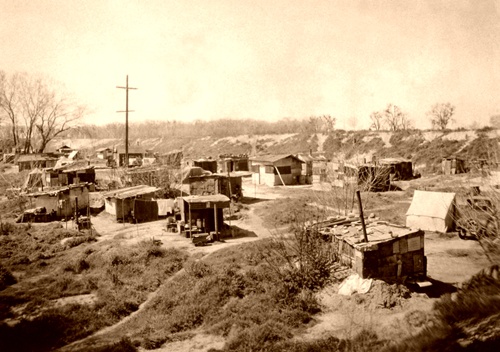
What was the main reason for the emergence of “Hoovervilles” like the one shown in the photograph?
a)
Many Americans had lost jobs during the Great Depression.
b)
Thousands of homes had been destroyed by the effects of the Dust Bowl.
c)
Housing projects could not keep up with the demand for homes needed by the poor.
d)
Preparations for World War I had created a shortage of building materials.
37.
What was a guiding principle of the New Deal economic policies?
a)
Pro-business tax breaks would solve the problems associated with urban poverty.
b)
Antitrust legislation would destroy the free market economy of the United States.
c)
Rugged individualism must be allowed to solve social inequality.
d)
Government must assume more responsibility for helping the poor.
38.
This was a major innovation found in most homes by the end of the 20s.
a)
Radio
b)
Television
c)
Telephone
d)
Microwave.
39.
Henry Ford is credited with mastering 
a)
Modern day filming.
b)
Use of the Assembly Line.
c)
Flying aeroplanes.
d)
Radio Broadcasting.
40.
The Red Scare led to which of the following?
a)
The ratification of the 19th amendment
b)
a demand for limits on immigration
c)
the start of the Great Depression
d)
the repeal of the 18th amendment 
41.
Nativists are against _______?
a)
Corruption
b)
African Americans
c)
Railroads
d)
Immigrants
42.
Which movement made Jazz popular?
a)
Return to Normalcy
b)
Harlem Renaissance
c)
Nativism
d)
Great Migration
43.
Why did African Americans move North during the Great Migration?
a)
Homestead Act
b)
Jobs in factories
c)
Nativism in the South
d)
Lower cost of living in cities
44.
Which New Deal program targeted the problem faced by bank failures?
a)
AAA
b)
FDIC
c)
Social Security
d)
SEC
45.
Which scandal saw the President attempt to take over the Judical Branch? 
a)
Zimmerman Note
b)
Tweed Ring
c)
Teapot Dome
d)
Court Packing Scheme
46.
Which of the following BEST describes the impact of Henry Ford on America?
a)
Ford manufactured a product too expensive for the middle class.
b)
Ford altered the course of government foreign policy
c)
Ford changed the method of mass production 
d)
Ford produced too many goods to keep prices high. 
47.
Which of the following caused the Red Scare of the 1920s? 
a)
anti-immigration sentiment 
b)
yellow journalism 
c)
fear of the spread of communism 
d)
crash of the stock market
48.
Nativists in the 20th century would MOST have approved of which of the following earlier efforts? 
a)
labor union reforms 
b)
Chinese Exclusion Act 
c)
Open Door Policy 
d)
progressive reforms 
49.
Which of these factors contributed most to the Dust Bowl? 
a)
Flash flooding and intense deforestation 
b)
Prolonged drought and poor farming practices 
c)
High winds and railroad construction 
d)
Severe heat and rapid suburban development 
50.

The Monroe Doctrine was written to keep European nations out of

a)

Central & South America

b)

Africa & India

c)

Japan & China

d)

Russia & the Middle East

51.

1. Andrew Jackson wanted to take the land from…

He did not what to give rights to which group of people in the US.

a)

free African Americans

b)

women

c)

Cherokee Indians

52.

An abolitionist was someone who

a)

a. liked slavery.

b)

b. supported the ratification of the Constitution.

c)

c. was against slavery.

53.

Why was the Battle of Gettysburg a turning point in the Civil War?

a)

a. The South did not try to invade the North again.

b)

b. Most of the northern army was destroyed.

c)

c. Lee surrendered to Gant.

54.

This is the island where European immigrants had to pass through in the early 1900’s.

a)

a. Angel Island

b)

b. Easter Island

c)

c. Ellis Island

d)

d. Liberty Island

55.

What 1890 massacre ended Native American resistance on the Great Plains?

a)

a. The Fetterman Massacre

b)

b. Wounded Knee

c)

c. Little Big Horn

56.

33. Why was the League of Nations an ineffective organization after WWI?

a)

a. No nations joined it

b)

b. Only American joined it

c)

c. Only England, France and Russia joined it

d)

d. The United States did not join it

57.

All of the following were reasons President Truman justified the dropping of the atomic bomb EXCEPT

a)

a. end the war quickly

b)

b. save American lives.

c)

c. protect the lives of Japanese civilians

58.

The atomic bomb was dropped on?

a)

a. Los Angeles and San Francisco

b)

b. Hiroshima and Nagasaki

c)

c. Tokyo and Kyoto

59.

What was the main effect of Thomas Paine’s pamphlet, Common Sense?

a)

It persuaded many colonists to support independence from Great Britain

b)

It listed ways that the colonies would be better off remaining British subjects

c)

It described ways that only Parliament had abused its power in governing the colonies

d)

It persuaded many soldiers in the Continental army to stay until the Revolution ended

60.

How did Thomas Jefferson use John Locke’s ideal of social contract to justify declaring independence?

a)

Since colonists agreed to be governed by King George III, he had the right to protect them

b)

Since King George III had treated the colonists poorly, they had the right to ask him for fairer treatment

c)

Since the colonists had not behaved as good subjects, King George III had the right to rule them harshly

d)

Since King George III had not protected the rights of his subjects, the colonists had the right to break from his rule

61.

What were the major industries that made the New England Colonies prosperous?

a)

Farming and hunting

b)

Fishing and the slave trade

c)

Shipbuilding and fishing

d)

Smuggling and pirating

62.

The type of government in which citizens vote for representatives to make decisions for them is known as a

a)

Monarchy

b)

representative democracy

c)

direct democracy

d)

Dictatorship

63.

How did Alexander Hamilton’s views on national policy differ from those of Thomas Jefferson?

a)

Hamilton wanted to pass lower tariffs

b)

Hamilton wanted a strong central government

c)

Hamilton wanted higher prices on American goods

d)

Hamilton wanted to protect powers of the states.

64.

What effect did the ruling in Marbury v. Madison have on the national government?

a)

It eliminated the Supreme Court’s power of judicial review

b)

It reinforced the importance of political parties in the government

c)

It showed that the judicial branch was the least powerful branch of government

d)

It confirmed the judiciary’s power to check the powers of the other two branches of government

65.

Which of the following was part of the Monroe Doctrine?

a)

The United States had the right to interfere in the affairs of newly independent countries in the Western Hemisphere

b)

European countries may not keep existing colonies in North or South America

c)

The United States would have a say in European affairs

d)

The U.S. would not interfere with existing colonies in the Western Hemisphere but European countries could not establish new colonies in North or South America.

66.

What was the purpose of the Missouri compromise?

a)

To maintain the balance of free and slave states

b)

To encourage the growth of slavery

c)

To end slavery gradually

d)

To ban the slave trade in all in territories

67.

As a __________, Jefferson was worried that making the Louisiana Purchase might be overstepping the president’s constitutional powers.

a)

Federalist

b)

strict constructionist

c)

loose constructionist

d)

Hamilton supporter

68.

In proposing the Kansas-Nebraska Act, Stephen Douglas wanted to use the governmental principle of __________ to determine if slavery would be allowed in the new territories.

a)

checks and balances

b)

popular sovereignty

c)

republicanism

d)

separation of powers

69.

What did President Lincoln proclaim in the Gettysburg Address?

a)

The Union would win the war so that slavery would end.

b)

The Union would need to win more battles before ultimately winning the war.

c)

The Union would win the war so that the ideals it was founded upon would continue.

d)

The Union would need to invade more territory before finally forcing an end to the war.

70.

Why did General Lee surrender to General Grant at Appomattox Courthouse?

a)

The Confederate Army used its last ammunition during the siege of Petersburg.

b)

The Confederate government was unable to pay its soldiers anymore.

c)

The Confederate government fled from Richmond to Raleigh.

d)

The Confederate Army was trapped and low on supplies.

71.
What are our Unalienable Rights according to the Declaration of Independence?
a)
Speech, Assembly, and Bearing Arms
b)
Expression, Petition, Religion
c)
Life, Liberty, and the Pursuit of Happiness
d)
Voting, Citizenship, and Serving on a Jury
72.

Which of the following is one way the Great Awakening affected colonial government?

a)

It led scientist to better understand the basic laws that govern nature

b)

It led colonists to begin to demand more political equality for all citizens

c)

It led citizens to become more isolated and less likely to discuss political issues

d)

It led people to believe a social contract existed between government and citizens

73.

What was the importance of the Battle of Yorktown?

a)

The British army under General Clinton captured the port city and took thousands of Patriots prisoner

b)

The Continental army under General Gates attacked a stronger British army and suffered the highest casualty rate of the war

c)

The Continental army under General Greene secured North and South Carolina by defeating Loyalist militia forces

d)

The British army under General Cornwallis surrendered to a combined American and French army in the last major battle of the war

74.

Why did many American colonists object to paying new taxes imposed following the French and Indian War?

a)

They felt that only landowners and merchants should pay taxes

b)

They were unable to afford the added costs related to these taxes

c)

They felt that only the Sons of Liberty should be able to pass taxes

d)

They were unable to vote for representatives who passed these taxes

75.

The Great Compromise was a resolution to which of the following?

a)

Representation in Congress

b)

Election of a President

c)

Selection of a Supreme Court justice

d)

Slave representation

76.

What physical feature generally follows the Proclamation Line of 1763?

a)

Great Smoky Mountains

b)

Appalachian Mountains

c)

Rocky Mountains

d)

Adirondack mountain range

77.
What is Andrew Carnegie NOT famous for?
a)
6th Wealthiest American Ever
b)
Donated 90% of wealth to charities
c)
Expanding the Oil Industry
d)
vertical integration
78.
What is Vertical Integration?
a)
control of one aspect of the supply chain
b)
entire supply chain is controlled by one company
c)
a monopoly
79.
What is Horizontal Integration?
a)
the entire supply chain is controlled by one company
b)
full control of one aspect of the supply chain
c)
a person who drains the country of natural resources
d)
a railroad
80.
What is the significance of Ellis Island?
a)
. It was the place where most European immigrants settled
b)
It was the place where most European immigrants passed through before they became citizens
c)
 It was the place where unwanted immigrants were sent by the U.S. government 
d)
It was the headquarters of the U.S. Immigration and Naturalization Service 
81.
This person was responsible for creating the first settlement house that assisted immigrants in Chicago.
a)
Ida B. Wells
b)
Susan B. Anthony
c)
Jane Addams
d)
Martha Washington
82.
Key Reforms of the Progressive Era
·  Initiative
·  Referendum
·  Recall
·  Direct Primary
·  17th Amendment

 
How did the reforms listed above impact America?

a)
A system of separate schools for new immigrants
b)
They gave citizens a greater voice in the democratic process of government
c)
More sources of revenue and taxes in state governments.
d)
They successfully brought economic relief to the urban working class
83.
This amendment allowed the people to directly elect their senators
a)
16th Amendment
b)
17th Amendment
c)
18th Amendment
d)
19th Amendment
84.
Roosevelt Corollary is also known as
a)
Big Stick Policy
b)
Dollar Diplomacy
c)
Rough Riders
d)
Monroe Doctrine