wayground logo

Free Printable Worksheets

Font size

S
M
L
XL
Worksheets

Electricity

Total questions: 100

Worksheet time: 1hrs 11mins

Name
Class
Date
1.
During a physics lab, a plastic strip was rubbed with cotton and became positively charged. The correct explanation for why the plastic strip becomes positively charged is that ...
a)
the plastic strip acquired extra protons from the cotton.
b)
the plastic strip acquired extra protons from the charging process 
c)
protons were created as the result of the charging process
d)
the plastic strip lost electrons to the cotton during the charging process 
2.
Insulators are different than conductors in that insulators ____.
a)
do not contain electrons or protons 
b)
 do not contain any charge
c)
have a weaker affinity for electrons 
d)
do not allow charge to freely move 
3.
Consider the conduction charging shown. 
a)
Electrons move from the insulating stand into the sphere.
b)
Protons move from the bar into the sphere.
c)
Electrons move from the charged metal bar into the sphere.
d)
Protons move from the sphere into the negatively charged bar.
4.
A glass rod becomes positively charged when it is rubbed with silk. This net positive charge accumulates because the glass rod
a)
gains electrons
b)
loses electrons
c)
gains protons
d)
loses protons
5.
 A balloon is rubbed against a student's hair and then touched to a wall. The balloon sticks to the wall due to
a)
magnetic forces between the particles of the balloon and the particles of the wall
b)
electrostatic forces between the particles of the balloon and the particles of the wall
c)
magnetic forces between the particles of the wall
d)
electrostatic forces between the particles of the balloon
6.
A negatively charged plastic comb is brought close to, but does not touch, a small piece of paper. If the comb and the paper are attracted to each other, the charge on the paper
a)
must be positive
b)
must be negative
c)
may be neutral or negative
d)
may be neutral or positive 
7.
When a plastic rod is rubbed with wool, the wool acquires a positive charge because
a)
protons are transferred from the wool to the rod
b)
protons are transferred from the rod to the wool
c)
electrons are transferred from the rod to the wool
d)
electrons are transferred from the wool to the rod
8.
A positively charged rod is held near the knob of a neutral electroscope. What best describes what will happen to the leaves?
a)
the leaves will spread apart and be positive
b)
the leaves will spread apart and be negative
c)
the leaves will stay closed and be positive
d)
the leaves will stay closed and be negative
9.
Two electrically neutral metal spheres, A and B, on insulating stands are placed in contact with each other. A negatively charged rod is brought near, but does not touch the spheres, as shown in the diagram below. How are the spheres now charged?
a)
A is positive and B is positive.
b)
A is negative and B is positive.
c)
A is positive and B is negative.
d)
A is negative and B is negative.
10.
A negatively charged rod touches the knob of a neutral electroscope. Which  best represents the distribution of charge on the electroscope.
a)
both the knob and leaves become positive
b)
both the knob and leaves become negative
c)
the knob becomes negative and the leaves become positive
d)
the knob becomes positive and the leaves become negative
11.
Electric charges that are alike _______ each other.
a)
Attract
b)
Repel
12.
What is the SI unit used to measure force? 
a)
pounds 
b)
grams 
c)
newtons 
d)
friction
13.
The charge of an electron is 
a)
positive. 
b)
negative. 
c)
Electrons have no charge
14.

When an object gains electrons it becomes __________

a)

Neutral

b)

Positively charged

c)

Negatively charged

15.

An atom of oxygen has 8 protons and 10 electrons, this means the atom is ____________

a)

positively charged because it has excess electrons

b)

negatively charged because it has excess electrons

c)

positively charged because it has a deficiency of electrons

d)

negatively charged because it has a deficiency of electrons

16.
If two balloons have the same charge, what will happen if you place them close to each other?
a)
Nothing
b)
They will be attracted
c)
They will pop
d)
They will push each other away.
17.

What are the charges of a proton, neutron, and electron (in order)

a)

positive, negative, neutral

b)

negative, neutral, positive

c)

neutral, positive, negative

d)

positive, neutral, negative

18.
When you charge a balloon by rubbing it on your hair this is an example of what method of charging?
a)
Friction
b)
Conduction
c)
Grounding
d)
Induction
19.
Two like charges
a)
 neutralize each other.
b)
repel each other. 
c)
must be neutrons. 
d)
attract each other.
20.
Charged objects are not attracted to neutral objects
a)
True
b)
False
21.
When a balloon is rubbed on clothes it acquires a charge by ___________
a)
Induction
b)
reduction
c)
friction 
d)
concuction
22.
Where do electrons go when you rub a balloon on your hair?
a)
Onto the balloon
b)
Into your hair
c)
Nowhere
23.
When a glass rod is rubbed with silk and the glass rod becomes positively charged, what happens to the electrons?
a)
they are removed from the rod
b)
they are added to the rod
24.
What do you call the process of charging a conductor by bringing it near another charged object?
a)
induction
b)
polarization
c)
neutralization
d)
conduction
25.
Which of the following is not a good conductor of electricity?
a)
copper
b)
silver
c)
Glass
d)
aluminum
26.
Which of the following is not a good insulator?
a)
Copper
b)
Glass
c)
rubber
d)
wool
27.
The law of conservation of charge states that...
a)
all atoms have more protons than electrons
b)
only protons can be rubbed off of an atom
c)
charge cannot be created or destroyed
d)
charge cannot be transferred 
28.
What is the name of the particle that is being transferred?
a)
Proton
b)
Neutron
c)
Electron
d)
Positron
29.
How can objects become electrified?
a)
By plugging them in to a socket
b)
Adding acid to them
c)
Rubbing with flannel
d)
Shaking them in the air
30.
Which of the following DOES NOT use electrostatics to work?
a)
Dryer sheets
b)
Electric Motor
c)
Photocopier
d)
Van de Graff Generator
31.
If you were to step out of a plane before it was grounded (discharged), what would happen?
a)
You would fall
b)
You would catch on fire
c)
You would receive a big shock
d)
Nothing
32.
If two balloons have the same charge, what will happen if you place them close to each other?
a)
Nothing
b)
They will be attracted
c)
They will pop
d)
They will push each other away.
33.

An atom of oxygen has 8 protons and 10 electrons, this means the atom is ____________

a)

positively charged because it has excess electrons

b)

negatively charged because it has excess electrons

c)

positively charged because it has a deficiency of electrons

d)

negatively charged because it has a deficiency of electrons

34.

After a balloon is rubbed against wool, the two objects will ________ each other because they have ___________ charges

a)

attract; like

b)

attract, opposite

c)

repel; like

d)

repel; opposite

35.

Which statement is true of a positively charged object?

a)

Positively charged objects do not contain any electrons.

b)

Positively charged objects do not contain neutrons or electrons.

c)

There is a lack of electrons on a positively charged object.

d)

The protons and the electrons are both positively charged on such objects.
36.

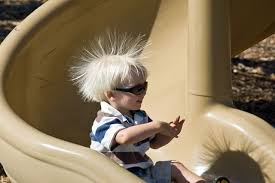
What method of static charging is shown in this picture

a)

Contact

b)

Friction

c)

Grounding

d)

Electron Shifting

37.

Why does the child's hair stick up?

a)

The boy is grounded since he's at the bottom of the slide

b)

He gained a charge from the slide, and since he's not grounded, his hairs have the same charge so they repel one another

c)

He gained a charge from the slide, and since he's not grounded, his hairs have opposite charges so they repel one another

d)

When hair is neutral, some have a positive side and some have negative side, so they will attract to each other, making it stand up

38.

What is the end result of charging by friction?

a)

Both object have the same charge, so they will attract one another

b)

Both object have the same charge, so they will repel one another

c)

Both object have the opposite charge, so they will attract one another

d)

Both object have the opposite charge, so they will repel one another

39.
Two like charges
a)
 neutralize each other.
b)
repel each other. 
c)
must be neutrons. 
d)
attract each other.
40.
What variable do "Newtons" represent?
a)
Electrostatic Charge
b)
Force
c)
Distance
d)
Mass
41.

A repulsive force exists between which two particles?

a)

Two neutrons

b)

An electron and a neutron

c)

An electron and a proton

d)

Two protons

42.

As two oppositely charged particles approach each other, what happens to the electrical force between them?

a)

The attractive force increases

b)

The magnitude of the electric force decreases

c)

The repulsive force increases

d)

The magnitude of their charges increases

43.

Same charges _____ each other

a)

repel

b)

attract

44.

Opposite charges _______ each other

a)

repel

b)

attract

45.

The number of protons is more than the electrons.

a)

Positively charged

b)

Negatively charged

c)

Neutral

46.

The number of protons and electrons is equal

a)

Positively charged

b)

Negatively charged

c)

Neutral

47.

When a positively charged glass rode passes near a metal sphere, it can become charged by

a)

Deduction

b)

Electroscope

c)

Induction

d)

Polarized

48.

A difference between electrical forces and gravitational forces is that...

a)

electrical forces can repel (have repulsive interactions)

b)

electrical forces only, follow the inverse square law

c)

electrical forces only, are affected by a change in distance

49.

When you rub a cloth against a PVC pipe, this is an example of charging by

a)

Conduction

b)

Induction

c)

Friction

d)

Touch

50.

If you brush your cat, and the brush becomes positively charged. Then you cat's hair is

a)

positively charged

b)

negatively charged

c)

uncharged

51.
Current electricity flows through
a)
wires
b)
string
c)
rubber
d)
plastic
52.
How does a switch work?
a)
It opens and closes the circuit
b)
It makes the light bulb brighter
c)
It is a resistor
53.
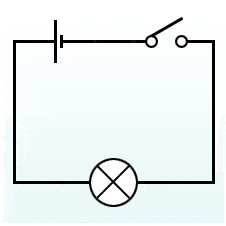
The image on the left is a 
a)
series circuit
b)
parallel circuit
c)
a weird circuit
54.
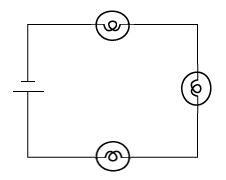
The image on the right is a 
a)
series circuit
b)
parallel circuit
c)
looks like the number 8
55.
What supplies the energy in an electric circuit?
a)
light bulb
b)
conductor
c)
wire
d)
battery
56.
Which of these could be used as a resistor in a circuit?
a)
pencil
b)
gas engine
c)
rubber eraser
d)
electric motor
57.
A material in which electrons are able to move easily
a)
Circuit
b)
Insulator 
c)
Resistance 
d)
Conductor 
58.
A material in which electrons are not able to move easily 
a)
Circuit 
b)
Insulator 
c)
Resistance 
d)
Conductor
59.
The rearrangement of electrons on a neutral object caused by a nearby charged object 
a)
Induction 
b)
Conduction 
c)
Friction 
d)
Conductor 
60.
Electric current that flows in only one direction. 
a)
Voltage 
b)
Direct Current 
c)
Alternating Current
d)
Series Circuit 
61.
The flow/movement of electric charges 
a)
Voltage
b)
Resistance 
c)
Current 
d)
Circuit 
62.
A closed path that electric current follows 
a)
Voltage
b)
Current
c)
Resistance 
d)
Circuit
63.
The tendency for a material to oppose the flow of electrons, changing electrical energy into thermal energy and light.
a)
Voltage
b)
Current
c)
Resistance
d)
Circuit 
64.
The current has only has one loop to flow through in this circuit. 
a)
Series Circuit 
b)
Parallel Circuit 
65.
This circuit contains two or more branches for current to move through. 
a)
Series Circuit 
b)
Parallel Circuit 
66.
Sally is creating a model to show what happens when electricity is used.  She decided to show the motor spinning below as her model. How could she best explain what is happening?
a)
Electric energy is transformed into energy of motion.
b)
Heat energy is transformed into energy of motion.
c)
Heat energy is transformed into electric energy.
d)
Electric energy is transformed into light energy.
67.
A student wants to use the diagram below to explain what happens when the light bulb turns on. How could she best explain what is happening?
a)
Light energy is transformed to electric energy.
b)
Electric energy is transformed to light energy.
c)
Electric energy is transformed to motion energy.
d)
Motion energy is transformed to electric energy.
68.
Will this circuit light the bulb? 
a)
Yes
b)
No
69.
Will this circuit light the bulb? 
a)
Yes
b)
No
70.
Tasha tested several items to see if they could conduct electricity.  Her data is shown below. What is the best claim she could make from her data?
a)
Wood is an insulator.
b)
Metal is an insulator.
c)
Keys are insulators.
d)
Toothpicks are conductors.
71.
Which of these substances conducts electricity the best?
a)
wood
b)
brick
c)
copper
d)
plastic
72.
What material would be safest to use as an insulator to cover electrical wires?
a)
rubber
b)
tin
c)
aluminum
d)
water
73.
____________ allows electricity to flow.
a)
A conductor
b)
An insulator
c)
A magnet
74.
Glass is a 
a)
conductor
b)
insulator
75.
The plastic around the wire is
a)
conductor
b)
insulator
c)
decoration
76.
____________ allows electricity to flow.
a)
A conductor
b)
An insulator
c)
A magnet
77.
____________ stops the flow of electricity.
a)
A conductor
b)
An insulator
c)
A magnet
78.

Choose the things that use electricity!

a)
b)
c)
79.

The ... uses electricity to keep food cold.

a)

Oven

b)

Kettle

c)

Refrigerator

80.

What's the name from this part!

a)

Bulb

b)

Battery holder

c)

Wires

81.

Which of these tools doesn't use electricity?

a)
b)
c)
d)
82.
What is a series circuit?
a)
The transfer of electrons from one object to another
b)
A circuit with a single path the current follows
c)
A circuit that goes in multiple directions
d)
A circuit that takes place in a series of events
83.
this circuit is .....?
a)
open
b)
parallel
c)
closed
d)
The cutest little circuit evah!
84.
The picture shows an electrical circuit. This circuit is a series circuit because: 
a)
It has 3 light bulbs.
b)
The same current flows through all three light bulbs.
c)
It uses a single battery.
d)
The electrical current has more than one path to flow through
85.
Current is measured in....
a)
Amps 
b)
Volts
c)
Ohms
d)
Coulombs
86.
this is the symbol for a _____?
a)
switch
b)
light 
c)
battery
d)
wires
87.
what is this symbol for?
a)
light bulb
b)
switch
c)
battery
d)
resistor
88.
What kind of circuit is this?
a)
Series
b)
Consecutive
c)
Parallel
d)
Training
89.
How should you put in an Ammeter?
a)
In Parallel
b)
In Series
90.
Voltage is measured in __.
a)
volts.
b)
watts.
c)
coulombs. 
91.
A voltmeter should be placed ........... in a circuit
a)
in parallel
b)
in series
c)
in order
d)
upside down
92.
What does this circuit symbol represent?
a)
diode
b)
light-dependent resistor (LDR)
c)
lamp
d)
light-emitting diode
93.
What does this circuit symbol represent?
a)
diode
b)
light-dependent resistor (LDR)
c)
lamp
d)
light-emitting diode
94.
Resistance is a measure of....
a)
the energy per unit charge in a circuit
b)
how hard it is for electrons to move through the circuit
c)
how hard it is for electrons to move through the battery
d)
the number of charge carriers in a circuit
95.

What does a voltmeter measure?

a)

Current

b)

Voltage

c)

Resistance

96.

The diagram shows a circuit including a lamp, an electric bell and three switches S1, S2 and S3. The lamp and bell are not faulty.


The bell is ringing but the lamp is not lit. Which switches are closed?

a)

S1 only

b)

S1 and S2 only

c)

S1 and S3 only

d)

S1, S2 and S3

97.

What is the current at point b?

a)

0.4A

b)

0.2A

c)

0.6A

d)

0A

98.

what is the current at point a?

a)

0.4A

b)

0.2A

c)

0.1A

d)

0A

99.

What is the current at point a and b?

a)

a=0.3A b=0.3A

b)

a=0A b=0A

c)

a=0.6A b=0.3A

d)

a=0.6A b=0.6A

100.

What is the current at point a?

a)

a=0.4A

b)

a=0.2A

c)

a=1.0A

d)

a=0.6A