Wayground logo

Free Printable Worksheets

Font size

S
M
L
XL
Worksheets

Advanced Science Cumulative Review April 25

Total questions: 50

Worksheet time: 1hrs 8mins
Name
Class
Date
1.
Scott drives a Jeep 12 km east, then 4 km north, then finally 3 km west. He traveled a total distance of:
a)
5 km
b)
10 km
c)
13 km
d)
19 km
2.
Liza is swimming laps from one end of a 50 meter pool to the other. Going from one end to the other is considered one lap. If she swims four complete laps, which statement is TRUE?
a)
Her distance and displacement are both zero.
b)
Her distance is zero, but her displacement is 200 meters.
c)
Her distance is 200 meters, but her displacement is zero.
d)
Her distance and displacement are both 200 meters.
3.
During a game of dodgeball, Marina runs 2.45 meters forward to grab a dodgeball, then runs 1.25 meters backward to avoid a opponent's dodgeball. Her displacement would be:
a)
3.7 meters backwards
b)
1.2 meters backwards
c)
3.7 meters forwards
d)
1.2 meters forwards
4.

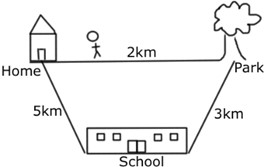
Jerry walked from home to school, then from the school to the park. What is his total displacement?

a)

2 km

b)

5 km

c)

8 km

d)

10 km

5.

Jerry walked from home to school, then from the school to the park. What is his total distance?

a)

2 km

b)

5 km

c)

8 km

d)

10 km

6.
The transfer of what type of atomic particle is responsible for the static charges on objects?
a)
neutrons
b)
protons
c)
electrons
d)
none of these
7.
What types of charges repel?
a)
Positive and Positive
b)
Positive and Neutral
c)
Negative and Neutral
d)
Neutral and Neutral
8.
The closer the charges, the ___________ the force between them
a)
closer
b)
further
c)
stronger
d)
weaker
9.
A balloon has a negative charge.  The glass rod has a positive charge.  What will happen when the glass rod is brought near the balloon?
a)
The balloon will be attracted to the rod
b)
The balloon will be repelled by the rod
c)
The balloon will remain in place
d)
The balloon will spin in circles
10.
Jupiter has about 317 times more mass than Earth. What can you infer from this fact? 
a)
That Jupiter’s gravitational force is much weaker than on Earth’s gravitational force.
b)
That Jupiter’s gravitational force is much stronger than Earth’s gravitational force.
c)
That Jupiter’s and Earth’s gravitational forces are equal.
d)
Mass has no effect on the gravitational force between two objects
11.

What conclusion can you state about this picture?

a)

The two balloons have opposite charges.

b)

The two balloons have like charges.

c)

The two balloons are neutral.

12.

Electricity happens with the flow of

a)

electrons.

b)

water

c)

sand

13.
In any collision (crash) the ______ is ALWAYS constant
a)
Total Momentum
b)
total speed
c)
total Velocity
d)
Energy
14.
Which object listed below has the greatest momentum?
a)
A 0.05 kg object rolling at 0.2 m/s.
b)
A 0.15 kg object rolling at 2 m/s.
c)
A 0.15 kg object rolling at 1 m/s
d)
A 0.4 kg object rolling at 2 m/s.
15.

According to Newton's Laws, for every action there is an ....

a)

equal and opposite reaction.

b)

equal and parallel reaction.

c)

unequal and opposite reaction.

d)

unequal and unrelated reaction.

16.
At which point is potential energy greatest?
a)
W
b)
X
c)
Y
d)
Z
17.
__________ is stored energy. 
a)
Potential
b)
Kinetic
c)
None of the above 
d)
All of the above 
18.
At which point is kinetic energy greatest? 
a)
W
b)
X
c)
Y
d)
Z
19.
A group of friends gather around a fire to stay warm.
a)
conduction
b)
convection
c)
radiation
20.

The plastic covering over this wire acts as a(n)...

a)

insulator

b)

conductor

21.

If you want to complete an electric circuit with a conductor. What is your best option?

a)

Wood stick

b)

Glass bead

c)

Aluminum foil

d)

Styrofoam

22.
When a pendulum swings, at which point is potential energy at its greatest?
a)
1
b)
2
c)
3
d)
4
23.
Explain what happens to the potential energy of a rock as it falls off the side of a cliff.
a)
The kinetic energy decreases as the potential energy increases.
b)
The kinetic energy decreases as the potential energy decreases.
c)
The potential energy decreases as the kinetic energy increases.
d)
The potential energy decreases as the kinetic energy decreases. 
24.

How does heat move?

a)

In many directions

b)

from warm places to cooler places

c)

from cold places to warm places

d)

Both B and C

25.

If you burn your hand on the handle of a hot pot, heat was transferred to your skin by

a)

conduction

b)

convection

c)

radiation

d)

equilibrium

26.

A material that reduces the flow of heat is a(n)

a)

conductor

b)

insulator

c)

metal

d)

radiator

27.

All of the following are good conductors of heat EXCEPT

a)

Copper

b)

Iron

c)

Plastic

d)

Aluminum

28.

In which of the following state are the particles closest together?

a)

Fluid

b)

Gas

c)

Liquid

d)

Solid

29.
What is the definition of CONVECTION
a)
When heat transfers through waves.
b)
When heat transfers from objects that are touching.
c)
a  hot liquid or air that  expands, becomes less dense, and rises or becomes more dense, and sinks.
d)
Heat traveling from the sun
30.
Which of these is an example of light energy being transformed into chemical energy?
a)
A glow stick lights up when broken.
b)
Water heated by the sun evaporates.
c)
A plant makes sugar in the sunlight.
d)
A battery causes a buzzer to vibrate.
31.
Which type of energy transformation occurs when a flashlight shines?
a)
chemical → thermal → electrical
b)
chemical → electrical → light
c)
thermal → chemical → light
d)
chemical → electrical → chemical
32.
The picture shows a microwave oven. As a microwave oven is operated, electrical energy is transformed into all of the following types of energy EXCEPT —
a)
Solar
b)
Light
c)
Thermal
d)
Mechanical
33.

What flows in circuits?

a)

neutrons

b)

atoms

c)

electrons

d)

energy

34.

What kind of energy does a battery use to power electrical circuits?

a)

mechanical

b)

chemical

c)

kinetic

d)

solar

35.

What does #1 represent?

a)

Period

b)

Frequency

c)

Wavelength

d)

Amplitude

36.

What does #2 represent?

a)

Period

b)

Frequency

c)

Wavelength

d)

Amplitude

37.

What kind of wave is pictured below?

a)

compressional wave

b)

transverse wave

c)

longitudinal wave

d)

mechanical wave

38.

Which wave is pictured?

a)

Transverse

b)

Longitudinal

c)

Electromagnetic

d)

Light

39.

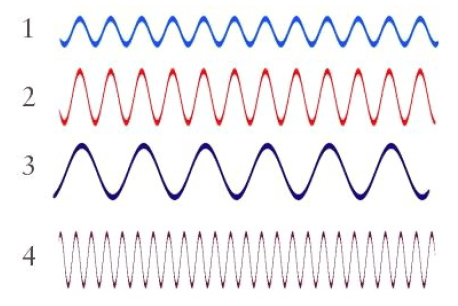
Which wave in the diagram has the greatest frequency?

a)

1

b)

2

c)

3

d)

4

40.
Which box has a higher density?  
a)
Box A
b)
Box B
c)
cannot be determined
d)
they are the same
41.
What is viscosity?
a)
A liquid's resistance to flow.
b)
a liquids flow.
c)
a liquid
d)
gas to solid.
42.

As temperature increases viscosity _______________.

a)

increases

b)

stays the same

c)

decreases

43.

Fluids with very high viscosity flow very _______________________.

a)

fast

b)

not at all

c)

slow

d)

whenever it wants

44.

How many valence electrons should Lithium have in its Lewis dot model?

a)

1

b)

2

c)

3

d)

4

45.

This is a correct dot diagram for carbon (C)

a)

true

b)

false

46.

This is a correct dot diagram for neon (Ne)

a)

true

b)

false

47.
What's a valence electron?
a)
electrons in the second energy level
b)
electrons in the outermost energy level
c)
the atomic number
d)
electrons in the first level
48.
Takes two small nuclei and combines them into a larger nucleus
a)
fission
b)
fusion
49.
The splitting of a nucleus into smaller nuclei is
a)
fusion
b)
fission
c)
half-life
d)
gamma radiation
50.
Which of the following statements BEST describes nuclear fusion?
a)
Nuclear fusion is a common source of energy
b)
Nuclear fusion usually requires freezing temperatures
c)
Nuclear fusion usually requires a high-temperature environment
d)
Nuclear fusion releases a small amount of energy compared to most chemical reactions