
 Worksheets
iLEAP Review #3
Total questions: 50
Worksheet time: 33mins
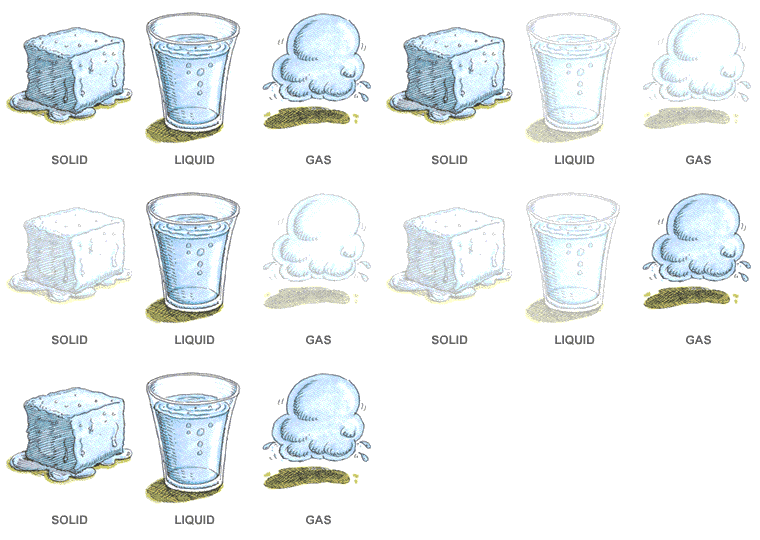


Which are examples of chemical change? Select THREE answers.
An egg is cooked.
Sugar dissolves in water.
A silver quarter tarnishes.
Water in a pan boils away.
Leaves in a compost pile rot.

Which state of matter has a fixed volume (amount of space it takes up) but not a fixed shape?
gas
liquid
solid

In which substance do the particles move the MOST?
air
ice
milk
wood

A student wants to make water vapor condense. What must the student do to the water vapor?
heat it
cool it
trap it in a container
mix it with other gases
Which is an example of a chemical property?
the color of a substance
the texture of a substance
whether a substance can rust
whether a substance feels cool
Water vapor is an example of
an atom
a liquid
a gas
a solid
Which is an example of a chemical change?
wood that has burned to ashes
paper that is cut into pieces
ice that melts into water
clay that is rolled into a ball
When heat is added to matter, what happens to its particles?
They move slower.
They move closer together.
They move faster.
They do not change.
Which tool would you use to measure mass?
balance
ruler
beaker
thermometer
Which answer makes a correct statement?
Physical change only changes the size.
Physical change only changes the color.
Physical changes begin and end with the same matter.
Physical changes change the matter into something totally different.
If enough heat is taken away from a container of water, what will happen?
It will begin to boil.
It will become a solid.
It will turn into a gas.
It will increase in weight.
A student is investigating chemical changes by using different materials. Which investigation would provide evidence of a chemical change
and why?
Melting a solid with fire would provide evidence of a chemical change because the solid would change shape.
Cutting cardboard into many smaller pieces would provide evidence of a chemical change because the pieces cannot be put back together.
Placing a solid into hot water and stirring while the solid dissolves would provide evidence of a chemical change because the dissolved material is lost.
Combining two liquids that give off heat and gas would provide evidence of a chemical change because the particles react to make a new material with different properties.
Which investigation would provide evidence of a chemical change?
Spray perfume into the air, and when the air and perfume mix, observe the change in odor that happens as they mix.
Put an antacid tablet in water, and when the antacid and water mix, observe the bubbles that form as a new substance is created.
Heat water in a pan on a stove, and observe the steam that forms as the state of matter of the water changes.
Blow air through a wand filled with soap solution, and observe the bubbles that form as the air becomes trapped.

What part of the water cycle is A?
evaporation
condensation
precipitation
run off

What part of the water cycle is B?
evaporation
condensation
precipitation
run off

What part of the water cycle is C?
evaporation
condensation
precipitation
run off
Oceans, glaciers, lakes, and rivers are part of Earth's
hemisphere
lithosphere
hydrosphere
atmosphere
Earth’s surface has a relatively thin, solid outer shell called the lithosphere. This solid part of Earth is part of the
hydrosphere
geosphere
outer core
atmosphere
Rocks are classified as igneous, metamorphic, or sedimentary according to
their color.
how they formed.
their shape.
the minerals they contain.
Which human activity would help reduce the amount of carbon dioxide in the atmosphere?
decrease the number of recycling programs
increase the human population
decrease the burning of fossil fuels
increase the number of cars being driven

Which statement is best supported by the diagram?
Chemicals applied by farmers lower the level of pollution in drinking water.
Human activities do not affect groundwater.
Toxic waste is safe if buried below the level of the basements of nearby homes.
Drinking water can become polluted from unsuspected sources.
The sun appears to move across the sky during the day. The best explanation for this apparent motion is that Earth is
rotating on its axis
much smaller than the Sun
revolving around the Sun
tilted on its axis
A student notices that at certain times of the year, the sunlight in the early morning is just beginning to shine while she is eating breakfast. At other times of the year the sunlight is later in the day. Why is this true?
the Earth rotates on its axis
the Earth revolves around the sun
the Earth's orbit is an oval shaped path
the Earth has 24 hours in 1 day

The student’s claim is correct; the evidence in the picture shows that both valleys were formed by the
constructive force of deposition because flowing water carries large rocks from far away and drops
them along a river, making the banks taller.
The student’s claim is correct; the evidence in the picture shows that both valleys were formed by the
destructive forces of weathering and erosion because flowing water breaks down rock and carries the
small pieces downstream.
The student’s claim is not correct; the evidence in the picture shows that valley 1 was formed by the
destructive forces of weathering and erosion because flowing water breaks down rock and carries the
small pieces downstream, but valley 2 was formed by the constructive force of deposition because
flowing water carries large rocks from far away and drops them along a river, making the banks taller.
The student’s claim is not correct; the evidence in the picture shows that valley 1 was formed by
the constructive force of deposition because flowing water carries large rocks from far away and
drops them along a river, making the banks taller, but valley 2 was formed by the destructive forces
of weathering and erosion because flowing water breaks down rock and carries the small pieces
downstream.

The student’s claim is correct because water fills small cracks in rocks, freezes, and expands, making the cracks larger over time.
The student’s claim is correct because the rock was carried from the top of the volcano to its base by a glacier, creating many cracks over time.
The student’s claim is not correct because the rock was picked up by moving water and rolled against
other rocks, smoothing its surface and causing cracks in a short period of time.
The student’s claim is not correct because large cracks in rocks are caused when lava from a volcano
covers the rock so its temperature rises and falls in a short period of time, causing it to break.
Earthquakes and volcanoes can both happen underwater. When earthquakes happen underwater, they can
cause________.
Earthquakes
Volcanoes
Tsunamis
Landslides
What best describes the mantle of Earth?
a thin layer that is located on the surface
a solid layer made of iron and nickel
the largest layer between the crust and outer core
the smallest layer that is made up of molten rock
Which is a process that most likely formed the Appalachian Mountains found in the eastern part of North America?
earthquake
folded rock
plate tectonics
volcanic activity
Which statement about the formation of rocks is true?
Heat and pressure can change igneous rock to sedimentary rock.
Weathering and erosion can change sedimentary rock into sediment.
Heat and pressure cause metamorphic rock to weather and erode.
Weathering and erosion prevent magma from changing into igneous rock.
Which of the following techniques should farmers
use to prevent erosion?
A. Plant rows of trees around the edge of the crop
field
B. Water crops with only distilled water
C. Spray pesticides around the base of each crop
D.Leave the field unplanted for a season to
increase minerals

The picture shows a sea arch found along a
coastline.
Which processes most likely contributed to the
formation of the sea arch?
A. Ice and wind erosion
B. Wave and wind erosion
C. Wave and sediment deposition
D. Chemical and sediment deposition

The picture shows a landform at X.
What is the landform at X, and how did it form?
A. It is a delta that formed when a river slowed
down as it flowed into the ocean, causing rocks
and sand that it was carrying to settle and build
up over time.
B. It is an island that formed when wind picked up
and carried rocks and sand from the banks of a
river and dropped them into the ocean.
C. It is a peninsula that formed as ocean waves
carved away land and pulled pieces of the shore
out to sea.
D. It is a sand dune that formed by coastal winds
blowing beach
Which features of Earth's surface are most likely
produced by wind deposition?
A. Deltas
B. Mountains
C. Fault lines
D. Sand dunes
Which is a destructive process where rocks, soil, roads, buildings are broken down into smaller parts?
weathering
erosion
magma
deposition
Which is the movement of materials from one place to another by natural methods, and can be both constructive (delta) or destructive (landslide)?
weathering
erosion
magma
deposition
Which is the process whereby soil and rock that is eroded from one location is deposited as sediment in another location, such as the soil in the Mississippi Delta?
weathering
erosion
magma
deposition
What is a constructive process that is a break in a weakness in Earth’s crust that lets magma come out from the mantle and onto Earth’s surface?
tornado
volcano
earthquake
glacier
What is the definition of a nonrenewable resource?
Something from the Earth that CAN be brought back or reproduced.
Something from the Earth that CAN NOT be brought back or reproduced in the lifetime of a human.
Something that is expensive.
Something that is hard to get from the Earth.
What is being released into the air by humans, animals, factories, and cars that is not good for our ozone and atmosphere?
Oxygen
Carbon
Air
H20
The process of sediment sticking together to form new rocks is called?
concretion
cementation
fraction
sanitation

