wayground logo

Free Printable Worksheets

Font size

S
M
L
XL
Worksheets

TBF Quiz #4 - Topics 10 & 11

Total questions: 64

Worksheet time: 2hrs 8mins

Name
Class
Date
1.

The process that causes the inherited traits of a species to change over time

a)

DNA

b)

natural selection

c)

evolution

d)

mutation

2.

I formed the theory of evolution by natural selection after my research of various species of finches on the Galápagos Islands. Who am I?

a)

Reginald Punnett

b)

Charles Darwin

c)

Dr. M'Benga

d)

Gregor Mendel

3.
Nature has a way of causing organisms that inherit advantageous traits to survive and reproduce more successfully than the ones that don't. This process is known as...
a)
natural selection
b)
genetic variation
c)
adaptation
d)
overproduction
4.

What do we call a difference found in a population of organisms?

a)

Species

b)

Variation

c)

Trait

d)

Organism

5.
Populations of species which do not adapt to their environment can eventually become...
a)
stronger
b)
humans
c)
extinct
d)
angry
6.

What do we call a complete living thing?

a)

Variation

b)

Trait

c)

Organism

d)

Species

7.

A group of similar organisms that can successfully reproduce among themselves in their natural environment is called

a)

a trait.

b)

an organism.

c)

a community.

d)

a species.

8.
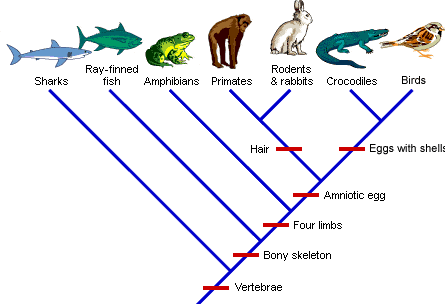
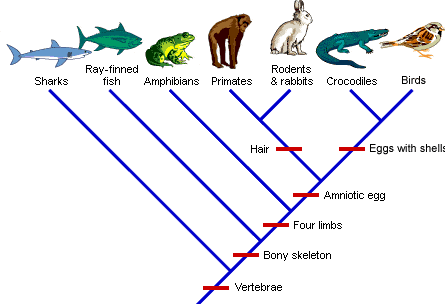
According to this cladogram, sharks are MOST closely related to which organism? 
a)
Amphibians
b)
Ray finned fish
c)
Crocodiles
d)
Birds
9.
According to this cladogram, birds are LEAST related to: 
a)
Amphibians
b)
Sharks
c)
Ray Finned Fish
d)
Crocodiles
10.
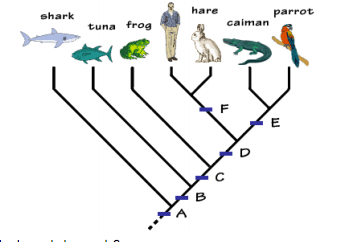
On the cladogram, which organism is the closest relative of the human?
a)
Frog
b)
Hare
c)
Caiman
d)
Parrot
11.
Evolution typically happens...
a)
in a few weeks
b)
over millions of years
c)
never
d)
in 100 years
12.
Darwin said that the number of offspring an organism has ___________________
a)
stays the same
b)
is more than can survive
c)
is less than needed
13.
Darwin said that within a species there will be _________________________
a)
nothing different
b)
variation/differences
14.
Organisms with differences/variations that are helpful will ______________________
a)
live longer
b)
become extinct
c)
show no change
15.

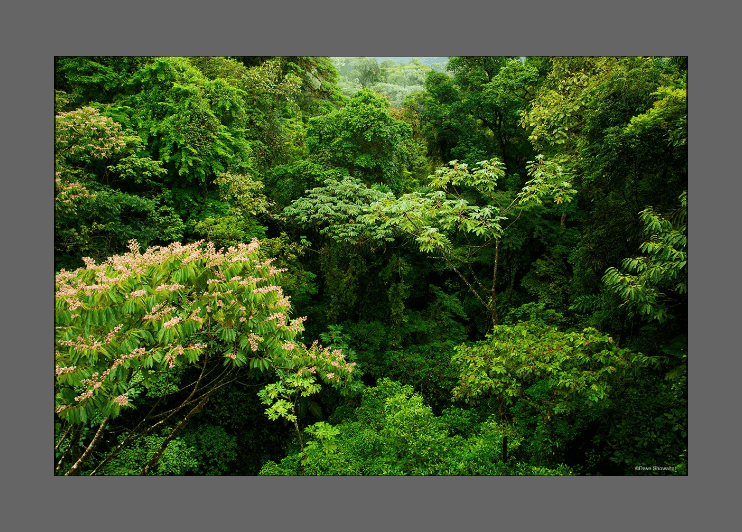
A yellow morph and green morph of an insect lives in the rainforest canopy. You would expect:

a)

the green population to increase and the yellow to decrease

b)

both populations should stay the same

c)

both populations will increase

d)

the green population to decrease and the yellow to increaseThis is a wrong answer

16.

How do you "win" at natural selection?

a)

survive

b)

go extinct

c)

survive & reproduce

17.
Which organisms are most likely to survive?
a)
the best adapted
b)
the fastest
c)
the strongest
d)
the most domesticated (tamed)
18.
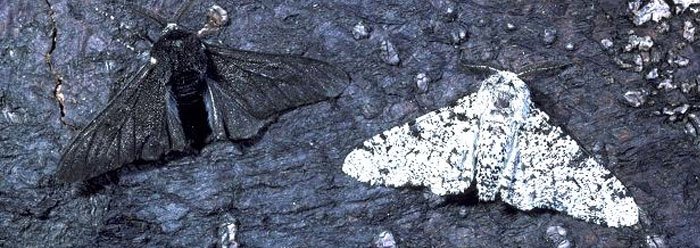
The trees these moths used to live on were white, but have been covered in soot from coal factories. Which moth will be more successful in this environment?
a)
Dark moth
b)
Light moth
c)
Both will be equally successful
d)
Neither will be successful
19.
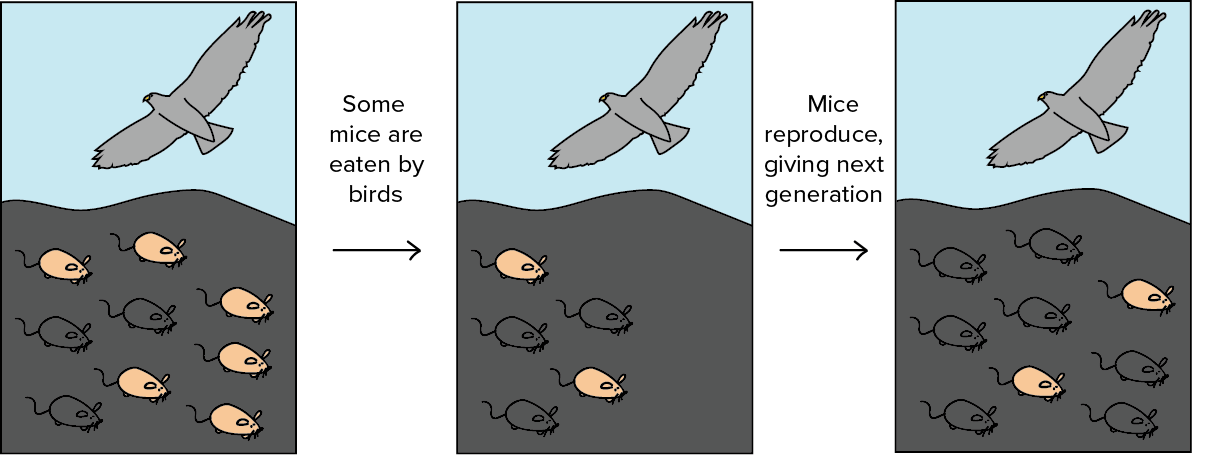
Why is the mouse population changing over time?
a)
The light mice can reproduce more successfully than the dark mice
b)
The hawks eat more dark mice than light mice because the dark mice taste better
c)
The hawks eat more light mice than dark mice because they can see the light mice more easily
d)
The hawks eat more dark mice than light mice because they can see the dark mice more easily
20.

1. The process of choosing parent organisms for desired characteristics is called

a)

natural selection

b)

Artificial selection

c)

random selection

d)

genetic manipulation

21.

What is an example of artificial selection?

a)

Letting dogs choose their own mate

b)

Letting plants pollinate on their own

c)

Crossing a labrador and a poodle to create a labradoodle

22.

Artificial selection has been a big factor in the evolution of:

a)

Dogs

b)

Panda bears

c)

Snakes

d)

Jellyfish

23.

Which statement is true comparing natural selection and artificial selection?

a)

In natural selection, traits benefit humans and in artificial selection, the traits benefit the species

b)

In natural selection, traits benefit the species and in artificial selection, the traits benefit humans

c)

In natural and artificial selection, the process takes hundreds of years to occur

d)

In natural and artificial selection, nature determines what traits will be passed down to offspring.

24.

The following is a similarity between artificial selection and natural selection

a)

Takes hundreds of years

b)

Humans determine traits

c)

Nature determines traits

d)

Offspring are produced

25.

Artificial selection is also known as

a)

natural selection

b)

unnatural selection

c)

genetic manipulation

d)

selective breeding

26.

When nature selects and species with beneficial adaptation survive and produce offspring

a)

natural selection

b)

artificial selection

27.

When humans select desirable traits to be passed down to offspring

a)

natural selection

b)

artificial selection

28.

When a farmer breeds only his or her best livestock, the process involved is.......

a)

natural selection

b)

artificial variation

c)

artificial selection

d)

survival of the fittest

29.
Which of the following orders the rock layers accurately from youngest to oldest?
a)
1, 2, 3, 4, 5
b)
5, 4, 3, 2, 1
c)
2, 3, 4, 5, 1
d)
1, 2, 3, 5, 4
30.
Which of these rock layers is relatively the newest?
a)
Kaibab formation
b)
Zoraster Granite
c)
Redwall limestone
d)
Unkar group
31.
Which fossil is relatively the oldest?
a)
Trilobite
b)
Ammonite
c)
Crinoid
d)
Gastropod
32.
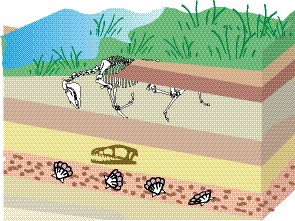
Which of the following happened in first?
a)
Deer
b)
Dog
c)
Human
d)
Bear
33.
Which of the following does the law of superposition tell scientists?
a)
Absolute age
b)
Relative age
c)
Exact age
d)
All of the answer choices
34.
An organism that no longer exists on Earth is called
a)
Decayed
b)
Evolved
c)
Extinct
d)
Preserved
35.
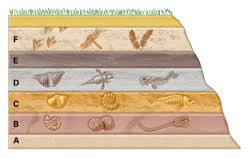
Which rock layer contains the newest fossils?
a)
F
b)
E
c)
B
d)
C
36.
According to the law of superposition, the oldest fossils are found 
a)
At the top of the rock layers
b)
Near the bottom of the rock layers
c)
In the middle of the rock layers
d)
Somewhat near the surface
37.
The best index fossils have which two traits?
a)
widespread geographically, long lifespan
b)
widespread geographically, short lifespan
c)
specific place, long lifespan
d)
specific place, short lifespan
38.
The Law of Superposition helps scientists to determine what?
a)
The absolute age of rock layers
b)
The age of fossils
c)
The relative age of rock layers
d)
the super powers of rocks
39.
According to the law of superposition, which layer is the youngest?
a)
A
b)
B
c)
C
40.
Which rock layer in the diagram seems to be the oldest?
a)
F
b)
E
c)
B
d)
A
41.

States that younger rocks lie above older rocks if the layers have not been disturbed

a)

law of superposition

b)

law of cross-cutting

c)

law of unconformity

d)

law of uniformitarianism

42.
An organism that no longer exists on Earth is called
a)
Decayed
b)
Evolved
c)
Extinct
d)
Preserved
43.
What type of rock do fossils form in?
a)
Igneous
b)
Sedimentary
c)
Metamorphic
d)
Classic
44.
Which rock layer most likely contains fossils of the most recently evolved organisms?
a)
1
b)
2
c)
3
d)
4
45.

Which rock layer is the youngest?

a)

A

b)

B

c)

C

d)

D

46.

The photograph below shows an outcrop with two basaltic intrusions, labeled A and B, in a rock unit, labeled C. What is the relative age of these three rock units from oldest to youngest?

a)

B → A → C

b)

B → C → A

c)

C → A → B

d)

C → B → A

47.

Which layer is the youngest?

a)

gray limestone

b)

red conglomerate

c)

brown siltstone

d)

brown sandstone

48.

Which rock layer is the oldest?

a)

A

b)

B

c)

C

49.

Which of the following layers is the youngest?

a)

A

b)

E

c)

F

d)

K

50.

Which of the following layers is the oldest?

a)

A

b)

E

c)

F

d)

K

51.
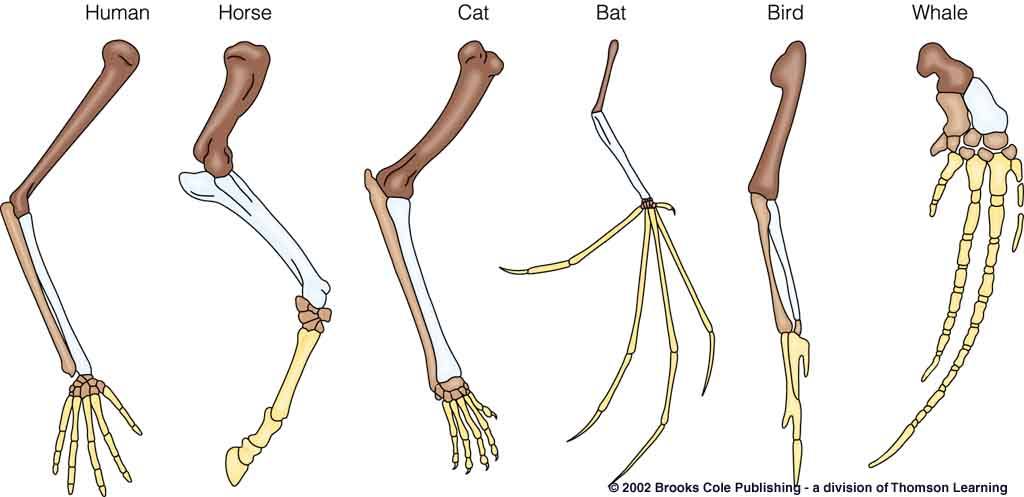
Humans, birds, whales, and lizards all have similar arm bones. What is the reason for this?
a)
The function of these bones is the same in all animals
b)
They live in similar environments
c)
They have a common ancestor
d)
All organisms resemble humans
52.

Which of the following pieces of evolution evidence deals with comparing similar structures in various species?

a)

fossil record

b)

comparing rock layers

c)

comparing biochemistry

d)

homologous structures

53.
The structures shown are_________
a)
homologous
b)
heterologous
c)
analogous
d)
vestigial
54.

An example of a homologous structure

a)

human arm and bird wing

b)

rat appendix and human appendix

c)

human head and bird wing

55.

The diagram shows an image of a Pterosaur wing, bat wing, and bird wing. These are all different organisms, but share similar wing structures. If these structures are similar due to common ancestry, which of the following best describes them?

a)

Vestigial Organ

b)

Embryological Similarities

c)

Homologous Structures

d)

Analogous Structures

56.
A fossil of an extinct dinosaur is found and the anatomy of the fossil shows similarities to that of a bird. What could this mean?
a)
This is purely by chance and isn't significant
b)
The extinct dinosaur and modern bird share a common ancestor
c)
All dinosaurs evolved into birds and that's why there aren't any dinosaurs alive today
d)
Dinosaurs choose to fly, and evolved into birds to escape predation and capture food
57.
Biologists discover two rabbit species living on opposite sides of a large river. What could they do to test and see if these species came from a common ancestor?
a)
Compare DNA sequences
b)
Compare body structures
c)
Compare protein sequences
d)
All of these
58.
A change in the inherited characteristics of an organism over time is ________
a)
evolution.
b)
development.
c)
growth.
d)
ancestry.
59.
Another word for specific parts that form an organ, system, or living thing is __________.
a)
structure.
b)
vertebrae.
c)
forelimb.
d)
organism.
60.
_____________  is the study of embryos to see how their similarities and differences indicate an evolutionary relationship.
a)
Paleontology
b)
Common ancestry
c)
Homologous structure
d)
Embryology
61.
In stage one (top row) of these embryos, most of the embryos________
a)
look very similar.
b)
have very different features.
c)
show different stages of development.
d)
have only a tail if they are non-human.
62.
In the the third embryonic stage (bottom row), mammal embryos _____
a)
have more characteristics in common with each other than with reptiles or birds.
b)
are still hard to tell from reptiles and birds.
c)
have the same features as fish, reptiles, and birds.
d)
do not have tails.
63.
The more similar the stages of embryonic development, the more likely that organisms share ____________
a)
a common ancestor.
b)
embryos.
c)
eggs.
d)
embryology.
64.

What are some common similarities that all embryos share? select ALL that apply

a)

tails at some point of development

b)

similar shape

c)

eye spots that develop into eyes

d)

all develop into mammals