wayground logo

Free Printable Worksheets

NEW

Font size

S
M
L
XL
Worksheets

Nuclear chemistry

Total questions: 28

Worksheet time: 28mins
Name
Class
Date
1.
Which process produces alpha particles?
a)
Alpha decay
b)
Beta decay
c)
Gamma decay
d)
Nuclear fusion
2.
Which process involves the joining of small nuclei?
a)
Beta decay
b)
Alpha decay
c)
Nuclear fission
d)
Nuclear fusion
3.
Which process involves the splitting of large nuclei?
a)
Beta decay
b)
Alpha decay
c)
Nuclear fission
d)
Nuclear fusion
4.
The time taken for half of an amount of radioactive atoms to decay.
a)
Nuclear fusion
b)
Full-life
c)
Dead time
d)
Half-life
5.
Arrange in order of increasing ability to penetrate matter.
a)
Beta, gamma, alpha
b)
Alpha, gamma, beta
c)
Gamma, beta, alpha
d)
Alpha, beta, gamma
6.
Which type of radiation has the greatest penetrating power?
a)
Alpha
b)
Beta
c)
Gamma 
d)
Microwaves
7.
The technetium-99 isotope has a half-life of 6.0 hours. If 100.0 mg were injected into a patient how much remains after 18 hours?
a)
33.0 mg
b)
12.5 mg
c)
.33 mg
d)
15.8 mg
8.
What happens to the atomic number during alpha decay?
a)
The atomic number decreases by 4
b)
The atomic number increases by 1
c)
The atomic number decreases by 2.
d)
The atomic number stays the same.
9.
Balance the following equation:
146C --> 0-1e + ________
a)
145B
b)
146C
c)
147N
d)
42He
10.

In the symbol 167N what the 7 stand for?

a)

Mass number

b)

Atomic number

c)

Atomic mass

d)

Number of neutrons

11.
The half life of Thorium-234 is 24 days. What fraction of the element remains after 96 days
a)
1/2
b)
1/4
c)
1/8
d)
1/16
12.
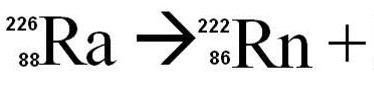
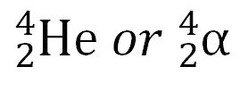
Complete the nuclear equation and determine the type of decay that is occurring in this reaction. 
a)
alpha
b)
beta
c)
gamma
d)
none
13.
Alpha particles have a _____ charge.
a)
+2
b)
0
c)
+1
d)
-1
14.
Barium-122 has a half-life of 2 minutes. A fresh sample weighing 80 g was obtained. If it takes 10 minutes to set up an experiment using barium-122, how much barium-122 will be left when the experiment begins?
a)
0.25g
b)
2.5g
c)
25g
d)
80g
15.
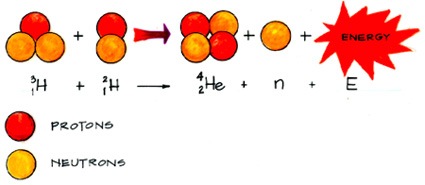
What do these symbols represent?
a)
alpha particle
b)
beta particle
c)
neutron
d)
gamma ray
16.
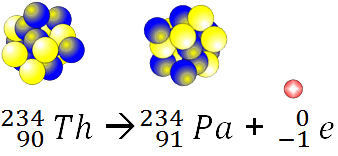
Which type of nuclear radiation is being emitted here?
a)
Alpha
b)
beta
c)
gamma 
d)
none
17.

Which type of radioactive decay gives off energy only (no particles)?

a)

alpha

b)

beta

c)

gamma

18.
Gamma rays have a _____ charge
a)
0
b)
+1
c)
-1
d)
+2
19.

Beta particles have a _____ charge.

a)

+2

b)

0

c)

+1

d)

-1

20.
What would two different isotopes of an atom have in common?
a)
Number of neutrons 
b)
Number of protons
c)
Atomic weight 
d)
Atomic mass
21.
What happens when the number of protons in an atom changes? 
a)
The number of electrons changes too 
b)
Usually nothing happens, unless the atom is radioactive 
c)
The atomic nucleus explodes
d)
It becomes a completely different atom, with different properties 
22.
What happens to the atomic number during alpha decay?
a)
The atomic number decreases by 4
b)
The atomic number increases by 1
c)
The atomic number decreases by 2.
d)
The atomic number stays the same.
23.

Changes electron configuration to gain stability.

a)

this is true for chem reactions

b)

this is true for nuclear reactions

24.

Cannot be stopped or slowed down

a)

This is true for chemical reactions

b)

this is true for nuclear reactions

25.

Which produces LESS energy?

a)

fission

b)

fusion

26.

What is the area on a graph where all stable nuclei found called?

a)

neutron proton ratio

b)

trasmutation

c)

stable

d)

band of stability

27.

C-14 is used to

a)

date organic fossils

b)

date inorganic fossils

c)

check thyroid function

d)

shrink tumors

28.

Co-60 is used to

a)

date organic fossils

b)

date inorganic fossils

c)

check thyroid function

d)

shrink tumors