wayground logo

Free Printable Worksheets

NEW

Font size

S
M
L
XL
Worksheets

RC 1 and 2 Minitest

Total questions: 50

Worksheet time: 2hrs 30mins

Name
Class
Date
1.
Which of the following are NOT found in animal cells
a)
chloroplasts and cytoplasm
b)
chloroplasts and cell wall
c)
cell wall and cell membrane
d)
mitochondria and nucleus
2.

True or False: Interphase uses the most time for cell growth

a)

True

b)

False

3.

Cellular Respiration occurs within me and I am in BOTH plant and animal cells. I am a....

a)

Nucleus

b)

Golgi Body

c)

Cytoskeleton

d)

Mitochondria

4.
Which is true of prokaryotic and eukaryotic cells?
a)
Prokaryotic cells are larger than eukaryotic cells.
b)
Eukaryotic cells do not have nuclei, and prokaryotic cells do have nuclei.
c)
Prokaryotic cells lack membrane-bound organelles, and eukaryotic cells contain membrane-bound organelles.
d)
Eukaryotic cells are simpler than prokaryotic cells.
5.

Which of the following structures is ALWAYS found in both eukaryotic and prokaryotic cells?

a)

nucleus

b)

mitochondria

c)

ribosomes

d)

cell wall

6.
Name the phase:
a)
Anaphase
b)
Telophase
c)
Metaphase
d)
Prophase
7.

What are the "X" shaped things in the drawing.

a)

PMATs

b)

Chromosomes

c)

Ribosomes

d)

Telophase

8.
DNA is replicated during the ______ phase of the cell cycle.
a)
G1
b)
Synthesis
c)
G2
d)
G0
9.
After meiosis II the daughter cells will contain ____ chromosomes if the original cell contained 78.
a)
78
b)
39
c)
23
d)
46
10.

Is this karyotype for a male or female?

a)

MALE

b)

FEMALE

11.

Mitosis makes sure that all daughter cells are _____.

a)

genetically identical, diploid

b)

genetically identical, haploid

c)

genetically diverse, diploid

d)

genetically diverse, haploid

12.
Crossing over helps promote 
a)
male genotype
b)
genetic variation
c)
DNA replication
d)
mitosis
13.
the process of making a copy of DNA
a)
transcription
b)
double helix
c)
DNA replication
d)
replication fork
14.
Nitrogen base that pairs with adenine
a)
cytosine
b)
DNA polymerase
c)
deoxyribose
d)
thymine
15.
Which shows the correct complementary base pairing for DNA?
a)
C-A, T-G
b)
A-G, C-T
c)
C-G, U-A
d)
T-A, G-C
16.
If we think of DNA as a ladder, which parts are the steps of the ladder?
a)
the nitrogenous base pairs
b)
the phosphate-sugar backbone
c)
the genes
d)
the phospholipid bilayer
17.
The sequence of bases forms the
a)
Genetic Code
b)
DNA base pair
c)
Double Helix
d)
Paired bases
18.
What are the possible combinations of a pea plant with the alleles PP and a male pea plant with the alleles pp.
P= purple
p= white
a)
all Pp
b)
all PP
c)
Pp,PP,Pp,PP
d)
all pp
19.
B = brown fur  b = white fur
In the punnett square, what is the probability for white fur? 
a)
0%
b)
25%
c)
50%
d)
75%
20.
What is a phenotype?
a)
The expression of a trait; physical appearance.
b)
refers to the genetic makeup of an individual
c)
An organism that has the same genes for a trait (ex. TT or tt)
d)
the passing of traits from parent to offspring
21.

Viruses are surrounded by a protein coat known as a

a)

Capsid

b)

Capsule

c)

Enzyme

d)

Nucleotide

22.
Needs host cell to reproduce.
a)
Virus
b)
Bacteria
c)
Fungus
d)
Protozoan
23.
How does a virus cause a person to develop the common cold?
a)
invades the host cell to reproduce
b)
removes energy from the host cell
c)
produces toxins in the host cell
d)
protects the host cell from bacteria
24.
What do viruses have in common with living cells? They both...
a)
store genetic information
b)
have chloroplasts
c)
use glucose for cellular respiration
d)
have endoplasmic reticulum
25.
Which viral life cycle allows viral genetic material to lay dormant while the host cell reproduces?
a)
lytic
b)
mitosis
c)
lysogenic
d)
S phase
26.

This pigment is found in chloroplasts.

a)

rhodopsin

b)

chlorophyll

c)

thylakoid

d)

stroma

27.

Proteins are produced at this organelle.

a)

golgi body

b)

ribosome

c)

cytoskeleton

d)

cilia

28.
To convert the energy of glucose into  the  usable form of ATP is a function of _________.
a)
Cell Wall
b)
Cytoplasm
c)
Nucleus
d)
Mitochondria
29.
To store water, glucose (sugar) materials (building blocks) or wastes is a function of _________.
a)
Cell Wall
b)
Vacuole
c)
Chloroplast
d)
Mitochondria
30.
In mice, the homozygous mice are black and white. The heterozygous mice are gray. What pattern of inheritance is expressed in fur color in mice?
a)
complete dominance and recessiveness
b)
co-dominance
c)
incomplete dominance
d)
pleiotropy
31.
AB blood type is an example of what type of inheritance?
a)
complete dominance
b)
incomplete dominance
c)
codominance
d)
polygenic inheritance
32.
A red flowered plant (RR) breeds with a White flowered plant (WW). The gene for petal color in these plants expresses incomplete dominance.  What percentage of the offspring will have pink (RW) flowers?
a)
0%
b)
25%
c)
50%
d)
100%
33.
Aa, DD, bB, yy are all examples of
a)
genotypes
b)
phenotypes
34.
Heterozygous is when...
a)
the alleles are the same
b)
the alleles are different
c)
the alleles are absent
d)
the alleles are present
35.
How many PAIRS of sex chromosomes do humans have?
a)
23
b)
46
c)
1
d)
2
36.

How many nucleotides make up a codon?

a)

1

b)

3

c)

5

d)

15

37.
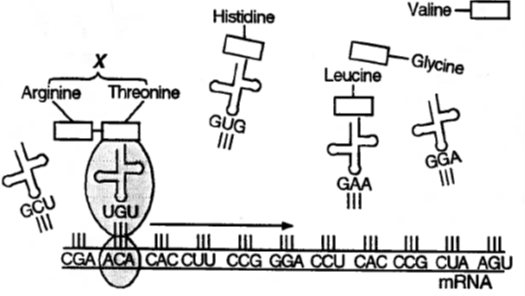
What process is going on in this photo? 
a)
Transcription 
b)
Translation 
c)
Replication 
d)
All the above 
38.
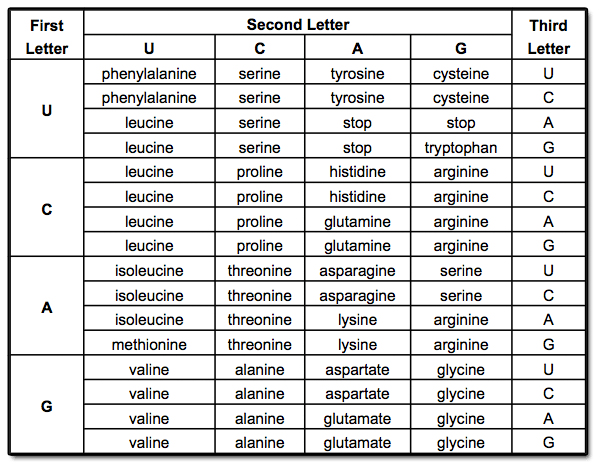
What amino acid is represented by the codon UUA?
a)
Phenylalanine
b)
Tyrosine
c)
Leucine
d)
Stop codon
39.
The codon CCU codes for what amino acid?
a)
Isoleucine
b)
Stop
c)
Methionine
d)
Proline
40.
How are mutations passed on to offspring?
a)
Any mutation that an organism acquires in its life can be passed on to the offspring through its gametes (sex cells)
b)
Only mutations that occur in the gametes can be passed on to the offspring
c)
Mutations are not usually passed on to the offspring. A mutation stays within the original organism.
d)
Mutations are not passed to offspring. They only occur within developing embryos.
41.
What do we call the process of turning DNA into mRNA?
a)
Translation
b)
Transcription 
c)
Replication
42.
When DNA is transcribed to RNA.... 
a)
A pairs with U
b)
C pairs with U
c)
A pairs with T
d)
C pairs with T
43.
Amino acids are the building blocks of... 
a)
DNA
b)
RNA
c)
Atoms
d)
Proteins
44.
_______ is made during transcription and ________ is made during translation.
a)
mRNA / a protein
b)
a protein / mRNA
c)
Ribosome / Nucleus
d)
mRNA / tRNA
45.
Nucleotides are made up of a sugar, phosphate, and..?
a)
nitrogenous base
b)
nucleic acid
c)
cholesterol
d)
fatty acid
46.
Brings the amino acids to the ribosome
a)
mRNA
b)
tRNA
c)
rRNA
d)
DNA
47.
For the quickest source of energy if going for a run, you should eat a food that contains a high percentage of 
a)
sodium
b)
protein
c)
fats
d)
carbohydrates
48.
What is the term for the amount of energy that needs to be added for a chemical reaction to start?
a)
bond energy
b)
chemical energy
c)
activation energy
d)
reactant energy
49.

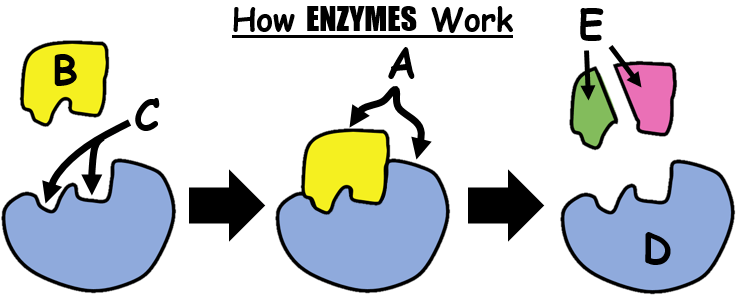
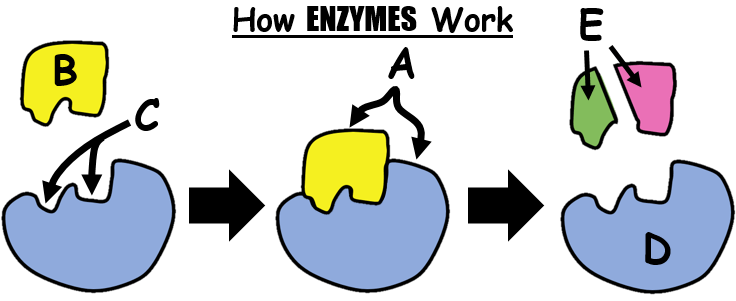
Letter D is the -

a)
active site
b)
enzyme
c)
substrate
d)
products
50.

Letter B is the-

a)
active site
b)
enzyme
c)
substrate
d)
products