wayground logo

Free Printable Worksheets

Font size

S
M
L
XL
Worksheets

Class Quiz (27th April 2022)

Total questions: 70

Worksheet time: 1hrs 10mins

Name
Class
Date
1.
Current is measured in....
a)
Amps 
b)
Volts
c)
Ohms
d)
Coulombs
2.
What 'flows' in a wire?
a)
Protons
b)
Neutrons
c)
Atoms
d)
Electrons
3.

A current of 0.5 A flows in a circuit. Calculate the charge flowing through the circuit in one minute.

a)

0.5 C

b)

30 C

c)

120 C

4.

A large lightning bolt can carry up to 120000 A and 350 C. Calculate the time for which the current flows. 

a)

2.92 s

b)

0.0092 s

c)

2.92×10³ min2.92\times10^{-3}\ \min

d)

2.92×1032.92\times10^{-3} s

5.
What is the symbol for Current
a)
C
b)
Q
c)
I
d)
A
6.
What is the unit for Charge
a)
C
b)
Q
c)
I
d)
A
7.
What is the symbol for Charge
a)
C
b)
Q
c)
I
d)
A
8.
What is a formula to calculate Charge
a)
Q=I*t
b)
Q=I/t
c)
Q = V*E
d)
Q = V/E
9.
What is a formula to calculate Charge
a)
Q=t/I
b)
Q=I/t
c)
Q = V*E
d)
Q = E/V
10.
How much charge must pass by a point in 10 s for the current to be  0.50 A? 
a)
0,05C
b)
5,0C
c)
20C
d)
2,0C
11.
What size resistor would produce a 3 Amp current flow with a 12 Volt battery
a)
1 Ohm
b)
3 Ohms
c)
4 Ohms
d)
12 Ohms
12.
What is current measured in?
a)
Ω (Ohms)
b)
V (Volts)
c)
A (Amps)
d)
W (Watts)
13.

What is Potential difference measured in?

a)
Ω (Ohms)
b)
V (Volts)
c)
A (Amps)
d)
W (Watts)
14.
What is resistance measured in?
a)
Ω (Ohms)
b)
V (Volts)
c)
A (Amps)
d)
W (Watts)
15.
What is Resistance?
a)
The flow of electrons
b)
Electric potential difference
c)
A battery
d)
The ability to reduce the flow of electrons
16.
Electricity that flows in a closed path is called a
a)
path
b)
current
c)
circuit
d)
light
17.
What is the Voltage of a circuit that has a resistance of 5 Ω and a current of 2 A?
a)
25 V
b)
10 V
c)
2.5 V
d)
0.4 V
18.
The mathematical relationship among Voltage, Current, and Resistance
a)
Faraday's Law
b)
Tesla's Law
c)
Edison's Law
d)
Ohm's Law
19.
Current times Resistance equals
 (I X R)
a)
Power
b)
Voltage
c)
Amperage
d)
Ohm
20.

Voltage divided by Resistance

(V / R)

a)

Current

b)

Power

c)

Ohms

d)

Watts

21.
If the Voltage is increased and the resistance stays the same, Current will
a)
Increase
b)
Decrease
c)
Stay the same
d)
X
22.
If the Voltage stays the same and Resistance is increased, Current will 
a)
Increase
b)
Decrease
c)
Stay the same
d)
X
23.
How many Volts would we need to produce a current flow of 8 Amps through a 6 Ohm resistor
a)
12 volts
b)
24 volts
c)
1.3333
d)
48 volts
24.
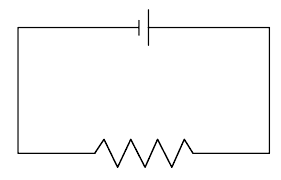
This circuit has a 24 volt battery and the resistor is 8 ohms. How many amps are running through the circuit?
a)
3 Amps
b)
192 Amps
c)
2 Amps
d)
4 Amps
25.
What word means how hard it is for electrons to flow through.
a)
Current
b)
Voltage
c)
Resistance
d)
Power
26.
To complete a circuit the switch must be
a)
unattached
b)
open
c)
closed
d)
It depends
27.
How many Volts would it take to push 1 Amp through a resistance of 1 Ohm
a)
10 volts
b)
1 volt
c)
48 volts
d)
5 volts
28.
What size resistor would produce a 3 Amp current flow with a 12 Volt battery
a)
1 Ohm
b)
3 Ohms
c)
4 Ohms
d)
12 Ohms
29.

What would the circuit resistance be if a 7.5 A current flows while charging system producing 15 Volts

a)
15 Ohms
b)
4 Ohms
c)
0.3333 Ohms
d)
2 Ohms
30.

What is the formula for ohms law?

a)

1+2=3

b)

R X V = I

c)

V =I x R

d)

E=mc2E=mc^2  

31.
Voltage is measured in __.
a)
volts.
b)
watts.
c)
coulombs. 
32.
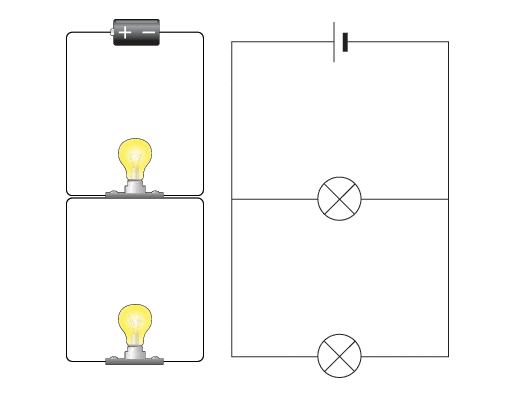
If the voltage across the battery was 10V in this diagram. What would the voltage across each bulb be?
a)
10V
b)
5V
c)
20V
d)
0V
33.
What is the rule for voltage in a parallel circuit?
a)
stays the same
b)
adds up
c)
inverse of the sum of the reciprocals
34.

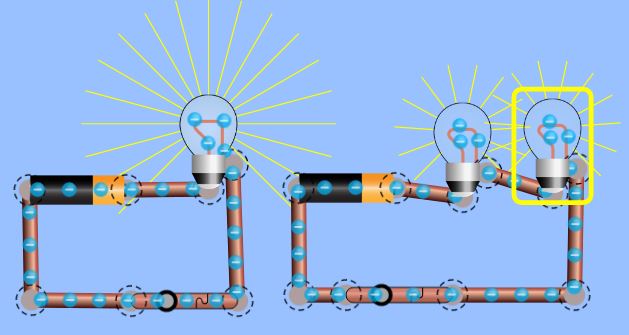
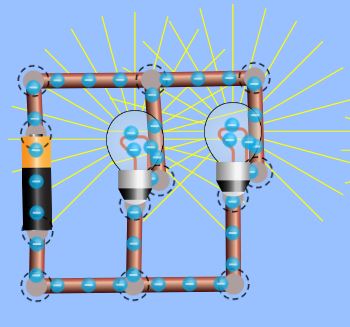
The difference in electrical potential energy per unit charge between two points in a circuit is called
a)
resistance
b)
friction
c)
induction
d)
voltage
35.
Adding more bulbs to a series circuit will make each bulb burn less brightly.
a)
True
b)
False
36.
Adding more bulbs to a parallel circuit will make each bulb burn less brightly.
a)
True
b)
False
37.
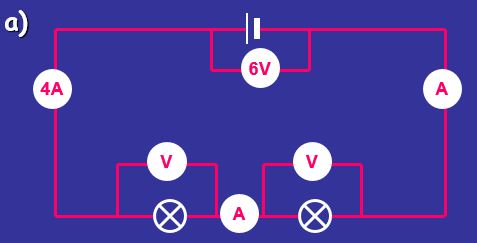
The lamps are identical.  What is the voltage across each lamp?
a)
6 V
b)
12V
c)
3 V
d)
2.5 V
38.
If the cell provides 12 volts and there are four identical bulbs, each bulb will use ___ volts.
a)
12
b)
1
c)
4
d)
3
39.
The voltage across each bulb is 9V.  What is the voltage across the cell?
a)
4.5
b)
9
c)
18
d)
27
40.
What is the voltage across the bottom lamp?
a)
3 V
b)
6 V
c)
12 V
d)
18 V
41.

In metals, magnetism is generated by moving

a)
protons.
b)
electrons.
c)
neutrons.
d)
elements.
42.
What do the lines around this magnet represent?
a)
North Pole
b)
South Pole
c)
Magnetic Declination
d)
Magnetic Field
43.
As the distance between two magnets increases (they get farther apart), the force between them:
a)
Increases
b)
Decreases
c)
Stays the Same
44.
If you cut a magnet in half, what happens to the poles?
a)
One half gets the North Pole, the other half gets the South Pole
b)
Both halves get only a North Pole
c)
Both halves get only a South Pole
d)
Both halves get a North pole and a South Pole
45.
What is responsible for the Magnetic Field around Earth?
a)
The Earth's crust
b)
The Earth's molton iron core
c)
The Earth's mantel
d)
The Sun
46.
If the North Pole of a permanent magnet is placed next to a compass as seen in the picture, which direction will the needle move?
a)
Clockwise
b)
Counter-clockwise
c)
It will not move
d)
Need more information
47.
An electromagnet's poles may be reversed by:
a)
decreasing the voltage of the coil
b)
increasing the number of coils
c)
changing the direction of current flow
d)
altering the material used to make the coils
48.
Which direction is the North Pole of this electromagnet?
a)
Right
b)
Left
c)
Up
d)
Down
49.
In un-magnetized materials the domains are __________ aligned.
a)
super
b)
slightly
c)
randomly
d)
always
50.
Electric motors are devices that convert _____ energy into  _____ energy.
a)
electrical; mechanical
b)
mechanical; electrical
c)
chemical; potential
d)
mechanical; kinetic
51.
What kind of magnet can be turned on and off?
a)
refridgerator magnet
b)
electromagnet
c)
magnetite
d)
iron
52.

The part of magnet with strongest magnetic field is......

a)
the bars.
b)
the force field.
c)
the poles. 
d)
the middle.
53.

If a glass plate is placed over a magnet and iron filings are sprinkled over the glass, a pattern will be visible. What does this pattern indicate?

a)

The magnetic field

b)

The electrostatic field

c)

The piezoelectric effect

d)

The chemical reaction of the magnet and the filings

54.

What causes magnetism?

a)

the sun

b)

moving neutrons

c)

moving charges

d)

friction

55.

How can a wire become magnetic?

a)

point it north

b)

add a resistor

c)

heat it up

d)

run a current through it

56.

What device takes in mechanical energy and produces electricity?

a)

motor

b)

generator

c)

electromagnet

d)

battery

57.
Electromagnetic induction is change in ___________________. 
a)
surface area
b)
magnetic poles
c)
magnetic flux
58.
Voltage can be induced in a wire by
a)
a. moving the wire near a magnet.
b)
b. moving a magnet near the wire.
c)
c. changing the current in a nearby wire.
d)
d. all of these
59.
What would happen if I move a bar magnet in and out of a coil of copper wire?
a)
Electric current would disappear 
b)
The magnet would explode 
c)
Electric current will flow through the wire
d)
It would produce a gravitational field
60.
A magnet is moved in and out of a coil of wire connected to a high-resistance voltmeter. If the number of coils doubles, the induced voltage 
a)
quadruples
b)
doubles
c)
is the same
d)
halves
61.
A magnet can move in a coil of wire to produce electricity in which system?
a)
Generator
b)
Motor
c)
Magnet
d)
Transformer
62.
___ Law says that the Induced current is proportional to the change of magnetic flux 
a)
Lenz'
b)
Faraday's
c)
Ampere's
63.

Which description best applies to Lenz's Law?

a)

An induced current occurs when a magnet passes through a tube.

b)

When a change in magnetic field occurs to a coil the direction of current goes in the in the other direction to this change.

c)

The direction of an induced current is such to align with the change that created it.

d)

A magnet is a tube is always slowed by its magnetic field.

64.

Which activity will produce the highest current?

a)

Move the magnet bar (with speed 1m/s) into the coil while the coil remains stationery

b)

Move the coil into the magnet bar (with speed 1m/s) while the magnet remains stationery

c)

Move the coil and magnet towards each other (with speed 1 m/s each)

d)

Move the coil and magnet away from each other (with speed 1 m/s)

65.

Which action will increase the deflection of the galvanometer pointer?

a)

The magnetic pole is reversed

b)

The number of turns of coils is increased

c)

The coil is made from insulated wire

d)

The magnet is slowly pushed into the coil

66.
The voltmeter is at 0 in this image. How would you manipulate the experiment to create electricity (measured in volts)?
a)
Flip the magnet around so the North pole is facing out
b)
Move the magnet back and forth
c)
Take the magnet out
d)
Add more coils around the paper cylinder
67.
Electromagnetic induction is taking place in this experiment. How much electricity is being produced?
a)
-10 Volts
b)
10 Volts
c)
100 Volts
d)
This question cannot be answered based on this image
68.
How could the experimenter increase the amount of electricity being induced by this experiment?
a)
Increase the number of coils
b)
Decrease the number of coils
c)
Flip the magnet around
d)
Nothing, the amount of electricity cannot be increased
69.
What is one way to increase the current in a wire?
a)
Decrease the number of coils
b)
Increase the number of coils
c)
Move the magnet slower
d)
Take the wire off of the magnet
70.
What benefit is gained by the addition of the iron core in an electromagnet?
a)
It makes a strong magnet weaker
b)
It makes a weak magnet stronger
c)
There is no benefit at all
d)
It lets currents interact with each other