wayground logo

Free Printable Worksheets

NEW

Font size

S
M
L
XL
Worksheets

Bohr model and Ionic and Covalent compounds

Total questions: 28

Worksheet time: 25mins

Name
Class
Date
1.

Valence electrons are transferred

a)

Ionic bonds

b)

Covalent bonds

2.

Valence electrons are shared

a)

Ionic bonds

b)

Covalent bonds

3.

Generally, atoms form bonds so that _______________.

a)

Each atom loses its electrons

b)

Each atom has a stable electron configuration

c)

Each atom has an unstable electron configuration

d)

Each atom gains electrons

4.

What type of bonding does this picture show?

a)

Ionic

b)

Covalent

5.

What type of bonding does this picture show?

a)

Ionic

b)

Covalent

6.
Covalent Compounds HAVE a positive (+) or negative (-) charge 
a)
True
b)
False
c)
Que onda, Hagerman? 
d)
What was that now? 
7.
Ionic Compounds HAVE a positive (+) or negative (-) charge 
a)
True
b)
False
c)
Que onda, Hagerman? 
d)
What was that now? 
8.
The correct name for NaCl is...
a)
Sodium Chlorine
b)
Sodium Chloride
c)
Nickel Chloride
d)
Sodium Choroxide 
9.
Why does K become positive when it bonds to Cl to form KCl?
a)
Because it loses an electron to have a full valence shell 
b)
Because it gains an electron to have 2 valence electrons
c)
Because it loses an electron to become negatively charged
d)
Because Cl gives away its 7 electrons to Na to form an equal charge 
10.
CO2
a)
Ionic
b)
Covalent
c)
Polyatomic Ion 
d)
Metallic 
11.
NaCl
a)
Ionic
b)
Covalent
c)
Metallic
d)
Polyatomic Ion 
12.
MgCl2
a)
Ionic
b)
Covalent
c)
Polyatomic Ion
d)
Metallic 
13.
SO4
a)
Covalent
b)
Ionic
c)
Metallic
d)
Polyatomic Ion
14.
All atoms/elements bond in order to ....
a)
Have a full valence shell
b)
Give away electrons or take electrons
c)
Only share electrons
d)
To create electrical currents for human use 
15.
Why does CO2 not have a charge? 
a)
The metal gives away an electron to the non-metal
b)
The metal takes the electron from the non-metal
c)
The non-metals equally share electrons
d)
The metal and the non-metal equally share electrons
16.
What is the name of this element?
a)
Helium
b)
Hydrogen
c)
Argon
d)
Silver
17.
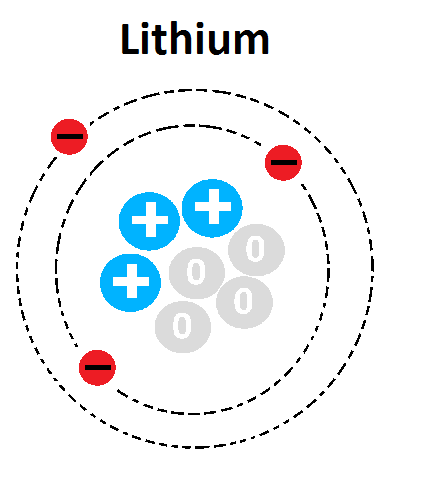
What is the name of this element?
a)
Lithium
b)
Boron
c)
Carbon
d)
Neon
18.
What is the mass number of this atom?
a)
1
b)
3
c)
4
d)
7
19.
What is the atomic number of this atom?
a)
2
b)
4
c)
6
d)
none of the above
20.
How many valence electrons?
a)
2
b)
3
c)
5
d)
10
21.
What's a valence electron?
a)
electrons in the second energy level
b)
electrons in the outermost energy level
c)
the atomic number
d)
electrons in the first level
22.

On the periodic table, Groups are

a)

Horizontal rows

b)

Vertical columns

23.

On the periodic table, Periods are

a)

Horizontal rows

b)

Vertical columns

24.

What is this element?

a)

Beryllium (atomic #4)

b)

Boron (atomic #5)

c)

Carbon (atomic #6)

d)

Nitrogen (atomic #7)

25.

How many valence electrons?

a)

2

b)

3

c)

4

d)

5

26.

What group does this element belong to?

a)

1

b)

2

c)

17

d)

18

27.

How many valence electrons?

a)

2

b)

4

c)

6

d)

8

28.

Which Bohr model represents Neon?

a)
b)
c)
d)