
 Worksheets
States of Matter
Total questions: 46
Worksheet time: 30mins

Which state of matter has both definite shape and definite volume?
Gas
Solid
Liquid

Which state of matter has no definite shape and no definite volume?
Solid
Liquid
Gas

Which state of matter has definite volume but not a definite shape?
Solid
Liquid
Gas

Matter can be defined as...
The amount of matter within an object
Anything that has mass and volume
The amount of space an object occupies
Mass can be defined as..
The amount of matter within an object (usually measured in kg's)
The amount of space an object occupies
Anything that has mass and volume
Volume can be defined as
The amount of matter an object contains
The amount of space an object occupies
Anything that has mass and volume
A gas has...
A lot of space between the atomic particles which allows the particles to move freely
Atomic particles that move very quickly
Atomic particles that move in all different directions
All of these answers are true

A solid has..
Atomic particles that can only vibrate in their fixed positions
Atomic particles tightly arranged in fixed positions
Atomic Particles that have a definite and organised pattern
All of these answers are true

A liquid has...
Atomic particles that have a little bit of space between them
Atomic particles that can roll over one another and move around
Atomic particles with no fixed arrangement/ pattern
All of these answers are true

Which state of matter has the most energy / the atomic particles can move the quickest?
Solid
Liquid
Gas
All of the states of matter

Which state of matter has the least amount of energy/ the particles move the least amount and can only vibrate in their fixed positions ?
Solid
Liquid
Gas
All states of matter contain atomic particles that move slowly
The three main states of matter are:
Solid and liquid
Solid, liquid and gas
Plasma, liquid and solid

What state of matter is milk?
Liquid
Solid
Gas
Gases fill their entire container
False
True
Liquids take the shape of their container
False
True

The smoke is...
Liquid
Solid
Gas

What state of matter does the picture below represent?
solid
liquid
gas
plasma
What is a Solid?
Matter that has a fixed shape and size.
Matter that has a fixed size and no fixed shape
Matter that has no fixed shape or size
Matter that has no fixed shape and size
The state of matter that keeps its shape and volume when it is placed in a different container is called ______.
gas
liquid
solid
The state of matter that expands to fill its container is called ______.
gas
liquid
solid
What is matter made up of?
particles that are too large to be seen
tiny butter particles
particles that are too small to be seen
tiny water particles

The diagram shows arrangement of particles in a
Solid
Liquid
Gas
Define a liquid.
Matter that has fixed shape but no fixed volume
Matter that has fixed shape and fixed volume
Matter that has fixed volume, but no fixed shape

The particles in the picture are tightly held together with very tiny movement. They have shape and fixed volume. Therefore, the picture represents _________.
solid
liquid
gas
plasma
In which state of matter will there be the LARGEST space between molecules?
Solid
Liquid
Gas
The measure of how much space something takes up is ______.
matter
mass
volume
density
What is a gas?
Matter that has fixed shape but no fixed volume
Matter that has no fixed shape and no fixed volume
Matter that has no fixed shape but fixed volume
compounds

What state is represented in the gif?
Solid
Liquid
Gas
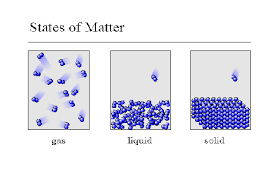
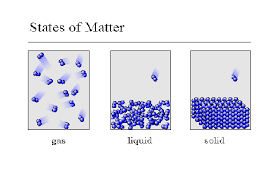

Freezing
Solid to gas
Liquid to solid
Gas to solid

Boiling
liquid to gas
gas to solid
gas to liquid

What is happening when my ice cream changes from a solid to a liquid?
freezing
melting
burning
What is condensation?
gas to solid
gas to liquid
liquid to solid
Liquid to Gas
Condensation
Evaporation
Sublimation


As temperature increases, what happens to particles?
They speed up gaining kinetic energy
They slow down losing kinetic energy
As temperature decreases, what happens to particles?
They speed up gaining kinetic energy
They slow down losing kinetic energy

What is happening in this picture of water boiling?
Molecules are speeding up gaining kinetic energy
Molecules are slowing down losing kinetic energy

What is happening in this picture of this lake freezing?
Molecules are speeding up gaining kinetic energy
Molecules are slowing down losing kinetic energy
The phase change from a solid to a liquid is....
Freezing
Evaporation
Melting
Sublimation
Solid Carbon Dioxide is called Dry Ice. Dry ice turns straight from a solid into a gas skipping the liquid phase. This phase change is called...
Sublimation
Evaporation
Condensation
Freezing

Carbon dioxide gas has three main properties. Which properties below are correct regarding CO2 in its gas state
Carbon Dioxide gas is odourless
Carbon Dioxide gas is colourless
Carbon Dioxide gas is denser than air
All of these answers are correct

