
NEW
Font size
 Worksheets
Penguin Unit Review
Total questions: 53
Worksheet time: 21mins


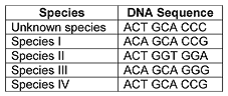
What type of evidence is shown in the image above?
Fossils
Vestigial structures
Homologous Structures
DNA

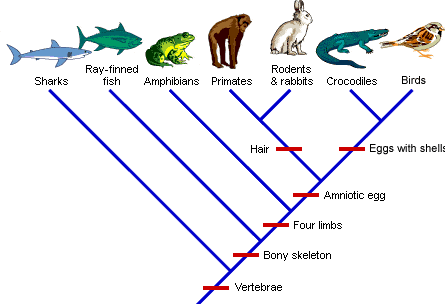
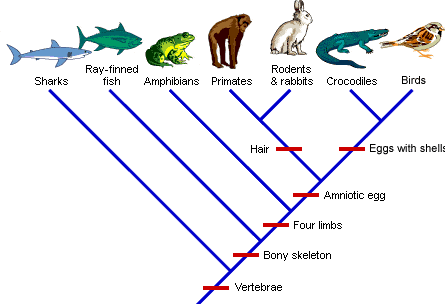
Gray Wolf: Canis lupus
Aardwolf: Proteles cristatus
Coyote: Canis latrans

House Cat and Red Fox

Some organisms that share a common ancestor have features that have different functions, but similar structures. These are known as
vestigial structures
analogous structures
homologous structures
embryology
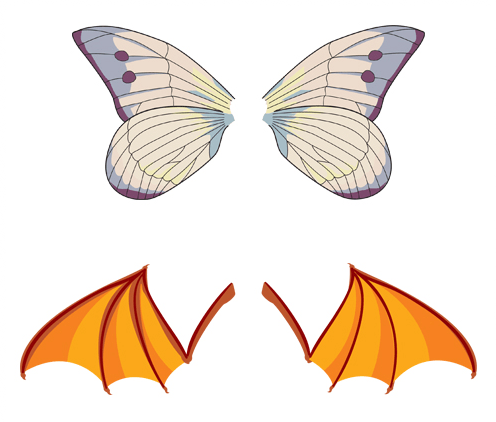
What is this an example of?
Homologous structure
Analogous structure
Vestigial organs
Functional adaption
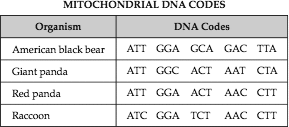
What conclusions can be made based on this table shown?
the American black bear and the giant panda are most closely related
the giant panda and the red panda are most closely related
the red panda and the racoon are the most closely related
the giant panda and the racoon are most closely related


Some organisms have features that have different functions, but similar structures. One example is the forelimb of humans, dogs, birds, and whales. What term best describes the relationship between these forelimbs?
They are homologous.
They are vestigial.
They are analogous.
They are embryological.
How do fossils support evolution?
Individual species disappear and reappear in the fossil record over time.
Organisms in the fossil record are identical to living organisms.
The fossil record provides evidence that all organisms developed at the same time.
The fossil record provides evidence that organisms have changed over time.

What best describes the hind leg bones seen in the whale?
The bones are analogous structures to the fins of living fish.
The bones are vestigial structures that had a function in an ancestor.
The bones are homologous structures to the wings of butterflies.
The bones are fossil structures from an extinct ancestor.
Mutations are important because they bring about --
death in the organisms in which they develop.
benefits for the individual, not the population.
genetic variation needed for a population to evolve.
equilibrium within a population.

According to the diagram, which organism is older?
gastropod
trilobite
fern
ammonite
Why are advantageous traits more likely to be passed down to offspring?
because they come from recessive alleles.
because they come from dominant alleles
because they help the organism survive and reproduce.
because once a trait is in the gene pool, it cannot go away.

Which of the following statements gives the most likely explanation for the presence of two very similar species of squirrels living on opposite sides of the Grand Canyon?
One squirrel traveled across the canyon and started a new population on the other side.
Members of one single squirrel species were geographically separated by the formation of the canyon.
One squirrel traveled across the canyon and interbred with a different population on the other side.
Members of two different squirrel species migrated from two different places to opposite sides of the canyon.
The formation of a new species is a process known as ___________________, which is typically the result of divergence.
microevolution
gradualism
punctuated equilibrium
speciation

Amino acid sequences can be compared to determine relationships between species. When comparing the sequences provided, which two organisms are humans most closely related to?
horses and gorillas
gorillas and chimpanzees
chimpanzees and zebras
zebras and horses
Where does most air pollution come from?
Human activities
Wildfires
Volcanic eruptions
Allergens
The area where a plant or animal lives
environment
location
habitat
home
What is a human activity that can cause habitat destruction?
Planting trees
Buying clothes
Deforestation
Pick up fruits and vegetables
As the human population grows, the demand for natural resources stays the same.
true
false
_____________________ is the contamination of air, land, and water.
Conservation
Ecology
Pollution
What is one way people help the environment?
building new cities
tearing down a forest
throwing away plastic
Eat less meat
The H in HIPPO stands for?
hairline fracture
habitat preservation
habitat destruction
health and safety
The I in HIPPO stands for...
invasive species
immigration
intraspecies competition
inventions
One of the P's in HIPPO stands for...
power plant
pollution
predation
parasites
One of the P's in HIPPO stands for...
population growth (of humans)
predation (of humans)
poison
preservation
The O in HIPPO stands for...
oxygen
other organisms
othello
overconsumption of resources
Which applies to this environmental problem:
The albatross are dying from eating plastic items that look like food.
Habitat Loss
Invasive Species
Pollution
Population Growth
Overconsumption
Which applies to this environmental problem:
The zebra mussel is outcompeting native species and causing damage in the Missouri River.
Habitat Loss
Invasive Species
Pollution
Population Growth
Overconsumption
Which applies to this environmental problem:
Only 10% of Madagascar's forests remain due to deforestation.
Habitat Loss
Invasive Species
Pollution
Population Growth
Overconsumption
Which applies to this environmental problem:
The use of Earth's natural resources has more than tripled in 40 years.
Habitat Loss
Invasive Species
Pollution
Population Growth
Overconsumption
Which applies to this environmental problem:
Australia's Great Barrier Reef has lost more than half of its corals since 1995 due to warmer seas driven by climate change.
Habitat Loss
Invasive Species
Pollution
Population Growth
Overconsumption

