
 Worksheets
IGCSE Physics: Forces & Motion
Total questions: 102
Worksheet time: 2hrs 41mins
When an object is ....
What other information is needed to calculate the useful work done in lifting the bricks?


In which situation is it IMPOSSIBLE for the object to be in equilibrium?

A car moves along a level road.
The diagram shows all of the horizontal forces acting on the car.
Which statement is correct?
The car is slowing down.
The car is speeding up.
The car is moving at a constant speed.
The car is moving backwards.
Which force and distance produce the smallest moment about a pivot?
a 6.0 N force at a perpendicular distance of 4.0m from the pivot
a 7.0 N force at a perpendicular distance of 6.0 m from the pivot.
a 10 N force at a perpendicular distance of 4.0 m from the pivot
a 12 N force at a perpendicular distance of 3.0 m from the pivot.
A resultant force of 4.0N acts on an object of mass 0.50 kg for 3.0 seconds.
What is the change in velocity caused by this force?
4.0 m / s
6.0 m / s
12 m / s
24 m / s

The diagram shows a tug-of-war between team X and team Y. The arrows show the forces exerted by the teams on the rope.
What is the size of the resultant force on the rope and in which direction does the resultant force act?
size of resultant force = 75 N; direction of resultant force = to the left
size of resultant force = 75 N; direction of resultant force = to the right.
size of resultant force = 725 N; direction of resultant force = to the left
size of resultant force = 725 N; direction of resultant force = to the right.
Which property of an object cannot be changed by a force?
mass
motion
shape
size

An unstretched spring obeys Hooke’s law and has a length of 10 cm. A load with a mass of 2.0 kg is hung from it, and its length becomes 14 cm.
The load is now increased to 6.0 kg, and the new length of the spring is Y. The limit of proportionality is not reached.
What is Y?
22 cm
26 cm
30 cm
42 cm

A spring is suspended from a stand. Loads are added and the extensions are measured.
Which graph shows the result of plotting extension against load?


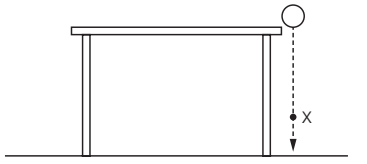
A ball is dropped from a table-top. Air resistance may be ignored.
Which row describes the velocity and the acceleration of the ball at point X
acceleration = constant; velocity = constant
acceleration = constant; velocity = increasing
acceleration = increasing; velocity = constant
acceleration = increasing; velocity = increasing
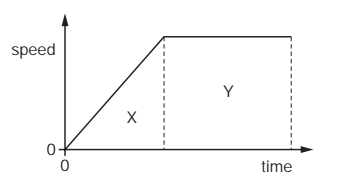
The diagram shows the speed-time graph for a car.
Which area represents the distance travelled while the car is accelerating?
X
X + Y
Y
Y - X

A wooden bar is pivoted at its centre so that it can rotate freely. Two equal forces F are applied to the bar.
In which diagram is the turning effect greatest?


A hole is drilled in a square tile. The diagram shows the tile hanging freely on a nail.
Where is the centre of mass of the tile?
A
B
C
D

A balloon and a mass are attached to a rod that is pivoted at P.
The balloon is filled with helium, a gas less dense than air, so that it applies an upward force on the rod.
The rod is horizontal and stationary.
Which action causes the rod to rotate clockwise?
Move both the balloon and mass 10 cm to the left.
Move both the balloon and mass 10 cm to the right.
Move both the balloon and mass to the 25 cm mark
Move the balloon to the 20 cm mark and the mass to the 30 cm mark.
Link between moment, force and (perdindicular) distance (to pivot)
moment = force x distance
moment = force / distance
moment = distance / force
moment = force / moment
momentum = forks x distant ants

A ball of mass 0.50 kg falls and hits the floor at 10 m / s.
It rebounds at speed 8.0 m / s, as shown.
The collision between the ball and the floor lasts for 0.50 s.
What is the average force acting on the ball during the collision?
2.0 N upwards
2.0 N downwards
18 N upwards
18 N downwards

A gas molecule strikes the wall of a container. The molecule rebounds with the same speed.
What happens to the kinetic energy and what happens to the momentum of the molecule?
Kinetic energy changes; momentum changes
Kinetic energy changes; momentum stays the same.
Kinetic energy stays the same; momentum changes
Kinetic energy stays the same; momentum stays the same.

A tennis ball of mass 0.060 kg travels horizontally at a speed of 25 m/s. The ball hits a tennis racket and rebounds
horizontally at a speed of 40 m/s.
The ball is in contact with the racket for 50 ms.
What force does the racket exert on the ball?
0.018 N
0.078 N
18 N
78 N
What is a force?
something Darth Vadar has
a push or a pull
something you can see
Force is measured in...
lbs
m/s2
grams
newtons
To calculate forces that are in the same direction you..
subtract them
add them
multiply them
divide them
To calculate forces that are in opposite directions you...
add them
subtract them
multiply them
divide them
The unbalanced force that opposes motion is known as...
friction
force
push or pull
the tires on a car
Forces that are considered to be in motion are called...
friction
unbalanced forces
balanced forces
If two cars move toward each other at the same speed which car will have more force?
A larger car because of its mass
A smaller car because of its mass
A larger car because of its speed
A smaller car because of its speed
Does mass or speed have a larger impact on moving objects?
Mass
Speed
An object in motion/rest stays in motion/ rest.... is what law?
Newton's 1st Law
Newton's 2nd Law
Newton's 3rd Law
The force of an object depends on mass and acceleration.... is what law?
Newton's 1st Law
Newton's 2nd Law
Newton's 3rd Law
For every action there is an equal and opposite reaction is stated by what law?
Newton's 1st Law
Newton's 2nd Law
Newton's 3rd Law
"Forces acting in pairs" is what law?
Newton's 1st Law
Newton's 2nd Law
Newton's 3rd Law
What 2 factors determine the amount of force an object receives?
speed & height
size & distance
mass & speed
If a car is moving fast toward a wall, the wall will....
apply an equal and opposite force back on the car?
allow the car to run through the wall
open up and swallow the car
do nothing
What is the equation for force?
E=mc2
F=ma
Q=mv3
Why does a person continue to fly forward in a car after a crash?
the person is not moving until the car stops
the person jumps out of the car
the person has more force than the wall
the person is still in motion
Inertia is...
an objects ability to change direction
an objects ability to move
forces depend on the mass and weight of the object
an objects tendency to resist change in motion
A resultant force of 4.0N acts on an object of mass 0.50 kg for 3.0 seconds.
What is the change in velocity caused by this force?
4.0 m / s
6.0 m / s
12 m / s
24 m / s
Which property of an object cannot be changed by a force?
mass
motion
shape
size
A ball is dropped from a table-top. Air resistance may be ignored.
Which row describes the velocity and the acceleration of the ball at point X
acceleration = constant; velocity = constant
acceleration = constant; velocity = increasing
acceleration = increasing; velocity = constant
acceleration = increasing; velocity = increasing
When the velocity of the car is constant, the force of friction on it is
zero
greater than the driving force
smaller than the driving force
the same size as the driving force
Which are the units for acceleration
m/s
m/s2
s/m
m/s3
The cyclist accelerates at 1.4 m/s2.
The mass of the cyclist and bicycle is 60 kg.
Calculate the resultant force.
(a)


The unit of force is...
m/s
m
N
kg
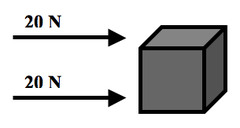
What is the resultant force?
40 N, Left
0 N, Balanced
400 N, Right
40 N, Right

What is the resultant force?
400 N, Up
400 N, Down
800 N, Up
800 N, Down

What is the resultant force?
17 N, Left
6N, Right
11N , Left
12N, Left

What is the resultant force?
40N, Left
40N, Right
0N, Balanced
75N, Right

As the angle of the incline increases, what happens to the normal force?
The normal force increases
The normal force decreases
The normal force is not affected by the incline
The normal force is only dependent on the force due to gravity

Given the FBD, which of the following must be true?
The frictional force must be accelerating the system to the left.
The box must be accelerating to the right.
The box must be moving to the right.
The FBD is incorrectly drawn. This situation isn't possible


Camille launches has a catapult that changes the velocity of a ball (m= 2 kg) from 0 to 10 m/s in one sec. What is the average force that is exerted on the ball during launch?
20 N
5 N
8 N
0.2 N

Which of the following statements is true about the image above?
The accelerations of the blocks will vary according to their mass
The net force acting on each block is the same
The blocks will experience the same acceleration
The 3m box will eat the 2m and the m boxes

Which of the following is not true about the system?
T3 is equal to the scalar sum of the magnitudes of T2 and T1
T3 is equal in magnitude to Fg
The x- components of the T1 and T2 and equivalent but in opposite directions
The system is in equilibrium.

Sam is hover boarding down they hall at a constant velocity. Assuming there is friction, which of the following must be true?
The force applied by the board must be greater than the frictional force
The frictional force must equal the force applied by the board
The force applied must equal zero
There is not enough information

If there is no friction, then the acceleration would be equal to
mg
sin(θ)mg
g
sin(θ)g

If μk = 0.65 and μs = 0.7, acceleration would be equal to
0 m/s/s
9.8 m/s/s
3.35 m/s/s
-2.63 m/s/s

A man standing on a scale in an elevator notices that the scale reads 40 newtons greater than his normal weight. Which type of movement of the elevator could cause this greater-than-normal reading?
accelerating upward
accelerating downward
moving upward at a constant speed
moving downward at a constant speed
A man weighing 800 Newtons is standing in an elevator. If the elevator rises with an acceleration of 0.5 meters per second2, the force exerted by the elevator on the man will be
400 N
800 N
1200 N
1000 N
A car travels up a hill at constant speed. Which of the following diagrams best represents the forces acting on the car at this instant?


Three forces of equal magnitude act on the box shown. One force is upward, one downward, and one rightward. Which of the following statements must be true based on this information? Select two answers.
The box must have a rightward component of velocity.
The box has no vertical component of velocity.
The acceleration of the box is directed to the right.
The velocity of the box is changing with time.

Vectors are quantities that have magnitude and direction
True
False
Scalars are quantities that have a magnitude and direction
True
False
Which of the following have inverse relationships?
The hotter the temperature rises, the slower the student walks the track.
As time continues since the beginning of the pandemic, the total number of cases continues to rise.
Starting from infancy, as we get older, we grow taller.
The faster you drive, the shorter the time it takes to arrive at your destination.
The measure of the force of gravity on an object
mass
weight
matter
grams
An objects displacement involves
distance
time
direction
state of matter
The distance of an object involves:
displacement
direction
length of path
width of path
the distance an object travels per unit of time in a particular direction
speed
velocity
acceleration
displacement
the distance an object travels per unit of time
speed
velocity
acceleration
displacement
A description of how close a measurement is to a the true value of the quantity measured
precision
accuracy
bias
A degree to which repeated measurements show the same result
precision
accuracy
bias
An independent variable is the measurable effect or response
True
False
The dependent variable is the variable that is manipulated in an experiment.
True
False
Which of the following have linear relationships?
The hotter the temperature rises, the slower the student walks the track.
As your adrenaline increases, your time spent on each test question decreases.
Starting from infancy, as we get older, we grow taller.
The faster you drive, the shorter the time it takes to arrive at your destination.
The more hours you focus on studying, the higher your grade will be.
A conclusion reached based on evidence and reasoning
Bias
Inference
Observation
Precision
An explanation using an integrated set of principles that organizes observations and predicts behaviors or events.
Hypothesis
Scientific Method
Theory
Bias

